Norman Biggs – författare
Visar alla böcker från författaren Norman Biggs. Handla med fri frakt och snabb leverans.
12 produkter
12 produkter
E-bok
PDF, Engelska, 2016364 kr
Läs direkt efter köp
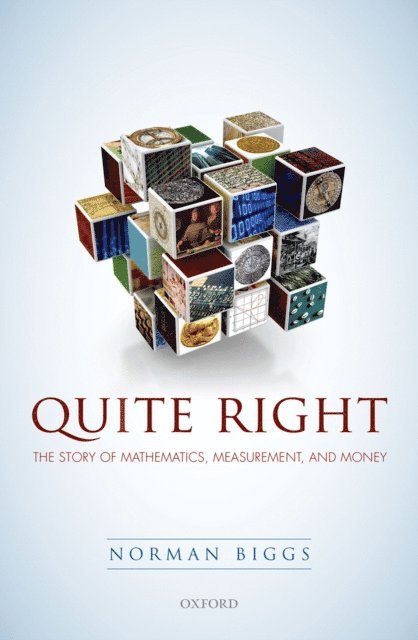
Mathematics did not spring spontaneously into life, with rules set in stone for all time. Its story is closely linked with the problems of measurement and money that have often driven its progress. Quite Right explains how mathematical ideas have gradually emerged since prehistoric times, so that they pervade almost every aspect of life in the twenty-first century. Many histories of mathematics focus on the activities of those for whom mathematics itself was the motivation. Professor Biggs adopts a wider viewpoint. Making use of new discoveries of artefacts and documents, he explains the part that mathematics has played in the human story, and what that tells us about the nature of mathematics. The story reveals the power and beauty of mathematical concepts, which often belie their utilitarian origins. The twin paradigms of logical justification and algorithmic calculation recur throughout the book. No other book tells the story of mathematics, measurement, and money in this way. Includes secontions on: -- The origins of calculation in ancient and medieval times -- How mathematics provides answers that are right, and what that means -- The impact of trade and the use of money on the development of mathematical algorithms -- The use of mathematics for secure communications -- How money and information are linked in our electronic world Quite Right is a fascinating story, suitable for anyone interested in the mathematical foundations of the world we live in. Norman Biggs is Professor (Emeritus) of Mathematics at the London School of Economics. He is the author of 12 books, including a perennial best-selling book Discrete Mathematics (Oxford University Press). He has a special interest in measurement and was Chair of the International Society of Weights and Scales Collectors from 2009-14. He served as a Vice President of the British Society for the History of Mathematics in 2014 and is an active member of the British Numismatic Society. ''This is a history of mathematics book with a difference. Instead of the usual chronological sequence of events, presented with mathematical hindsight (interpreting mathematical achievements from a modern point of view), this book tries to see things more from the context of the time - presenting the topics thematically rather than strictly chronologically, and including results and problems only when they fit into the themes … the level of exposition is first-rate, with a far greater fluency than most mathematical writers can attain … I am very happy to recommend it wholeheartedly.'' Professor Robin Wilson, University of Oxford
E-bok
Engelska, 2016364 kr
Läs direkt efter köp
Mathematics did not spring spontaneously into life, with rules set in stone for all time. Its story is closely linked with the problems of measurement and money that have often driven its progress. Quite Right explains how mathematical ideas have gradually emerged since prehistoric times, so that they pervade almost every aspect of life in the twenty-first century. Many histories of mathematics focus on the activities of those for whom mathematics itself was the motivation. Professor Biggs adopts a wider viewpoint. Making use of new discoveries of artefacts and documents, he explains the part that mathematics has played in the human story, and what that tells us about the nature of mathematics. The story reveals the power and beauty of mathematical concepts, which often belie their utilitarian origins. The twin paradigms of logical justification and algorithmic calculation recur throughout the book. No other book tells the story of mathematics, measurement, and money in this way. Includes secontions on: -- The origins of calculation in ancient and medieval times -- How mathematics provides answers that are right, and what that means -- The impact of trade and the use of money on the development of mathematical algorithms -- The use of mathematics for secure communications -- How money and information are linked in our electronic world Quite Right is a fascinating story, suitable for anyone interested in the mathematical foundations of the world we live in. Norman Biggs is Professor (Emeritus) of Mathematics at the London School of Economics. He is the author of 12 books, including a perennial best-selling book Discrete Mathematics (Oxford University Press). He has a special interest in measurement and was Chair of the International Society of Weights and Scales Collectors from 2009-14. He served as a Vice President of the British Society for the History of Mathematics in 2014 and is an active member of the British Numismatic Society. ''This is a history of mathematics book with a difference. Instead of the usual chronological sequence of events, presented with mathematical hindsight (interpreting mathematical achievements from a modern point of view), this book tries to see things more from the context of the time - presenting the topics thematically rather than strictly chronologically, and including results and problems only when they fit into the themes … the level of exposition is first-rate, with a far greater fluency than most mathematical writers can attain … I am very happy to recommend it wholeheartedly.'' Professor Robin Wilson, University of Oxford
Inbunden, Engelska, 2016
715 kr
Skickas inom 3-6 vardagar
Mathematics did not spring spontaneously into life, with rules set in stone for all time. Its story is closely linked with the problems of measurement and money that have often driven its progress. Quite Right explains how mathematical ideas have gradually emerged since prehistoric times, so that they pervade almost every aspect of life in the twenty-first century.Many histories of mathematics focus on the activities of those for whom mathematics itself was the motivation. Professor Biggs adopts a wider viewpoint. Making use of new discoveries of artefacts and documents, he explains the part that mathematics has played in the human story, and what that tells us about the nature of mathematics. The story reveals the power and beauty of mathematical concepts, which often belie their utilitarian origins. The twin paradigms of logical justification and algorithmic calculation recur throughout the book. No other book tells the story of mathematics, measurement, and money in this way.Includes secontions on:-- The origins of calculation in ancient and medieval times-- How mathematics provides answers that are right, and what that means-- The impact of trade and the use of money on the development of mathematical algorithms-- The use of mathematics for secure communications-- How money and information are linked in our electronic worldQuite Right is a fascinating story, suitable for anyone interested in the mathematical foundations of the world we live in.Norman Biggs is Professor (Emeritus) of Mathematics at the London School of Economics. He is the author of 12 books, including a perennial best-selling book Discrete Mathematics (Oxford University Press). He has a special interest in measurement and was Chair of the International Society of Weights and Scales Collectors from 2009-14. He served as a Vice President of the British Society for the History of Mathematics in 2014 and is an active member of the British Numismatic Society.'This is a history of mathematics book with a difference. Instead of the usual chronological sequence of events, presented with mathematical hindsight (interpreting mathematical achievements from a modern point of view), this book tries to see things more from the context of the time - presenting the topics thematically rather than strictly chronologically, and including results and problems only when they fit into the themes … the level of exposition is first-rate, with a far greater fluency than most mathematical writers can attain … I am very happy to recommend it wholeheartedly.' Professor Robin Wilson, University of Oxford
E-bok
PDF, Engelska, 1996687 kr
Läs direkt efter köp
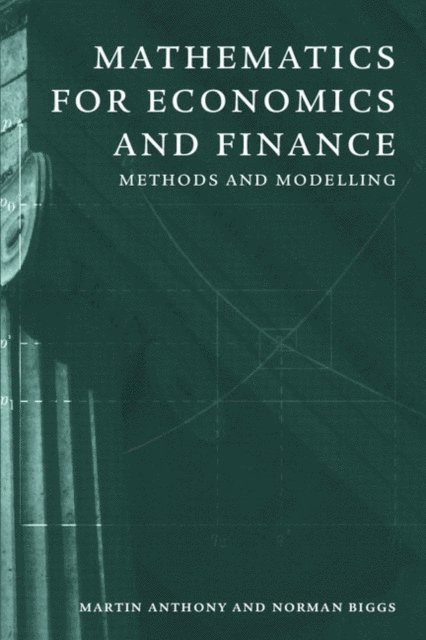
Mathematics has become indispensable in the modelling of economics, finance, business and management. Without expecting any particular background of the reader, this book covers the following mathematical topics, with frequent reference to applications in economics and finance: functions, graphs and equations, recurrences (difference equations), differentiation, exponentials and logarithms, optimisation, partial differentiation, optimisation in several variables, vectors and matrices, linear equations, Lagrange multipliers, integration, first-order and second-order differential equations. The stress is on the relation of maths to economics, and this is illustrated with copious examples and exercises to foster depth of understanding. Each chapter has three parts: the main text, a section of further worked examples and a summary of the chapter together with a selection of problems for the reader to attempt. For students of economics, mathematics, or both, this book provides an introduction to mathematical methods in economics and finance that will be welcomed for its clarity and breadth.
Häftad, Engelska, 1994
766 kr
Skickas inom 7-10 vardagar
This is a substantial revision of a much-quoted monograph, first published in 1974. The structure is unchanged, but the text has been clarified and the notation brought into line with current practice. A large number of 'Additional Results' are included at the end of each chapter, thereby covering most of the major advances in the last twenty years. Professor Biggs' basic aim remains to express properties of graphs in algebraic terms, then to deduce theorems about them. In the first part, he tackles the applications of linear algebra and matrix theory to the study of graphs; algebraic constructions such as adjacency matrix and the incidence matrix and their applications are discussed in depth. There follows an extensive account of the theory of chromatic polynomials, a subject which has strong links with the 'interaction models' studied in theoretical physics, and the theory of knots. The last part deals with symmetry and regularity properties. Here there are important connections with other branches of algebraic combinatorics and group theory. This new and enlarged edition this will be essential reading for a wide range of mathematicians, computer scientists and theoretical physicists.
Häftad, Engelska, 2024
582 kr
Skickas inom 7-10 vardagar
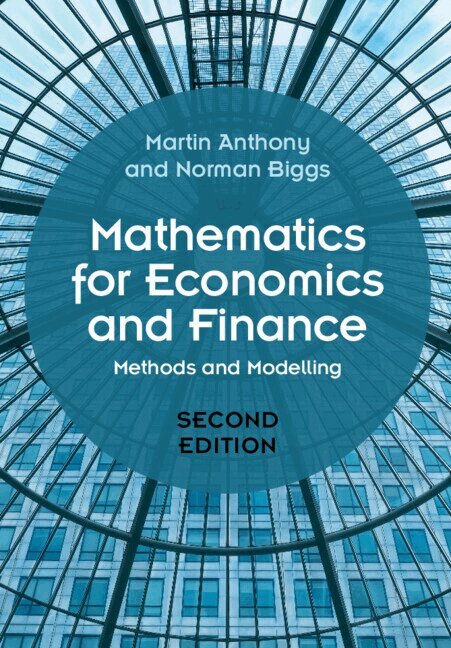
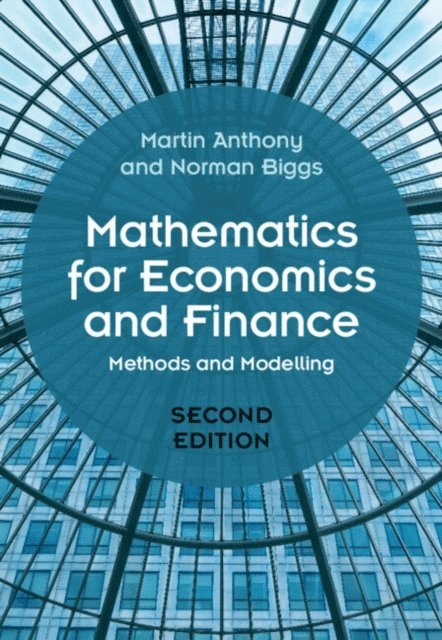
Accessible, concise, and interactive, this book introduces the mathematical methods that are indispensable in economics and finance. Fully updated to be as student friendly as possible, this edition contains extensive problems, worked examples and exercises (with full solutions at the end of the book). Two brand new chapters cover coupled systems of recurrence/differential equations, and matrix diagonalisation. All topics are motivated by problems from economics and finance, demonstrating to students how they can apply the mathematical techniques covered. For undergraduate students of economics, mathematics, or both, this book will be welcomed for its clarity and breadth and the many opportunities it provides for readers to practise and test their understanding.
Inbunden, Engelska, 2024
1 597 kr
Skickas inom 7-10 vardagar
Accessible, concise, and interactive, this book introduces the mathematical methods that are indispensable in economics and finance. Fully updated to be as student friendly as possible, this edition contains extensive problems, worked examples and exercises (with full solutions at the end of the book). Two brand new chapters cover coupled systems of recurrence/differential equations, and matrix diagonalisation. All topics are motivated by problems from economics and finance, demonstrating to students how they can apply the mathematical techniques covered. For undergraduate students of economics, mathematics, or both, this book will be welcomed for its clarity and breadth and the many opportunities it provides for readers to practise and test their understanding.
E-bok
Engelska, 2024712 kr
Läs direkt efter köp
E-bok
PDF, Engelska, 2024687 kr
Läs direkt efter köp
E-bok
Engelska, 1996712 kr
Läs direkt efter köp
Mathematics has become indispensable in the modelling of economics, finance, business and management. Without expecting any particular background of the reader, this book covers the following mathematical topics, with frequent reference to applications in economics and finance: functions, graphs and equations, recurrences (difference equations), differentiation, exponentials and logarithms, optimisation, partial differentiation, optimisation in several variables, vectors and matrices, linear equations, Lagrange multipliers, integration, first-order and second-order differential equations. The stress is on the relation of maths to economics, and this is illustrated with copious examples and exercises to foster depth of understanding. Each chapter has three parts: the main text, a section of further worked examples and a summary of the chapter together with a selection of problems for the reader to attempt. For students of economics, mathematics, or both, this book provides an introduction to mathematical methods in economics and finance that will be welcomed for its clarity and breadth.
E-bok
PDF, Engelska, 1994901 kr
Läs direkt efter köp
This is a substantial revision of a much-quoted monograph, first published in 1974. The structure is unchanged, but the text has been clarified and the notation brought into line with current practice. A large number of ''Additional Results'' are included at the end of each chapter, thereby covering most of the major advances in the last twenty years. Professor Biggs'' basic aim remains to express properties of graphs in algebraic terms, then to deduce theorems about them. In the first part, he tackles the applications of linear algebra and matrix theory to the study of graphs; algebraic constructions such as adjacency matrix and the incidence matrix and their applications are discussed in depth. There follows an extensive account of the theory of chromatic polynomials, a subject which has strong links with the ''interaction models'' studied in theoretical physics, and the theory of knots. The last part deals with symmetry and regularity properties. Here there are important connections with other branches of algebraic combinatorics and group theory. This new and enlarged edition this will be essential reading for a wide range of mathematicians, computer scientists and theoretical physicists.
E-bok
PDF, Franska, 2021501 kr
Läs direkt efter köp
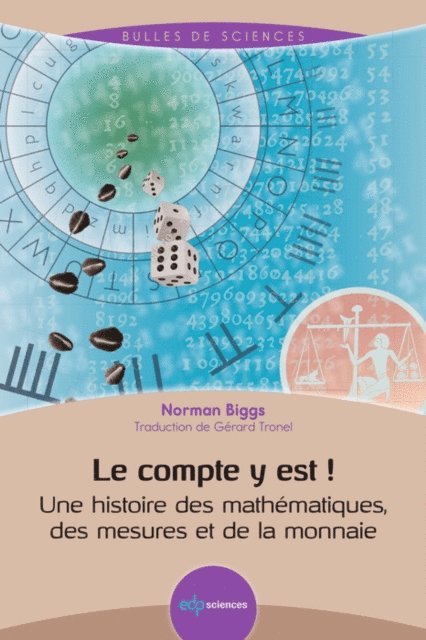
No detailed description available for "Le compte y est !".