Norval Morris – författare
Visar alla böcker från författaren Norval Morris. Handla med fri frakt och snabb leverans.
7 produkter
7 produkter
E-bok
Engelska, 2003357 kr
Läs direkt efter köp
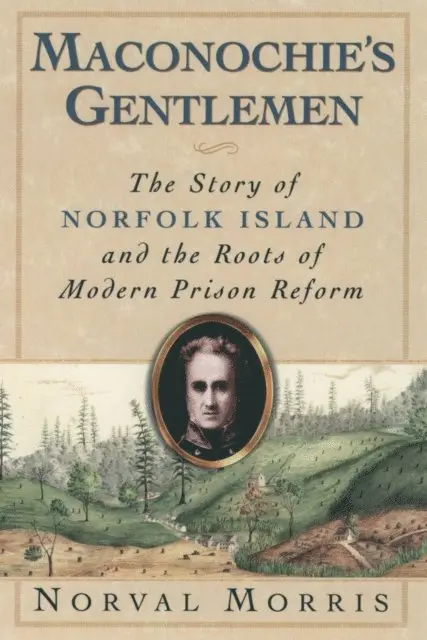
In 1840, Alexander Maconochie, a privileged retired naval captain, became at his own request superintendent of two thousand twice-convicted prisoners on Norfolk Island, a thousand miles off the coast of Australia. In four years, Maconochie transformed what was one of the most brutal convict settlements in history into a controlled, stable, and productive environment that achieved such success that upon release his prisoners came to be called "Maconochie''s Gentlemen". Here Norval Morris, one of our most renowned criminologists, offers a highly inventive and engaging account of this early pioneer in penal reform, enhancing Maconochie''s life story with a trenchant policy twist. Maconochie''s life and efforts on Norfolk Island, Morris shows, provide a model with profound relevance to the running of correctional institutions today. Using a unique combination of fictionalized history and critical commentary, Morris gives this work a powerful policy impact lacking in most standard academic accounts. In an era of "mass incarceration" that rivals that of the settlement of Australia, Morris injects the question of humane treatment back into the debate over prison reform. Maconochie and his "Marks system" played an influential role in the development of prisons; but for the last thirty years prison reform has been dominated by punitive and retributive sentiments, the conventional wisdom holding that we need ''supermax'' prisons to control the ''worst of the worst'' in solitary and harsh conditions. Norval Morris argues to the contrary, holding up the example of Alexander Maconochie as a clear-cut alternative to the "living hell" of prison systems today.
Häftad, Engelska, 1998
268 kr
Skickas inom 5-8 vardagar
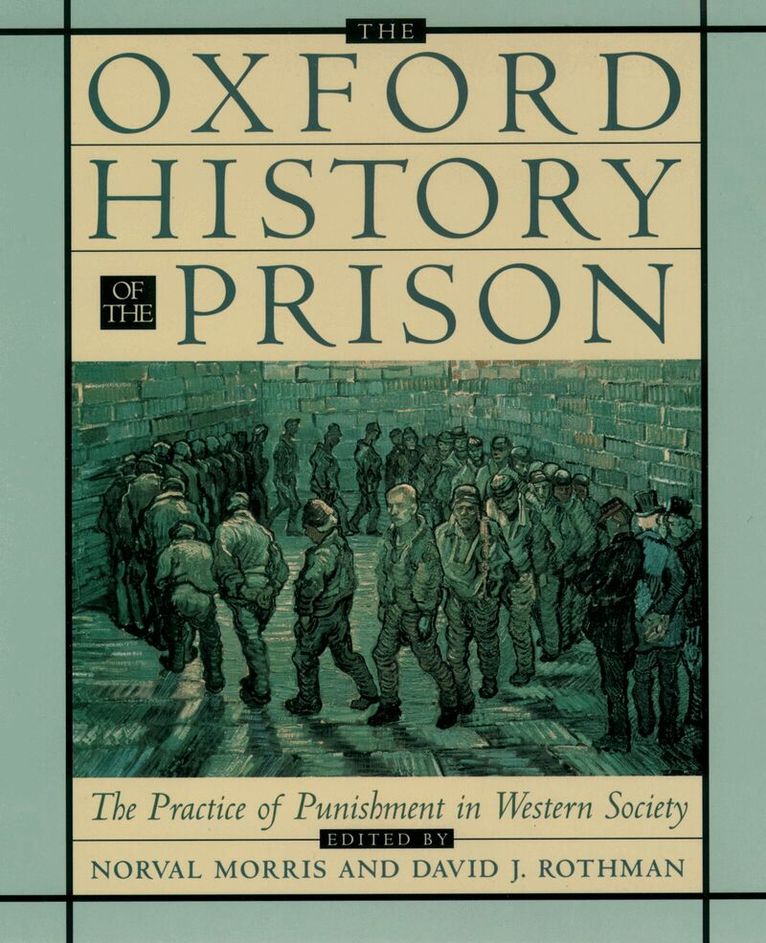
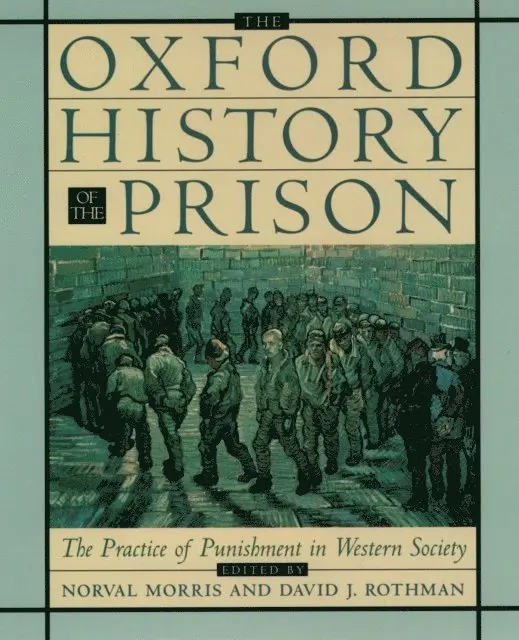
The Oxford History of the Prison is an informative account of the growth and development of the prison in Western society, from classical times to the present day. In fourteen chapters -- each written by specialists in social, legal, and institutional history -- the book explores not only the complex history of the prison, but also the social world of inmates and their keepers.
E-bok
PDF, Engelska, 2003301 kr
Läs direkt efter köp
In 1840, Alexander Maconochie, a privileged retired naval captain, became at his own request superintendent of two thousand twice-convicted prisoners on Norfolk Island, a thousand miles off the coast of Australia. In four years, Maconochie transformed what was one of the most brutal convict settlements in history into a controlled, stable, and productive environment that achieved such success that upon release his prisoners came to be called "Maconochie''s Gentlemen". Here Norval Morris, one of our most renowned criminologists, offers a highly inventive and engaging account of this early pioneer in penal reform, enhancing Maconochie''s life story with a trenchant policy twist. Maconochie''s life and efforts on Norfolk Island, Morris shows, provide a model with profound relevance to the running of correctional institutions today. Using a unique combination of fictionalized history and critical commentary, Morris gives this work a powerful policy impact lacking in most standard academic accounts. In an era of "mass incarceration" that rivals that of the settlement of Australia, Morris injects the question of humane treatment back into the debate over prison reform. Maconochie and his "Marks system" played an influential role in the development of prisons; but for the last thirty years prison reform has been dominated by punitive and retributive sentiments, the conventional wisdom holding that we need ''supermax'' prisons to control the ''worst of the worst'' in solitary and harsh conditions. Norval Morris argues to the contrary, holding up the example of Alexander Maconochie as a clear-cut alternative to the "living hell" of prison systems today.
E-bok
PDF, Engelska, 1991190 kr
Läs direkt efter köp
Across the country prisons are jammed to capacity, and in extreme cases, barges and mobile homes are used to stem the overflow. Probation officers in some cities have caseloads of 200 and more--hardly a manageable number of offenders to track and supervise. And with about one million people in prison and jail, and two and a half million on probation, it is clear we are experiencing a crisis in our penal system. In Between Prison and Probation, Norval Morris and Michael Tonry, two of the nation''s leading criminologists, offer an important and timely strategy for alleviating these problems. They argue that our overwhelmed corrections system cannot cope with the flow of convicted offenders because the two extremes of punishment--imprisonment and probation--are both used excessively, with a near-vacuum of useful punishments in between. Morris and Tonry propose instead a comprehensive program that relies on a range of punishment including fines and other financial sanctions, community service, house arrest, intensive probation, closely supervised treatment programs for drugs, alcohol and mental illness, and electronic monitoring of movement. Used in rational combinations, these "intermediate" punishments would better serve the community than our present polarised choice. Serious consideration of these punishments has been hindered by the widespread perception that they are therapeutic rather than punitive. The reality, however, Morris and Tonry argue, "is that the American criminal justice system is both too severe and too lenient--almost randomly." Systematically implemented and rigorously enforced, intermediate punishments can "better and more economically serve the community, the victim, and the criminal than the prison terms and probation orders they supplant." Between Prison and Probation goes beyond mere advocacy of an increasing use of interdediate punishments; the book also addresses the difficult task of fitting these punishments into a comprehensive, fair and community-protective sentencing system.
E-bok
Engelska, 1995222 kr
Läs direkt efter köp
The word "prison" immediately evokes stark images: forbidding walls spiked with watchtowers; inmates confined to cramped cells for hours on end; the suspicious eyes of armed guards. They seem to be the inevitable and permanent marks of confinement, as though prisons were a timeless institution stretching from medieval stone dungeons to the current era of steel boxes. But centuries of development and debate lie behind the prison as we now know it--a rich history that reveals how our ideas of crime and practices of punishment have changed over time.In The Oxford History of the Prison, a team of distinguished scholars offers a vivid account of the rise and development of this critical institution. Penalties other than incarceration were once much more common, from such bizarre death sentences as the Roman practice of drowning convicts in sacks filled with animals to a frequent reliance on the scaffold and on to forms of public shaming (such as the classic stocks of colonial America). The first decades of the nineteenth century saw the rise of the full-blown prison system--and along with it, the idea of prison reform. Alexis de Tocqueville originally came to America to write a report on its widely acclaimed prison system. The authors trace the persistent tension between the desire to punish and the hope for rehabilitation, recounting the institution''s evolution from the rowdy and squalid English jails of the 1700s, in which prisoners and visitors ate and drank together; to the sober and stark nineteenth-century penitentiaries, whose inmates were forbidden to speak or even to see one another; and finally to the "big houses" of the current American prison system, in which prisoners are as overwhelmed by intense boredom as by the threat of violence. The text also provides a gripping and personal look at the social world of prisoners and their keepers over the centuries. In addition, thematic chapters explore in-depth a variety of special institutions and other important aspects of prison history, including the jail, the reform school, the women''s prison, political imprisonment, and prison and literature.Fascinating, provocative, and authoritative, The Oxford History of the Prison offers a deep, informed perspective on the rise and development of one of the central features of modern society--capturing the debates that rage from generation to generation on the proper response to crime.
Inbunden, Engelska, 1973
842 kr
Skickas inom 10-15 vardagar
Häftad, Engelska, 1994
508 kr
Tillfälligt slut