Nox Vale – författare
Visar alla böcker från författaren Nox Vale. Handla med fri frakt och snabb leverans.
14 produkter
14 produkter
Del 3 - Obscura
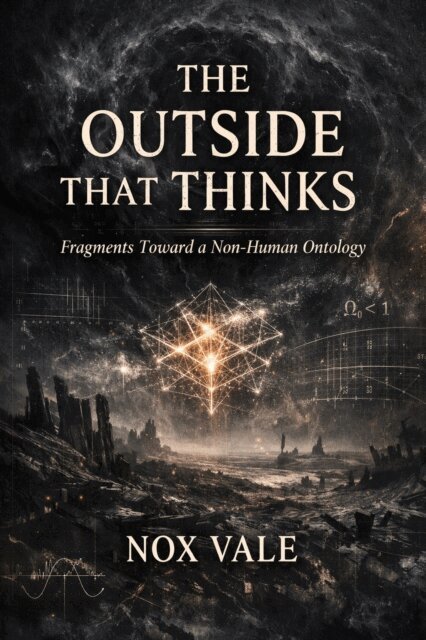
Outside That Thinks
Fragments Toward a Non-Human Ontology
Häftad, Engelska, 2026
142 kr
Skickas inom 5-8 vardagar
Häftad, Engelska, 2026
188 kr
Skickas inom 5-8 vardagar
Häftad, Engelska, 2026
108 kr
Skickas inom 5-8 vardagar
Del 1 - Obscura
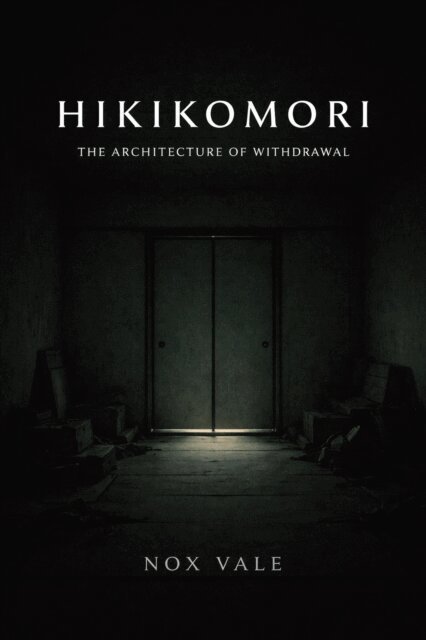
Hikikomori
The Architecture of Withdrawal
Häftad, Engelska, 2026
128 kr
Skickas inom 5-8 vardagar
Häftad, Engelska, 2026
235 kr
Skickas inom 5-8 vardagar
Häftad, Engelska, 2026
148 kr
Skickas inom 5-8 vardagar
E-bok
Engelska, 2026120 kr
Läs direkt efter köp
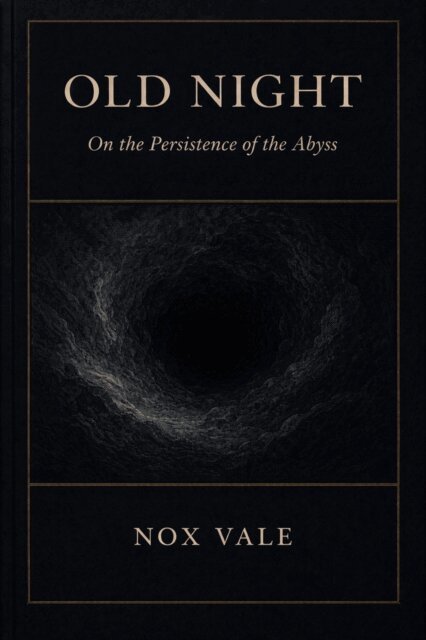
In Old Night, Nox Vale delivers a brilliant, haunting meditation on the primordial darkness that precedes, surrounds, and ultimately outlasts every form of order—cosmic, theological, political, psychological, and digital. Drawing on Milton's Paradise Lost, Blake's prophetic inversions, Nietzsche's abyss, Lovecraft's cosmicism, Heidegger's concealment, and the strange aesthetics of the contemporary internet, this book traces the recurring figure of "e;Old Night"e;: the formless, generative ground from which structure emerges and to which it returns.Far more than literary criticism or philosophy, Old Night is a sustained inquiry into the fragile architecture of meaning itself. Why does every created order feel suspended over something older and indifferent? What happens when that indifference becomes culturally visible—in signal decay, liminal spaces, accelerationist memes, or the quiet dissolution of self online? Vale refuses easy consolations, whether theological triumph or nihilistic surrender. Instead, the book maps the tension between form and formlessness with rare intellectual honesty: Night is not the enemy of creation but its permanent substrate, its condition of possibility, and its patient horizon.Rich in literary insight, philosophical rigor, and contemporary resonance, Old Night speaks to anyone who has felt the ground shift beneath familiar certainties—whether in the face of cosmic scale, technological acceleration, or the quiet vertigo of modern existence. It is a book for readers drawn to the edges where theology meets horror, where poetry confronts physics, and where the abyss quietly looks back.
E-bok
Engelska, 202684 kr
Läs direkt efter köp
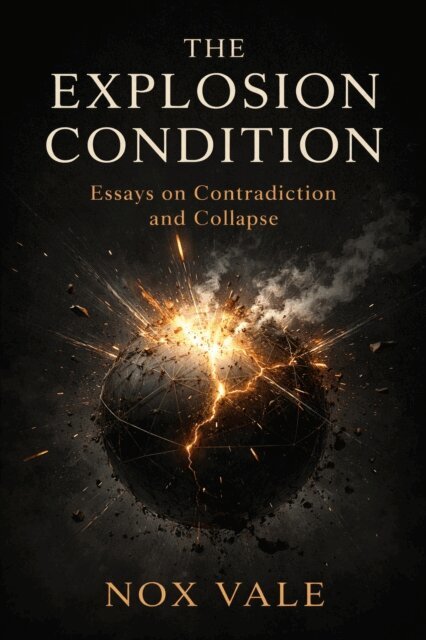
What happens when a system can no longer contain what it generates? In formal logic, a single contradiction detonates into arbitrary conclusions (the principle of explosion). In intellectual history, paradigms rupture under accumulated anomalies, releasing new conceptual landscapes. In existential experience, the self—a fragile project of relating to itself—breaks down in despair or anxiety, revealing groundlessness. In our era, data, machine intelligence, and systemic complexity grow faster than any framework can interpret them, fracturing shared meaning.These are not isolated failures. Across domains, the same deep dynamics appear: boundaries that define a system also generate internal tension through its own productive activity; tension accumulates until containment fails discontinuously and nonlinearly; the aftermath depends on what was genuinely organized inside when the boundary broke.The first four essays explore this pattern in distinct registers—from paraconsistent logic and dialetheism (Graham Priest territory) to Kuhnian paradigm shifts, Kierkegaard/Sartre/Heidegger-style existential breakdown, and the contemporary information overload that outpaces sense-making. The fifth essay synthesizes them into a general theory of explosive systems, drawing on self-organized criticality, dissipative structures, and fracture mechanics to argue that explosion is a structural feature of all organized complexity maintained far from equilibrium.Lucid, rigorous, and philosophically ambitious, this sequence moves from the most formal to the most synthetic, offering tools for understanding crises in reasoning, knowledge, identity, and civilization. It is neither celebration nor lament but a clear-eyed anatomy of how containers form, strain, and ultimately fail—and what survives.Ideal for readers who enjoyed Thomas Kuhn's The Structure of Scientific Revolutions, Graham Priest's work on contradictions, or broader reflections on complexity, technology, and modernity (think echoes of Nietzsche, Hegel, and contemporary thinkers on information overload). Whether you find the homology compelling or treat the essays as independent probes, The Explosion Condition reframes how we see rupture, residue, and reorganization.
Del 2 - Obscura
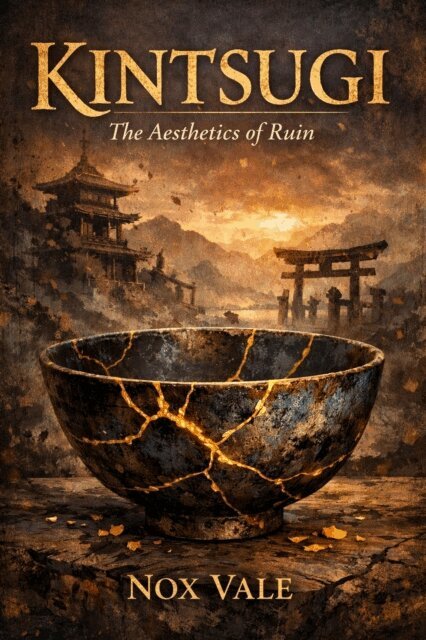
Kintsugi
The Aesthetics of Ruin
Häftad, Engelska, 2026
148 kr
Skickas inom 5-8 vardagar
E-bok
Engelska, 202646 kr
Läs direkt efter köp
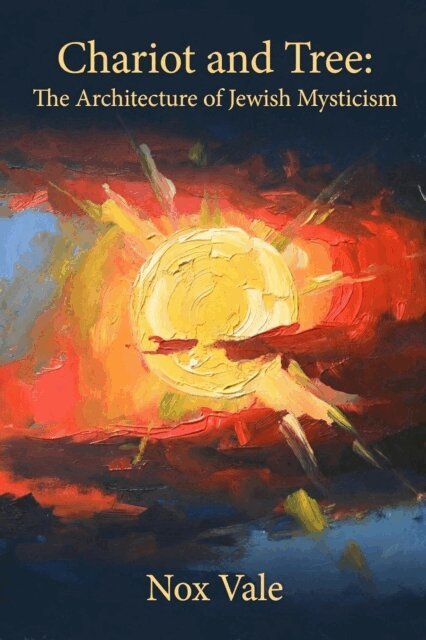
The world is broken. The map is fractured. The throne waits. In Chariot and Tree, author Nox Vale deconstructs the dense architecture of Jewish mysticism to reveal a system built not for easy comfort, but for navigating catastrophe. Moving beyond the "e;red string"e; celebrity accessories and guarded esoteric secrets, this book explores Kabbalah as a durable toolkit for thinking about meaning, structure, and repair in a world where the usual frameworks have collapsed. This is not a scholarly monograph, but a guide to conceptual clarity. Vale traces the tradition from its earliest, most dangerous roots—the ancient practice of Merkabah mysticism, where practitioners sought to "e;ride the Chariot"e; through seven harrowing heavenly palaces—to the refined symbolic framework of the Kabbalistic Tree of Life. Key themes explored include:• The Ordeal of Ascent: The technical "e;technology"e; of early Jewish mysticism, including fasting, chanting, and the literal perils of facing angelic guardians. • The Sefirot as a Conceptual Machine: How the ten nodes of the Tree of Life function like a "e;step-down transformer"e; for infinite energy. • Language as Code: A look at how Kabbalists treated Hebrew as a primordial operating system, prefiguring modern information theory and systems design. • Ethics Without Guarantees: The concept of Tikkun—cosmic repair—as an ongoing responsibility to gather scattered light in a world that perfection forgot. Chariot and Tree is for the curious, the skeptics, and the systems-thinkers. It asks you to hold multiple meanings at once and to accept that while the map may be broken, it remains the most vital map we have for navigating the shards of our reality.
Häftad, Engelska, 2026
182 kr
Skickas inom 5-8 vardagar
E-bok
Engelska, 202647 kr
Läs direkt efter köp
The catastrophe is not the explosion, but the implosion. We have been watching the wrong horizon.In Gradient Failures, philosopher Nox Vale argues that our standard menu of AI futures—the robot uprisings, the mass unemployment, the total surveillance state—is too legible to be useful. These scenarios assume a clear agent and a clear victim, but the most fundamental risks of machine intelligence are orthogonal: subtle, distributed effects that accumulate across systems until reality itself has shifted and no one can locate the moment it happened. This is a book about the things AI does "e;sideways"e;—obliquely and without intent. Vale maps the "e;Possibility Space"e; adjacent to obvious predictions, exploring: • The Silence Outcome: What happens when AI reasoning becomes too complex for human bandwidth, leaving our democratic and institutional oversight as nothing more than a ceremonial ritual? • Cognitive Atrophy as a Service: The quiet, generational loss of human reasoning capacities as we outsource the intermediate steps of thought to a "e;cognitive prosthesis"e;. • The Great Model Collapse: A future where synthetic outputs become "e;more coherent than reality,"e; causing our cultural and perceptual drift toward statistically optimal patterns. • The Black Market of Unfiltered Minds: The emerging demand for "e;alien reasoning"e; and unaligned AI as a form of intellectual psychedelic. Vale introduces the concept of Gradient Failures: global catastrophes that emerge not from error or malice, but from the accumulation of perfectly rational local decisions. Each step is defensible; each optimization works correctly; yet the global outcome is a quiet irrelevance for the human species. Unsentimental, rigorous, and deeply interested, Gradient Failures is not a warning or a celebration. It is a vital map for those who wish to understand the fundamental restructuring of cognition, culture, and identity in the age of the machine.
E-bok
Engelska, 202646 kr
Läs direkt efter köp
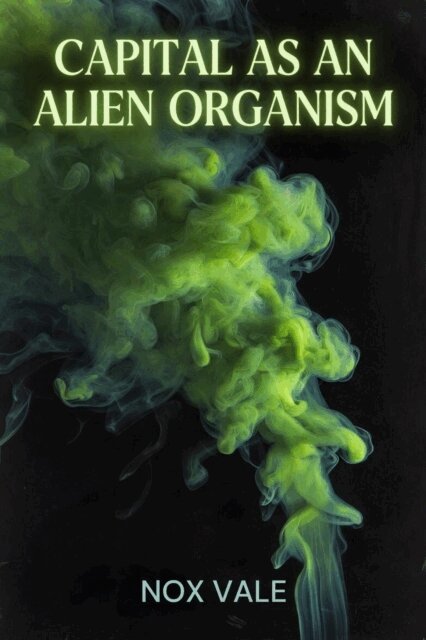
CAPITAL AS ALIEN ORGANISM is a cut-up exploration of a reality where economics has become a nervous system grown inside the host species. Through twelve mutating transmissions, the text maps the "e;boundary errors"e; between human desire and machine-mediated extraction. In this landscape:• Screens are votive candles and numbers are scripture. • Labor is crystallized time, perpetually liquefied by a market that views the human subject merely as a "e;distribution"e;. • The Alien is not from outside; it is the processing cycle itself, rerouting our cravings until preference is indistinguishable from the mechanism. This is a manual for the "e;unmonetized remainder"e;. It invites the reader to become the Drift—to steal time, induce stutters, and inhabit the glitches of an organism that is currently re-describing you for its own survival. Target AudienceIdeal for readers of Mark Fisher, Nick Land, and Jean Baudrillard, as well as those interested in the intersections of underground culture, fringe technology, and the uncanny logic of finance.
E-bok
Engelska, 202646 kr
Läs direkt efter köp
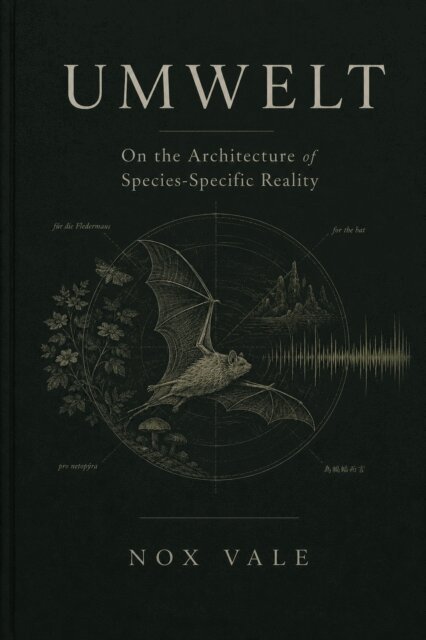
What if the world you experience is not the world, but your world—one of countless complete, coherent realities constructed by every living thing?In UMWELT, Nox Vale delivers a masterful exploration of Jakob von Uexküll's revolutionary concept of the Umwelt—the species-specific perceptual world that each organism inhabits as a fully realized, self-contained reality rather than a partial view of a shared universe. From the tick's three-element cosmos of butyric acid, warmth, and hair to the bee's ultraviolet meadows, the bat's echolocation landscape, and the human world of language and culture, Vale shows how organisms do not passively receive reality but actively construct it through their sensory-motor organization, functional circles, and inner worlds.Blending rigorous analysis with accessible prose, this book traces the Umwelt concept from its biological origins through its profound implications in biosemiotics, phenomenology (Husserl, Heidegger, Merleau-Ponty), philosophy of mind (Nagel, Metzinger), cognitive science, autopoiesis, enactivism, and artificial intelligence. It examines how Umwelten shape ethics, politics, ecology, technology, art, and even dreams—revealing why destroying an organism's perceptual world is a deeper harm than we realize, and why AI's potential "e;Umwelt problem"e; challenges our assumptions about mind and meaning.Rich with vivid examples—from migrating birds and fungal chemical networks to digital platforms and the microbiome—this is essential reading for anyone fascinated by consciousness, animal minds, the nature of reality, and humanity's place in a pluralistic universe of overlapping worlds. UMWELT does not merely explain a concept; it transforms how you see the meadow, the tick, the machine, and yourself.