Núria Casellas - Böcker
Visar alla böcker från författaren Núria Casellas. Handla med fri frakt och snabb leverans.
3 produkter
3 produkter
493 kr
Skickas inom 10-15 vardagar
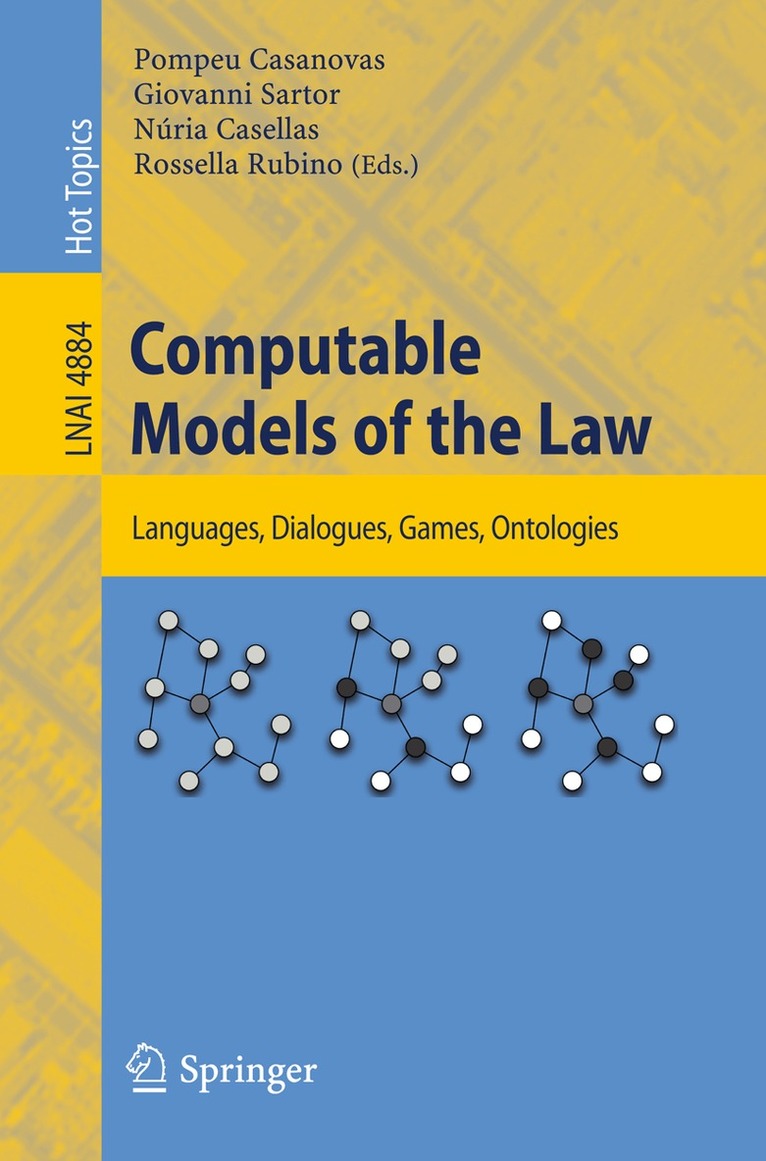
Information technology has now pervaded the legal sector, and the very modern concepts of e-law and e-justice show that automation processes are ubiquitous. European policies on transparency and information society, in particular, require the use of technology and its steady improvement.Some of the revised papers presented in this book originate from a workshop held at the European University Institute of Florence, Italy, in December 2006. The workshop was devoted to the discussion of the different ways of understanding and explaining contemporary law, for the purpose of building computable models of it -- especially models enabling the development of computer applications for the legal domain. During the course of the following year, several new contributions, provided by a number of ongoing (or recently finished) European projects on computation and law, were received, discussed and reviewed to complete the survey.This book presents 20 thoroughly refereed revised papers on the hot topics under research in different EU projects: legislative XML, legal ontologies, semantic web, search and meta-search engines, web services, system architecture, dialectic systems, dialogue games, multi-agent systems (MAS), legal argumentation, legal reasoning, e-justice, and online dispute resolution. The papers are organized in topical sections on knowledge representation, ontologies and XML legislative drafting; knowledge representation, legal ontologies and information retrieval; argumentation and legal reasoning; normative and multi-agent systems; and online dispute resolution.
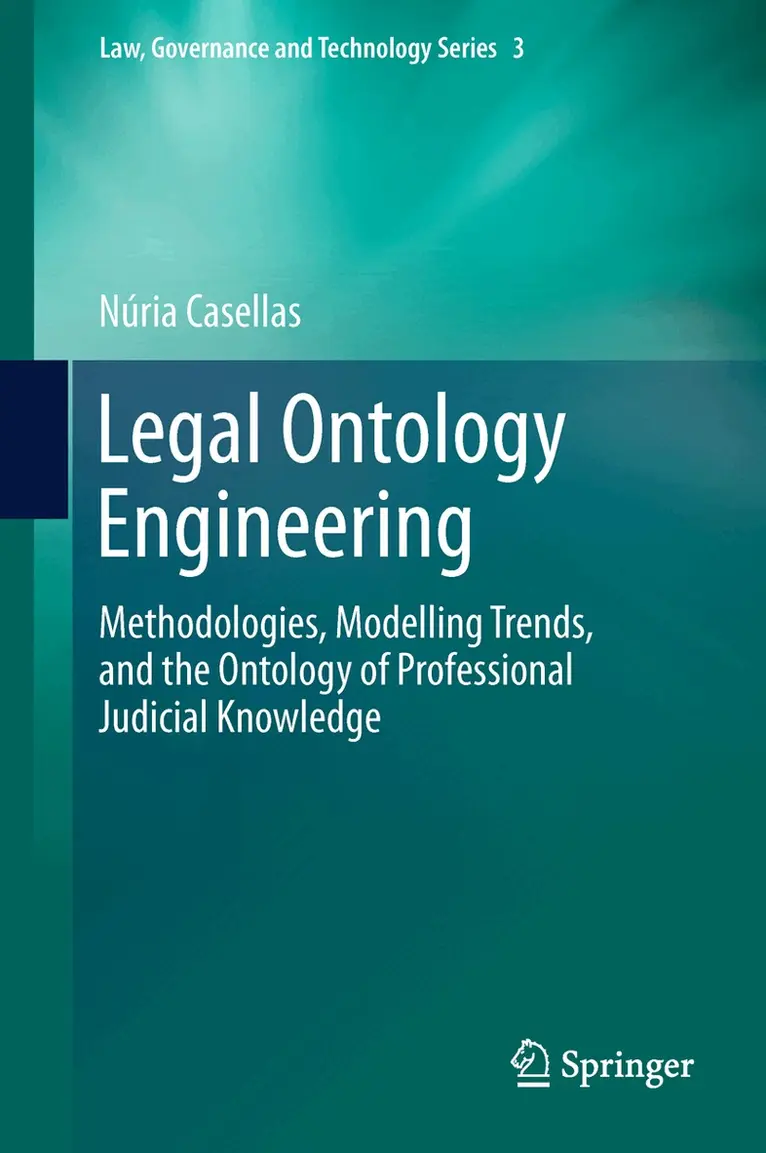
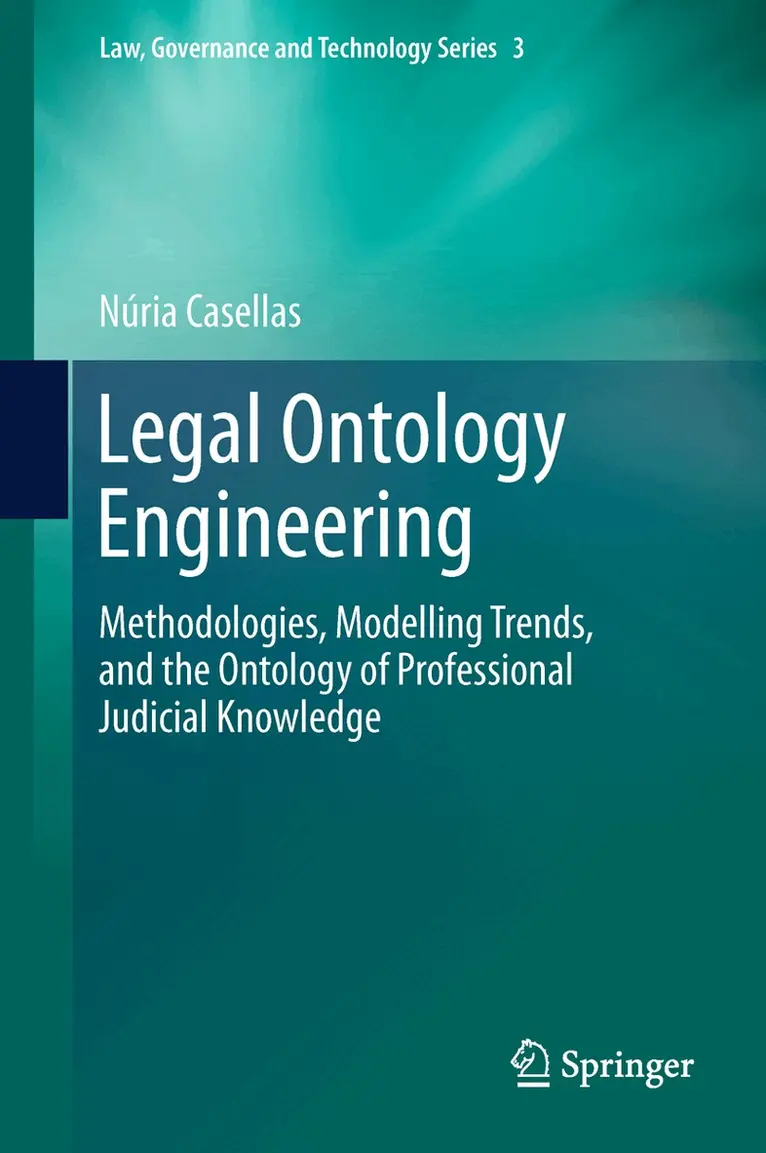
Legal Ontology Engineering
Methodologies, Modelling Trends, and the Ontology of Professional Judicial Knowledge
Inbunden, Engelska, 2011
1 643 kr
Skickas inom 10-15 vardagar
Enabling information interoperability, fostering legal knowledge usability and reuse, enhancing legal information search, in short, formalizing the complexity of legal knowledge to enhance legal knowledge management are challenging tasks, for which different solutions and lines of research have been proposed. During the last decade, research and applications based on the use of legal ontologies as a technique to represent legal knowledge has raised a very interesting debate about their capacity and limitations to represent conceptual structures in the legal domain. Making conceptual legal knowledge explicit would support the development of a web of legal knowledge, improve communication, create trust and enable and support open data, e-government and e-democracy activities. Moreover, this explicit knowledge is also relevant to the formalization of software agents and the shaping of virtual institutions and multi-agent systems or environments. This book explores the use of ontologism in legal knowledge representation for semantically-enhanced legal knowledge systems or web-based applications. In it, current methodologies, tools and languages used for ontology development are revised, and the book includes an exhaustive revision of existing ontologies in the legal domain. The development of the Ontology of Professional Judicial Knowledge (OPJK) is presented as a case study.
Legal Ontology Engineering
Methodologies, Modelling Trends, and the Ontology of Professional Judicial Knowledge
Häftad, Engelska, 2013
1 643 kr
Skickas inom 10-15 vardagar
Enabling information interoperability, fostering legal knowledge usability and reuse, enhancing legal information search, in short, formalizing the complexity of legal knowledge to enhance legal knowledge management are challenging tasks, for which different solutions and lines of research have been proposed. During the last decade, research and applications based on the use of legal ontologies as a technique to represent legal knowledge has raised a very interesting debate about their capacity and limitations to represent conceptual structures in the legal domain. Making conceptual legal knowledge explicit would support the development of a web of legal knowledge, improve communication, create trust and enable and support open data, e-government and e-democracy activities. Moreover, this explicit knowledge is also relevant to the formalization of software agents and the shaping of virtual institutions and multi-agent systems or environments. This book explores the use of ontologism in legal knowledge representation for semantically-enhanced legal knowledge systems or web-based applications. In it, current methodologies, tools and languages used for ontology development are revised, and the book includes an exhaustive revision of existing ontologies in the legal domain. The development of the Ontology of Professional Judicial Knowledge (OPJK) is presented as a case study.