Ofer Israeli - Böcker
Visar alla böcker från författaren Ofer Israeli. Handla med fri frakt och snabb leverans.
4 produkter
4 produkter
Complex Effects of International Relations
Intended and Unintended Consequences of Human Actions in Middle East Conflicts
Häftad, Engelska, 2021
594 kr
Skickas inom 3-6 vardagar
Identifies the many ways in which unexpected outcomes are endemic to international relations due to the complexity of world politics.In this comprehensive and unique theory-practice study, Ofer Israeli examines complex effects of international relations relating to various indirect-intended and unintended-consequences of intentional human action. These effects may be desirable or undesirable, overt or covert, anticipated or surprising, foreseeable but unanticipated, and anticipated but simultaneously neglected or discounted. Israeli focuses on six case studies from the Middle East, analyzing the unexpected and accidental results of interventions in this region by the United States, the United Kingdom, and other Western powers during the Cold War. From this research, he develops a complex-causal mechanism or practical tool that countries may use to implement foreign policy, with the goal of reducing the number of conflicts and wars globally, especially in the Middle East.
Complex Effects of International Relations
Intended and Unintended Consequences of Human Actions in Middle East Conflicts
Inbunden, Engelska, 2020
1 456 kr
Skickas inom 3-6 vardagar
Identifies the many ways in which unexpected outcomes are endemic to international relations due to the complexity of world politics.In this comprehensive and unique theory-practice study, Ofer Israeli examines complex effects of international relations relating to various indirect-intended and unintended-consequences of intentional human action. These effects may be desirable or undesirable, overt or covert, anticipated or surprising, foreseeable but unanticipated, and anticipated but simultaneously neglected or discounted. Israeli focuses on six case studies from the Middle East, analyzing the unexpected and accidental results of interventions in this region by the United States, the United Kingdom, and other Western powers during the Cold War. From this research, he develops a complex-causal mechanism or practical tool that countries may use to implement foreign policy, with the goal of reducing the number of conflicts and wars globally, especially in the Middle East.
942 kr
Skickas inom 10-15 vardagar
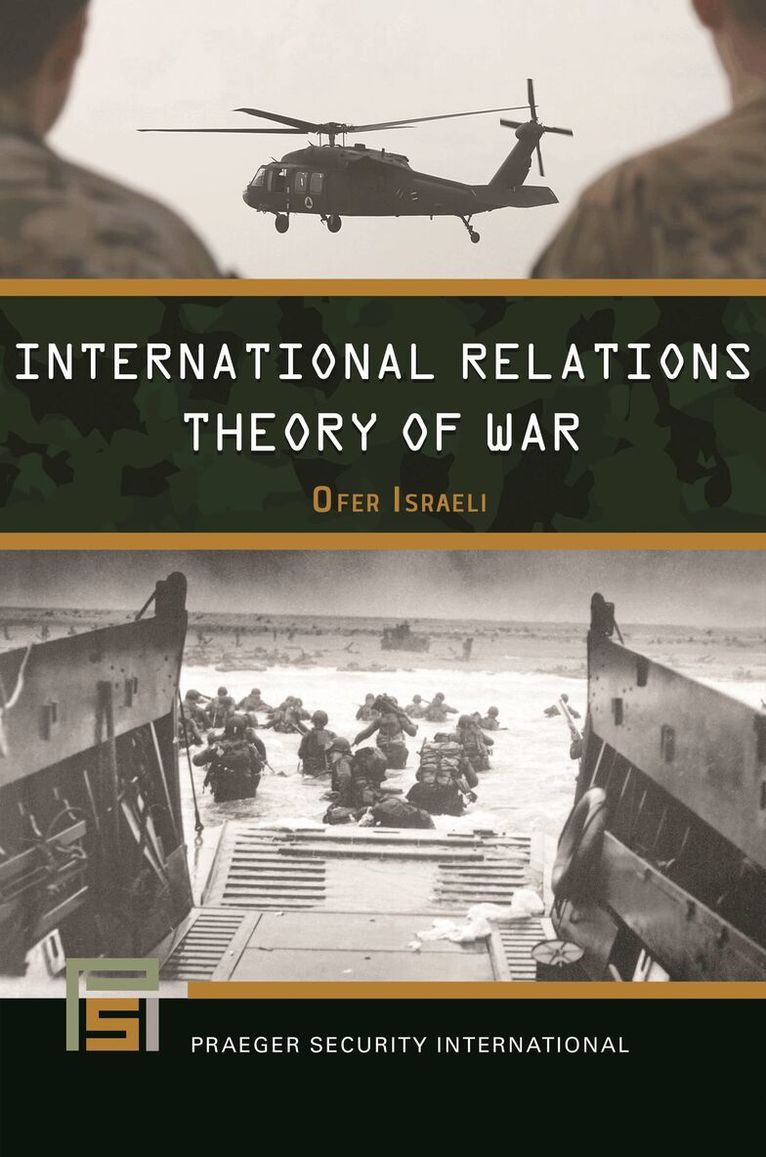
Covering 1816–2016, this book deals extensively with the international system as well as the territorial outcomes of several key wars that were waged during that time period, providing an instructive lesson in diplomatic history and international relations among global powers.Based on an in-depth review of the leading theories in the field of international relations, International Relations Theory of War explains an innovative theory on the international system, developed by the author, that he applies comprehensively to a large number of case studies. The book argues that there is a unipolar system that represents a kind of innovation relative to other systemic theories. It further posits that unipolar systems will be less stable than bipolar systems and more stable than multipolar systems, providing new insights relative to other theories that argue that unipolar systems are the most stable ones.The first chapter is devoted to explaining the manner of action of the two dependent variables—systemic international outcome and intra-systemic international outcome. The second chapter presents the international relations theory of war and its key assumptions. The third chapter precisely defines the distribution of power in the system. The fourth chapter examines the theory's two key phenomena. The fifth and last chapter presents the book's conclusions by examining the theoretical assumptions of the international relations theory of war.
394 kr
Skickas inom 10-15 vardagar
Covering 1816–2016, this book deals extensively with the international system as well as the territorial outcomes of several key wars that were waged during that time period, providing an instructive lesson in diplomatic history and international relations among global powers.Based on an in-depth review of the leading theories in the field of international relations, International Relations Theory of War explains an innovative theory on the international system, developed by the author, that he applies comprehensively to a large number of case studies. The book argues that there is a unipolar system that represents a kind of innovation relative to other systemic theories. It further posits that unipolar systems will be less stable than bipolar systems and more stable than multipolar systems, providing new insights relative to other theories that argue that unipolar systems are the most stable ones.The first chapter is devoted to explaining the manner of action of the two dependent variables—systemic international outcome and intra-systemic international outcome. The second chapter presents the international relations theory of war and its key assumptions. The third chapter precisely defines the distribution of power in the system. The fourth chapter examines the theory's two key phenomena. The fifth and last chapter presents the book's conclusions by examining the theoretical assumptions of the international relations theory of war.