Ola Bratteli – författare
Visar alla böcker från författaren Ola Bratteli. Handla med fri frakt och snabb leverans.
17 produkter
17 produkter
Inbunden, Engelska, 2002
547 kr
Skickas inom 10-15 vardagar
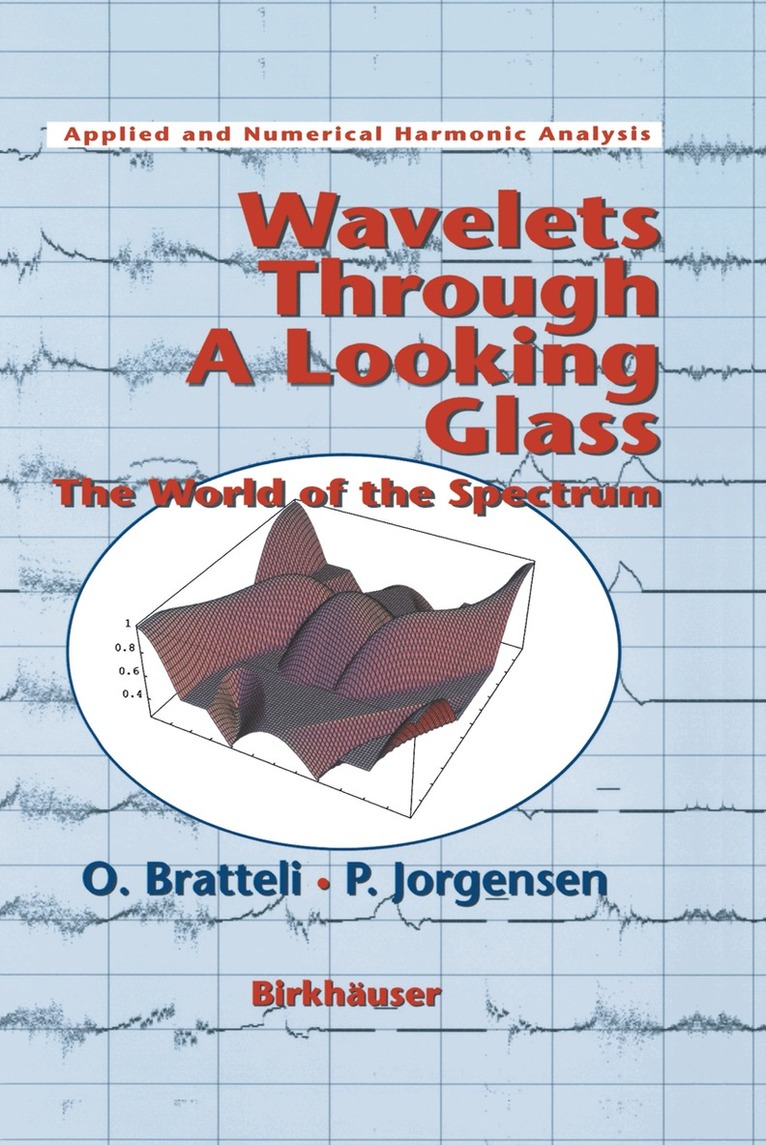
This book combining wavelets and the world of the spectrum focuses on recent developments in wavelet theory, emphasizing fundamental and relatively timeless techniques that have a geometric and spectral- theoretic flavor. The exposition is clearly motivated and unfolds systematically, aided by numerous graphics. Self-contained, the work deals with important applications to signal processing, communications engineering, computer graphics algorithms, qubit algorithms and chaos theory, and is aimed at a broad readership of graduate students and researchers in applied mathematics and engineering.
E-bok
PDF, Engelska, 2013712 kr
Läs direkt efter köp
This book combining wavelets and the world of the spectrum focuses on recent developments in wavelet theory, emphasizing fundamental and relatively timeless techniques that have a geometric and spectral- theoretic flavor. The exposition is clearly motivated and unfolds systematically, aided by numerous graphics. Self-contained, the work deals with important applications to signal processing, communications engineering, computer graphics algorithms, qubit algorithms and chaos theory, and is aimed at a broad readership of graduate students and researchers in applied mathematics and engineering.
Häftad, Engelska, 2013
547 kr
Skickas inom 10-15 vardagar
This book combining wavelets and the world of the spectrum focuses on recent developments in wavelet theory, emphasizing fundamental and relatively timeless techniques that have a geometric and spectral- theoretic flavor. The exposition is clearly motivated and unfolds systematically, aided by numerous graphics. Self-contained, the work deals with important applications to signal processing, communications engineering, computer graphics algorithms, qubit algorithms and chaos theory, and is aimed at a broad readership of graduate students and researchers in applied mathematics and engineering.
Inbunden, Engelska, 1987
3 046 kr
Skickas inom 10-15 vardagar
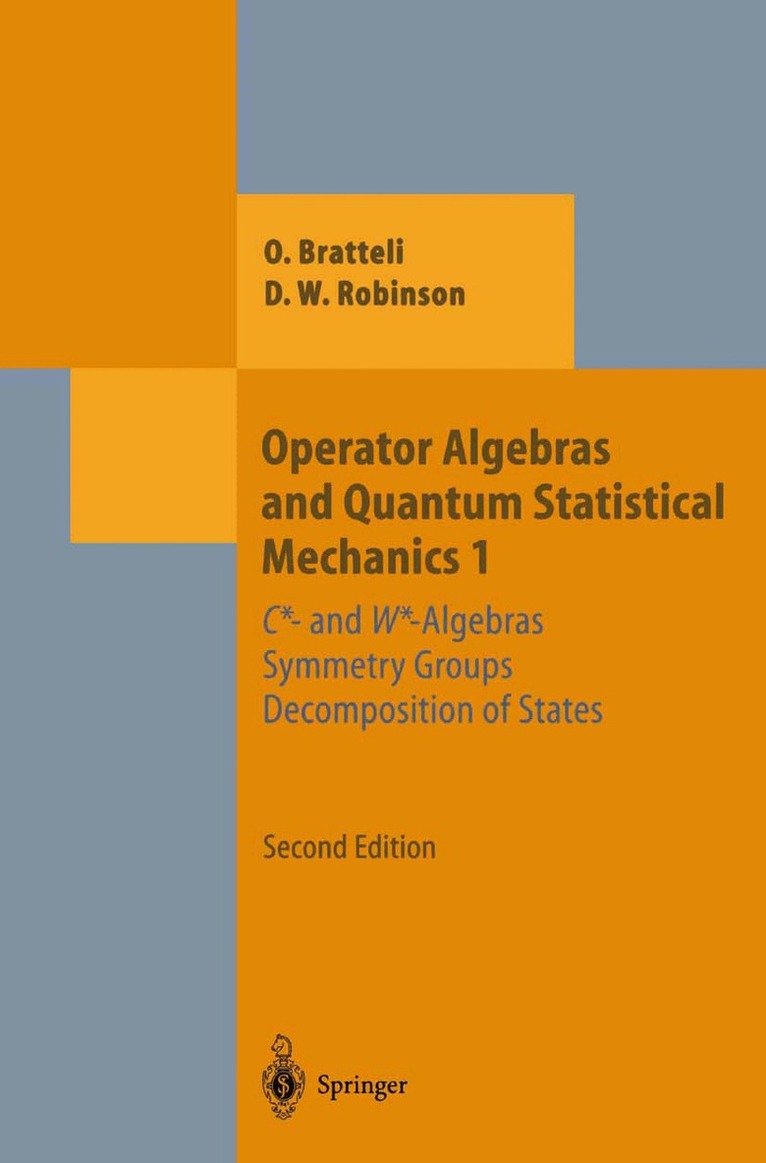
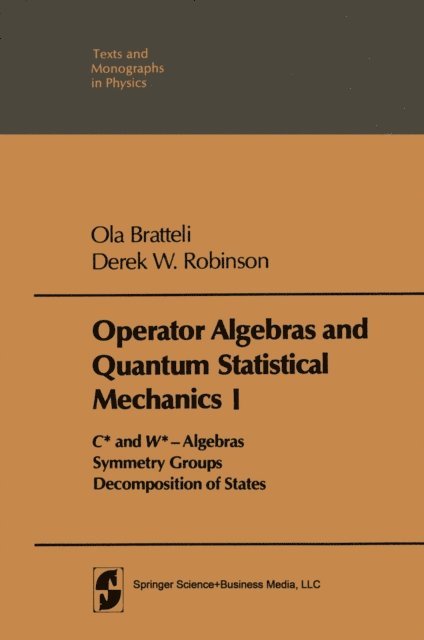
In this book we describe the elementary theory of operator algebras and parts of the advanced theory which are of relevance, or potentially of relevance, to mathematical physics. Subsequently we describe various applications to quantum statistical mechanics. At the outset of this project we intended to cover this material in one volume but in the course of develop ment it was realized that this would entail the omission ofvarious interesting topics or details. Consequently the book was split into two volumes, the first devoted to the general theory of operator algebras and the second to the applications. This splitting into theory and applications is conventional but somewhat arbitrary. In the last 15-20 years mathematical physicists have realized the importance of operator algebras and their states and automorphisms for problems of field theory and statistical mechanics. But the theory of 20 years aga was largely developed for the analysis of group representations and it was inadequate for many physical applications. Thus after a short honey moon period in which the new found tools of the extant theory were applied to the most amenable problems a longer and more interesting period ensued in which mathematical physicists were forced to redevelop the theory in relevant directions. New concepts were introduced, e. g. asymptotic abelian ness and KMS states, new techniques applied, e. g. the Choquet theory of barycentric decomposition for states, and new structural results obtained, e. g. the existence of a continuum of nonisomorphic type-three factors.
Del 1229 - Lecture Notes in Mathematics
Derivations, Dissipations and Group Actions on C*-algebras
Häftad, Engelska, 1986
550 kr
Skickas inom 10-15 vardagar
Del 1 - Abel Symposia
Operator Algebras
The Abel Symposium 2004
Inbunden, Engelska, 2006
1 092 kr
Skickas inom 10-15 vardagar
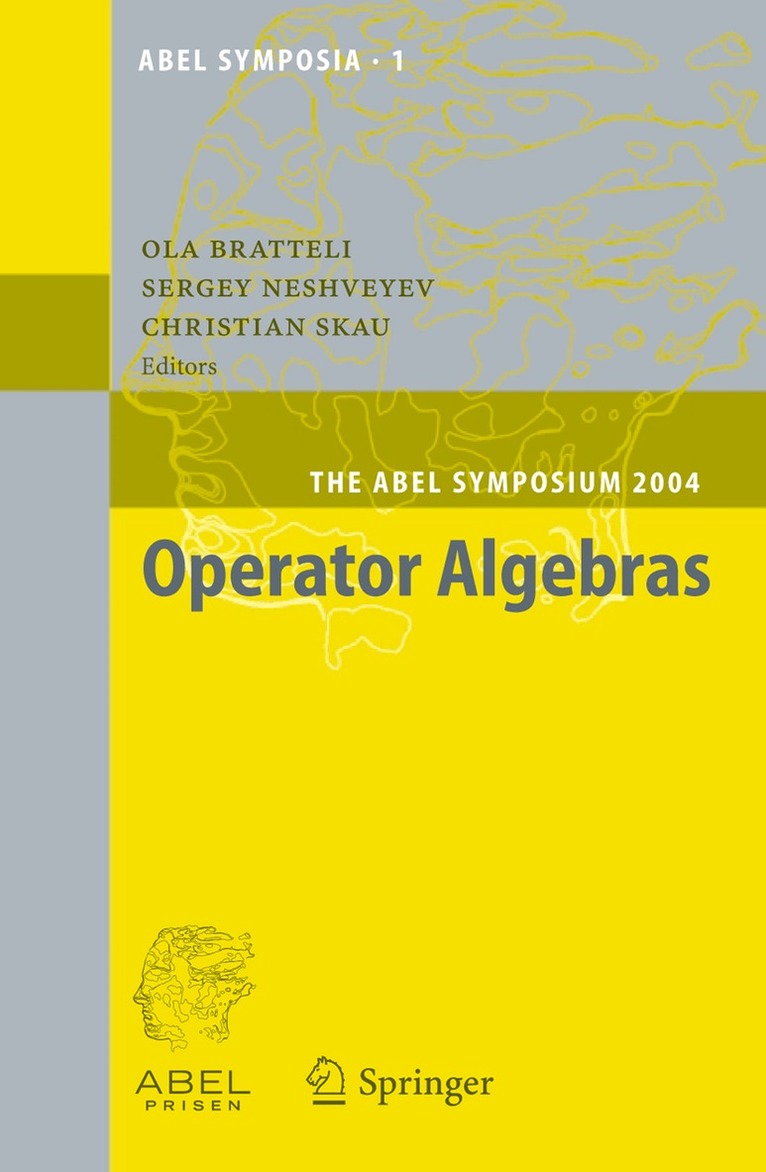
The theme of this symposium was operator algebras in a wide sense. In the last 40 years operator algebras has developed from a rather special dis- pline within functional analysis to become a central ?eld in mathematics often described as “non-commutative geometry” (see for example the book “Non-Commutative Geometry” by the Fields medalist Alain Connes). It has branched out in several sub-disciplines and made contact with other subjects like for example mathematical physics, algebraic topology, geometry, dyn- ical systems, knot theory, ergodic theory, wavelets, representations of groups and quantum groups. Norway has a relatively strong group of researchers in the subject, which contributed to the award of the ?rst symposium in the series of Abel Symposia to this group. The contributions to this volume give a state-of-the-art account of some of these sub-disciplines and the variety of topics re?ect to some extent how the subject has branched out. We are happy that some of the top researchers in the ?eld were willing to contribute. The basic ?eld of operator algebras is classi?ed within mathematics as part of functional analysis. Functional analysis treats analysis on in?nite - mensional spaces by using topological concepts. A linear map between two such spaces is called an operator. Examples are di?erential and integral - erators. An important feature is that the composition of two operators is a non-commutative operation.
E-bok
PDF, Engelska, 20071 416 kr
Läs direkt efter köp
The theme of this symposium was operator algebras in a wide sense. In the last 40 years operator algebras has developed from a rather special dis- pline within functional analysis to become a central ?eld in mathematics often described as “non-commutative geometry” (see for example the book “Non-Commutative Geometry” by the Fields medalist Alain Connes). It has branched out in several sub-disciplines and made contact with other subjects like for example mathematical physics, algebraic topology, geometry, dyn- ical systems, knot theory, ergodic theory, wavelets, representations of groups and quantum groups. Norway has a relatively strong group of researchers in the subject, which contributed to the award of the ?rst symposium in the series of Abel Symposia to this group. The contributions to this volume give a state-of-the-art account of some of these sub-disciplines and the variety of topics re?ect to some extent how the subject has branched out. We are happy that some of the top researchers in the ?eld were willing to contribute. The basic ?eld of operator algebras is classi?ed within mathematics as part of functional analysis. Functional analysis treats analysis on in?nite - mensional spaces by using topological concepts. A linear map between two such spaces is called an operator. Examples are di?erential and integral - erators. An important feature is that the composition of two operators is a non-commutative operation.
E-bok
PDF, Engelska, 2006687 kr
Läs direkt efter köp
Inbunden, Engelska, 1997
1 961 kr
Skickas inom 10-15 vardagar
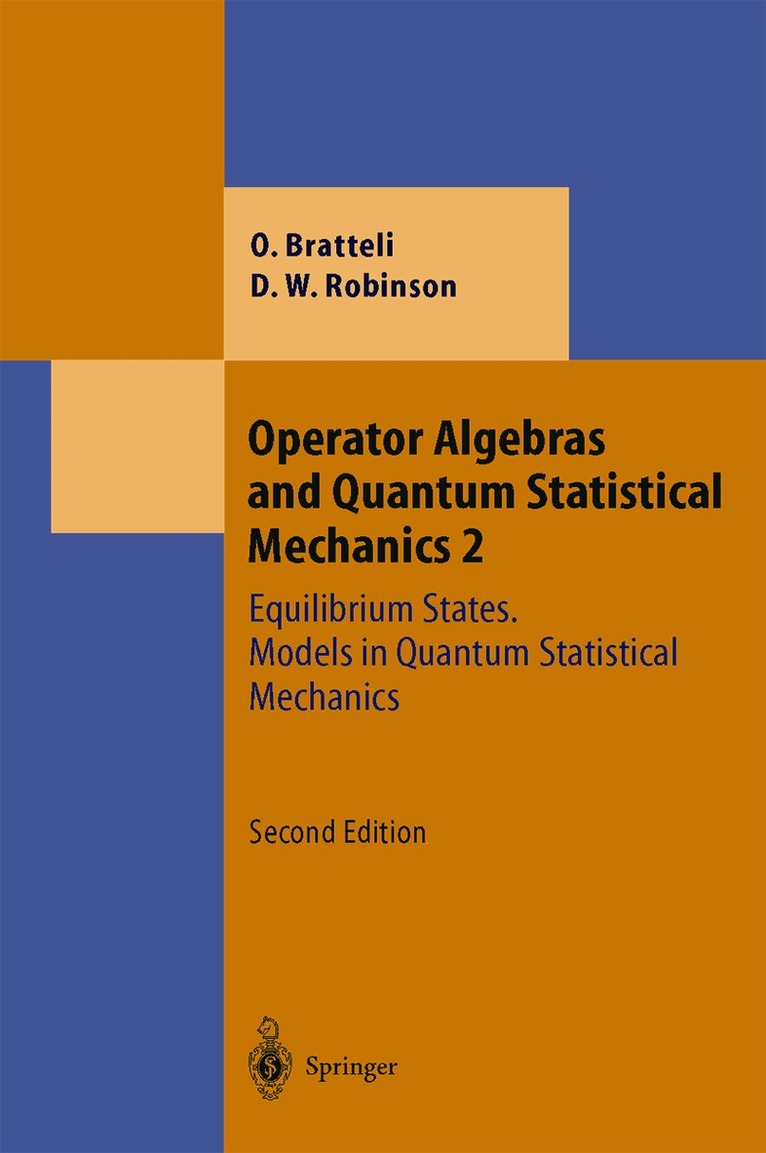
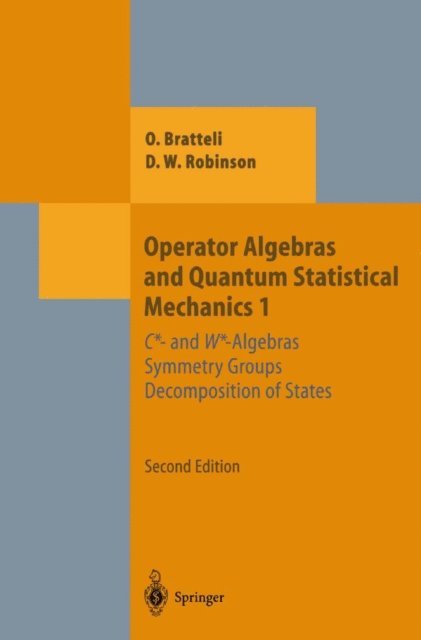
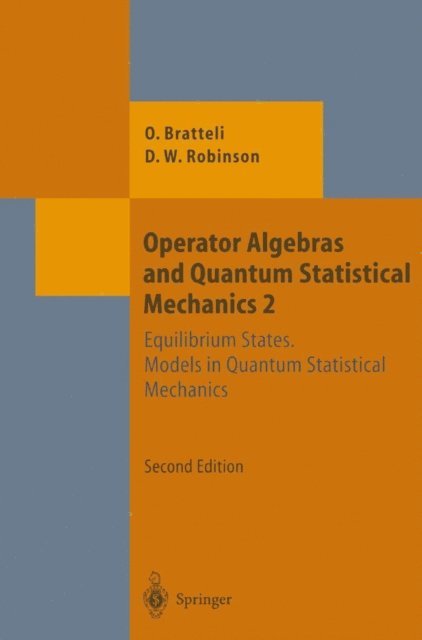
For almost two decades this has been the classical textbook on applications of operator algebra theory to quantum statistical physics. It describes the general structure of equilibrium states, the KMS-condition and stability, quantum spin systems and continuous systems.Major changes in the new edition relate to Bose--Einstein condensation, the dynamics of the X-Y model and questions on phase transitions. Notes and remarks have been considerably augmented.
Häftad, Engelska, 2010
3 046 kr
Skickas inom 10-15 vardagar
In this book we describe the elementary theory of operator algebras and parts of the advanced theory which are of relevance, or potentially of relevance, to mathematical physics. Subsequently we describe various applications to quantum statistical mechanics. At the outset of this project we intended to cover this material in one volume but in the course of develop ment it was realized that this would entail the omission ofvarious interesting topics or details. Consequently the book was split into two volumes, the first devoted to the general theory of operator algebras and the second to the applications. This splitting into theory and applications is conventional but somewhat arbitrary. In the last 15-20 years mathematical physicists have realized the importance of operator algebras and their states and automorphisms for problems of field theory and statistical mechanics. But the theory of 20 years aga was largely developed for the analysis of group representations and it was inadequate for many physical applications. Thus after a short honey moon period in which the new found tools of the extant theory were applied to the most amenable problems a longer and more interesting period ensued in which mathematical physicists were forced to redevelop the theory in relevant directions. New concepts were introduced, e. g. asymptotic abelian ness and KMS states, new techniques applied, e. g. the Choquet theory of barycentric decomposition for states, and new structural results obtained, e. g. the existence of a continuum of nonisomorphic type-three factors.
Del 1 - Abel Symposia
Operator Algebras
The Abel Symposium 2004
Häftad, Engelska, 2010
1 092 kr
Skickas inom 10-15 vardagar
The theme of this symposium was operator algebras in a wide sense. In the last 40 years operator algebras has developed from a rather special dis- pline within functional analysis to become a central ?eld in mathematics often described as “non-commutative geometry” (see for example the book “Non-Commutative Geometry” by the Fields medalist Alain Connes). It has branched out in several sub-disciplines and made contact with other subjects like for example mathematical physics, algebraic topology, geometry, dyn- ical systems, knot theory, ergodic theory, wavelets, representations of groups and quantum groups. Norway has a relatively strong group of researchers in the subject, which contributed to the award of the ?rst symposium in the series of Abel Symposia to this group. The contributions to this volume give a state-of-the-art account of some of these sub-disciplines and the variety of topics re?ect to some extent how the subject has branched out. We are happy that some of the top researchers in the ?eld were willing to contribute. The basic ?eld of operator algebras is classi?ed within mathematics as part of functional analysis. Functional analysis treats analysis on in?nite - mensional spaces by using topological concepts. A linear map between two such spaces is called an operator. Examples are di?erential and integral - erators. An important feature is that the composition of two operators is a non-commutative operation.
Häftad, Engelska, 2011
1 961 kr
Skickas inom 10-15 vardagar
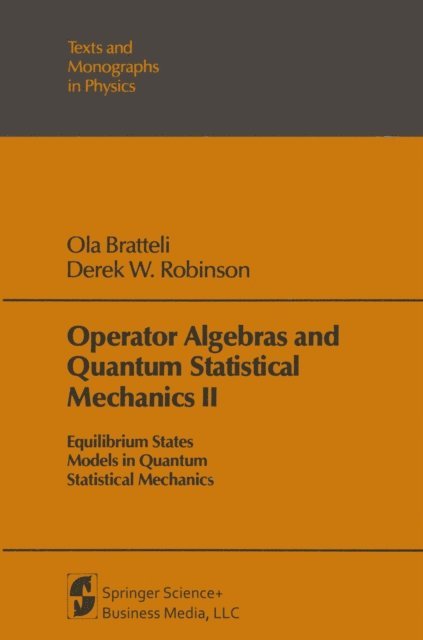
For almost two decades this has been the classical textbook on applications of operator algebra theory to quantum statistical physics. It describes the general structure of equilibrium states, the KMS-condition and stability, quantum spin systems and continuous systems.Major changes in the new edition relate to Bose--Einstein condensation, the dynamics of the X-Y model and questions on phase transitions. Notes and remarks have been considerably augmented.
E-bok
PDF, Engelska, 20121 140 kr
Läs direkt efter köp
In this book we describe the elementary theory of operator algebras and parts of the advanced theory which are of relevance, or potentially of relevance, to mathematical physics. Subsequently we describe various applications to quantum statistical mechanics. At the outset of this project we intended to cover this material in one volume but in the course of develop ment it was realized that this would entail the omission of various interesting topics or details. Consequently the book was split into two volumes, the first devoted to the general theory of operator algebras and the second to the applications. This splitting into theory and applications is conventional but somewhat arbitrary. In the last 15-20 years mathematical physicists have realized the importance of operator algebras and their states and automorphisms for problems offield theory and statistical mechanics. But the theory of 20 years ago was largely developed for the analysis of group representations and it was inadequate for many physical applications. Thus after a short honey moon period in which the new found tools of the extant theory were applied to the most amenable problems a longer and more interesting period ensued in which mathematical physicists were forced to redevelop the theory in relevant directions. New concepts were introduced, e. g. asymptotic abelian ness and KMS states, new techniques applied, e. g. the Choquet theory of barycentric decomposition for states, and new structural results obtained, e. g. the existence of a continuum of nonisomorphic type-three factors.
E-bok
PDF, Engelska, 20133 884 kr
Läs direkt efter köp
In this book we describe the elementary theory of operator algebras and parts of the advanced theory which are of relevance, or potentially of relevance, to mathematical physics. Subsequently we describe various applications to quantum statistical mechanics. At the outset of this project we intended to cover this material in one volume but in the course of develop ment it was realized that this would entail the omission ofvarious interesting topics or details. Consequently the book was split into two volumes, the first devoted to the general theory of operator algebras and the second to the applications. This splitting into theory and applications is conventional but somewhat arbitrary. In the last 15-20 years mathematical physicists have realized the importance of operator algebras and their states and automorphisms for problems of field theory and statistical mechanics. But the theory of 20 years aga was largely developed for the analysis of group representations and it was inadequate for many physical applications. Thus after a short honey moon period in which the new found tools of the extant theory were applied to the most amenable problems a longer and more interesting period ensued in which mathematical physicists were forced to redevelop the theory in relevant directions. New concepts were introduced, e. g. asymptotic abelian ness and KMS states, new techniques applied, e. g. the Choquet theory of barycentric decomposition for states, and new structural results obtained, e. g. the existence of a continuum of nonisomorphic type-three factors.
Engelska, 2013
625 kr
Skickas inom 5-8 vardagar
E-bok
PDF, Engelska, 20132 524 kr
Läs direkt efter köp
For almost two decades this has been the classical textbook on applications of operator algebra theory to quantum statistical physics. It describes the general structure of equilibrium states, the KMS-condition and stability, quantum spin systems and continuous systems.Major changes in the new edition relate to Bose--Einstein condensation, the dynamics of the X-Y model and questions on phase transitions. Notes and remarks have been considerably augmented.
E-bok
PDF, Engelska, 20131 100 kr
Läs direkt efter köp
In this chapter, and the following one, we examine various applications of C*-algebras and their states to statistical mechanics. Principally we analyze the structural properties of the equilibrium states of quantum systems con sisting of a large number of particles. In Chapter 1 we argued that this leads to the study of states of infinite-particle systems as an initial approximation. There are two approaches to this study which are to a large extent comple mentary. The first approach begins with the specific description of finite systems and their equilibrium states provided by quantum statistical mechanics. One then rephrases this description in an algebraic language which identifies the equilibrium states as states over a quasi-local C*-algebra generated by sub algebras corresponding to the observables of spatial subsystems. Finally, one attempts to calculate an approximation of these states by taking their limit as the volume of the system tends to infinity, the so-called thermodynamic limit. The infinite-volume equilibrium states obtained in this manner provide the data for the calculation of bulk properties of the matter under considera tion as functions of the thermodynamic variables. By this we mean properties such as the particle density, or specific heat, as functions of the temperature and chemical potential, etc. In fact, the infinite-volume data provides a much more detailed, even microscopic, description of the equilibrium phenomena although one is only generally interested in the bulk properties and their fluctuations.