Olafur Arnalds - Böcker
Visar alla böcker från författaren Olafur Arnalds. Handla med fri frakt och snabb leverans.
4 produkter
4 produkter
1 578 kr
Skickas inom 10-15 vardagar
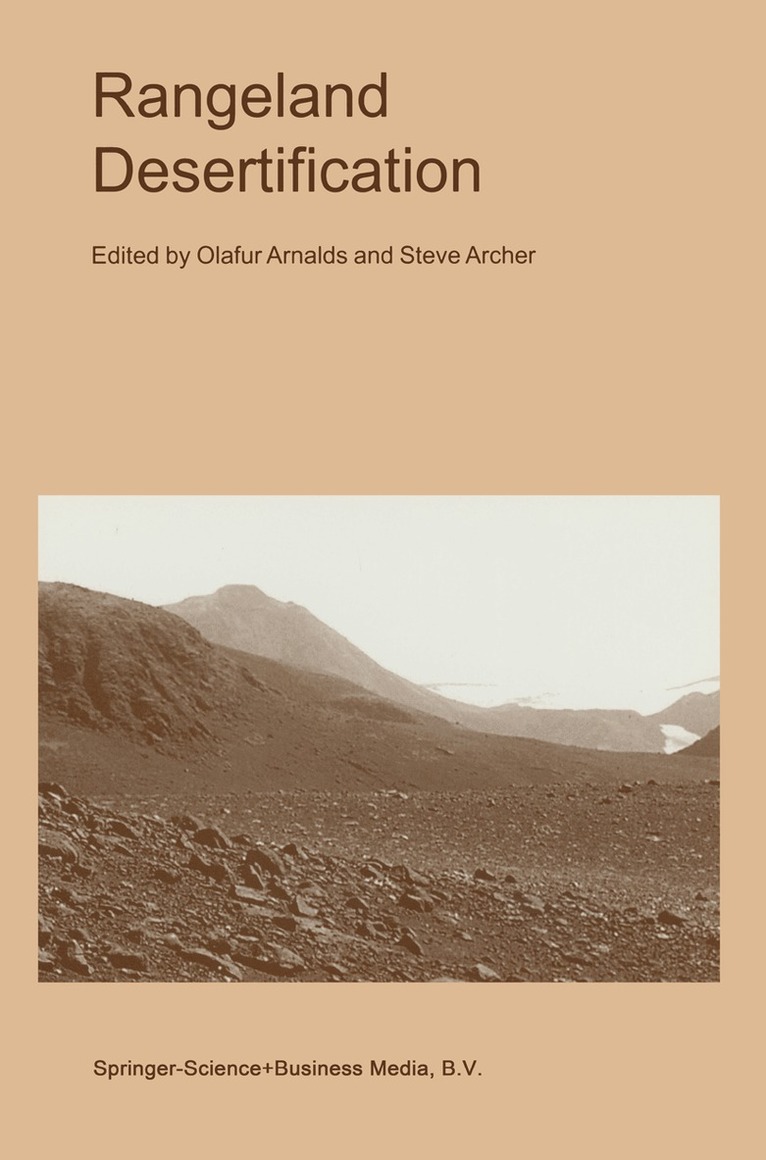
Desertification has occurred worldwide. The biophysical and socio-economic complexity of this phenomenon has challenged our ability to categorize, inventory, monitor and repair the condition of degraded lands. One of the most important distinctions to be made in relation to land degradation is between cultivated land used for annual crop production and "rangelands". Grazing by free-roaming livestock is the traditional primary use of the world's rangelands. However, there is growing recognition of the importance of these vast acreages for wildlife habitat, hydrology and ground water recharge, recreation and aesthetics. This text focuses on the desertification of rangelands and explores processes, problems and solutions. Chapters in the first section evaluate interactions between "natural" and human-induced disturbance regimes, thresholds, and non-linear change with respect to vegetation, hydrology, nutrients and erosion. Chapters in the second section examine socio-economic constraints and approaches for preventing and reversing degradation.
1 578 kr
Skickas inom 10-15 vardagar
Desertification has occurred worldwide. The biophysical and socio-economic complexity of this phenomenon has challenged our ability to categorize, inventory, monitor and repair the condition of degraded lands. One of the most important distinctions to be made in relation to land degradation is between cultivated land used for annual crop production and `rangelands'. Grazing by free-roaming livestock is the traditional primary use of the world's rangelands. However, there is growing recognition of the importance of these vast acreages for wildlife habitat, hydrology and ground water recharge, recreation and aesthetics. This text focuses on the desertification of rangelands and explores processes, problems and solutions. Chapters in the first section evaluate interactions between `natural' and human-induced disturbance regimes, thresholds, and non-linear change with respect to vegetation, hydrology, nutrients and erosion. Chapters in the second section examine socio-economic constraints and approaches for preventing and reversing degradation. The book provides a contemporary, process-oriented perspective on rangeland degradation of value to students, policy-makers and professionals alike.
1 064 kr
Skickas inom 10-15 vardagar
In this new volume in the World Soil series, the various types of Icelandic soils, their different characteristics, their formation, degradation and erosion are reviewed. At the same time, the book also deals with the agriculture and land use in general to give a complete view of Icelandic soils. The first part details the natural parameters such as the climate and the geography of Iceland. It also explains Icelandic geology, which is the major parameter controlling the soil formation in this country. The author describes the formation of Iceland, the main volcanic systems, central volcanoes, tephra production and its influence on the soils. Explanations on rocks, glaciers, rivers and other main geologic features are also given. The book continues with a description of the Icelandic geomorphology, giving insights on the main surface types, frost, cryoturbation and other cryogenic features. Then it details the different types of soils, their formation and main features, comparing the Icelandic soils to other soils elsewhere in the world. Erosion and land degradation are then reviewed, including the exceptionally active wind erosion and dust production. Finally, it gives an insight on land use, agriculture and vegetation types. All this accompanied by the most amazing photos to illustrate the great diversity of Icelandic Soil.
1 064 kr
Skickas inom 10-15 vardagar
In this new volume in the World Soil series, the various types of Icelandic soils, their different characteristics, their formation, degradation and erosion are reviewed. At the same time, the book also deals with the agriculture and land use in general to give a complete view of Icelandic soils. The first part details the natural parameters such as the climate and the geography of Iceland. It also explains Icelandic geology, which is the major parameter controlling the soil formation in this country. The author describes the formation of Iceland, the main volcanic systems, central volcanoes, tephra production and its influence on the soils. Explanations on rocks, glaciers, rivers and other main geologic features are also given. The book continues with a description of the Icelandic geomorphology, giving insights on the main surface types, frost, cryoturbation and other cryogenic features. Then it details the different types of soils, their formation and main features, comparing the Icelandic soils to other soils elsewhere in the world. Erosion and land degradation are then reviewed, including the exceptionally active wind erosion and dust production. Finally, it gives an insight on land use, agriculture and vegetation types. All this accompanied by the most amazing photos to illustrate the great diversity of Icelandic Soil.