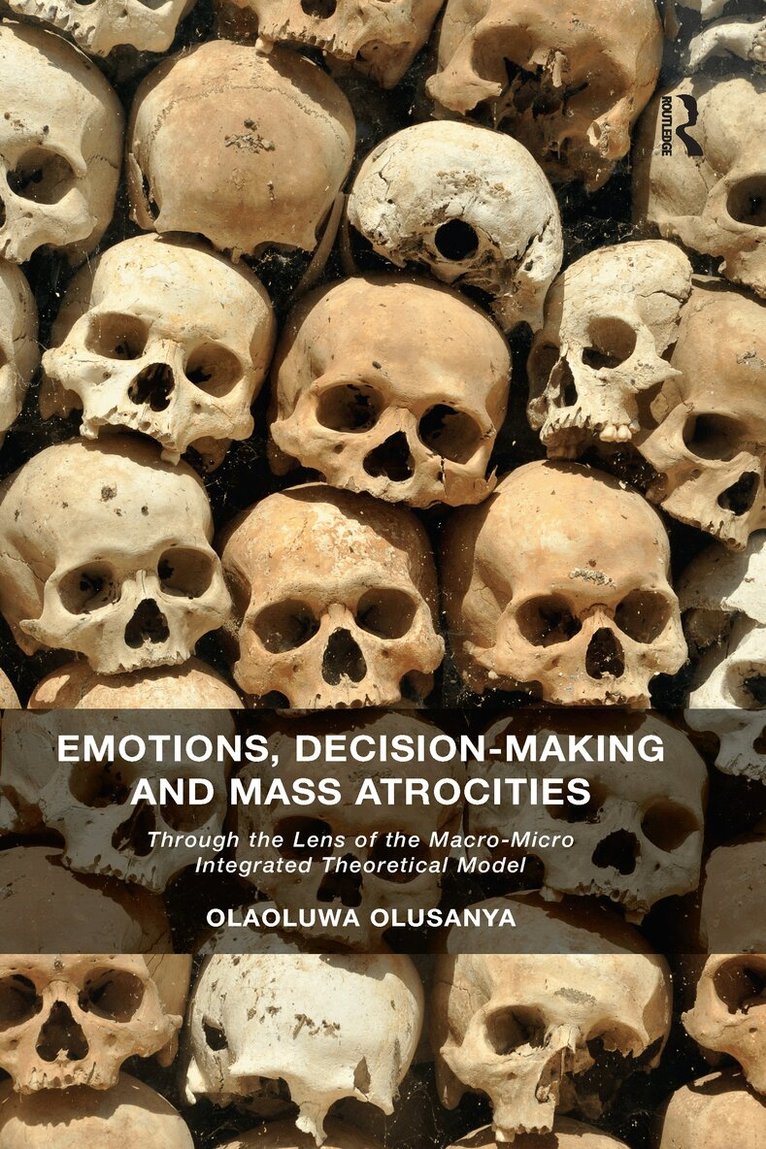
This book rehumanizes perpetrators of mass atrocities. At present a victim/perpetrator dichotomy appears to be the dominant paradigm: perpetrators have either been ’mechanistically dehumanized’, that is, perceived as unemotional, hard-hearted and conforming and thereby lacking the core features of human nature or alternatively, they have been ’animalistically dehumanized’. In other words they are seen as immoral, unintelligent, lacking self-control and likened to animals. Within sociology and criminology the dominant view is that genocide and other mass atrocities are committed by technologically-lobotomized perpetrators. Somehow the process of rationalization is believed to have transformed these people from emotionally healthy people into hollow soulless shells of human beings or zombies, devoid of a full range of normal emotions. These people are considered bereft of any ability to reason, think or feel, yet ambulant and able to respond to surrounding stimuli. However it is difficult to imagine crime (especially those involving a group of people working together for the duration of a particular criminal activity) without emotions. For instance, there is ample evidence suggesting that both crimes of passion and pre-meditated crimes involve emotional arousal. Furthermore, research in fields such as evolutionary biology, psychology and sociology of work and organizations suggest that emotions are essential for human progress and survival. In addition, emotions help us make the right call in risky and uncertain situations, in other words, the majority of real life situations. There is, therefore, a need to revisit existing assumptions around the role of emotions in mass atrocities.
This book deals with the identification of the aggressor state under International Law. This issue raises a deceptively easy question, that is, how does one distinguish the aggressor state from the victim state in situations involving the unilateral use of force? In a straightforward situation where state A attacks state B without any provocation, it is clear that state A is the aggressor. However, confusion begins to arise when state A first attacks state B as a form of ‘anticipatory’ self-defence; or when state A first attacks state B as a form of ‘pre-emptive’ self-defence; or when state A attacks state B in order to prevent state B from committing gross human rights atrocities against its own nationals. In all of these latter situations, the current rules are unclear and therefore either make it impossible to distinguish between the aggressor state and the victim state or give the aggressor state an unfair advantage over the victim state. This book utilizes general principles of Criminal Law in an attempt to tackle these questions and ultimately to devise a solution for distinguishing between the aggressor and the victim state regardless of the circumstances. Attention has also been given to the field of international relations.