Oliver Schlenkrich – författare
Visar alla böcker från författaren Oliver Schlenkrich. Handla med fri frakt och snabb leverans.
3 produkter
3 produkter
Häftad, Engelska, 2021
1 092 kr
Skickas inom 10-15 vardagar
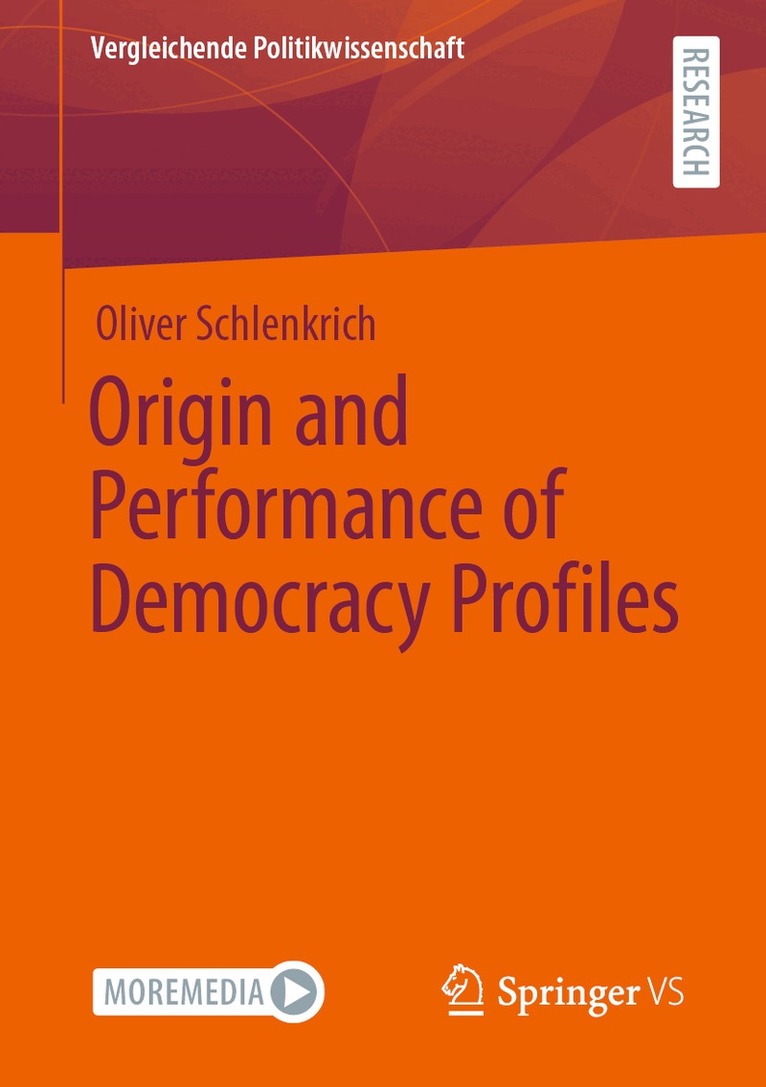
This study has two central research questions: Do democracy profiles affect policy performance? And what causes democracy profiles? Oliver Schlenkrich conceptualizes and measures different democracy profiles (e.g., libertarian-majoritarian or egalitarian-majoritarian democracies) based on trade-offs between the central democracy dimensions of political freedom, political equality, and political and legal control. In addition, the study conceptually and empirically develops a typology of political performance. Regarding the first research question, the empirical analyses of about 80 democracies from 1974 to 2017 indicate that there is not an overall better performing democracy profile. Thereby, the democracy profiles do not have an immediate effect, instead their effects require a longer period of time to manifest. With respect to the second research question, the empirical findings show that several structural and cultural factors are relevant (e.g., British heritage or a competitive culture). This work is mainly based on Bayesian statistics to cope with the complexity of the data and models.About the authorOliver Schlenkrich works currently on the DFG research project ‘Causes of Transformation and Democracy Profiles: Empirical Findings of the Democracy Matrix’ located at the Institute of Political Science and Sociology, University of Wuerzburg, Germany. His research interests concern democracy, political culture, political participation, quality of statehood, and quantitative methods.
E-bok
Engelska, 20211 379 kr
Läs direkt efter köp
This study has two central research questions: Do democracy profiles affect policy performance? And what causes democracy profiles? Oliver Schlenkrich conceptualizes and measures different democracy profiles (e.g., libertarian-majoritarian or egalitarian-majoritarian democracies) based on trade-offs between the central democracy dimensions of political freedom, political equality, and political and legal control. In addition, the study conceptually and empirically develops a typology of political performance. Regarding the first research question, the empirical analyses of about 80 democracies from 1974 to 2017 indicate that there is not an overall better performing democracy profile. Thereby, the democracy profiles do not have an immediate effect, instead their effects require a longer period of time to manifest. With respect to the second research question, the empirical findings show that several structural and cultural factors are relevant (e.g., British heritage or a competitive culture). This work is mainly based on Bayesian statistics to cope with the complexity of the data and models.About the authorOliver Schlenkrich works currently on the DFG research project ‘Causes of Transformation and Democracy Profiles: Empirical Findings of the Democracy Matrix’ located at the Institute of Political Science and Sociology, University of Wuerzburg, Germany. His research interests concern democracy, political culture, political participation, quality of statehood, and quantitative methods.
E-bok
PDF, Engelska, 2015249 kr
Läs direkt efter köp
The analysis of the relationship between center and periphery is one of many theoretical approaches found in all fields of the Humanities. Looking at this special relationship from several disciplinary perspectives is an effective methodology for establishing connections between various fields of study. Consequently, the issue contains articles dealing with, among others, the Russian enterprise in Alaska, German polar exploration, gender in Islamic contexts in Europe, labor relations, ''economic securitization'', cultural nationalism in Ghana, and Robert Rodriguez''s movie Machete. The historical perspective of cultural reception, the economic relationship between central and peripheral areas as well as the development of stereotypes as a consequence of the exchange between both areas are also part of the discussion.The first issue of Global Humanities therefore provides a broad outlook on the periphery-center relationship, giving the interested reader an insight into the different working fields of several disciplines within the Humanities. It furthermore can be considered an argument for strengthening interdisciplinary work in the future, highlighting the interconnectedness of history, literature, art, politics and many other disciplines.