Olivier Coutard - Böcker
Visar alla böcker från författaren Olivier Coutard. Handla med fri frakt och snabb leverans.
7 produkter
7 produkter
2 220 kr
Skickas inom 10-15 vardagar
This work examines the governance of large technical systems (LTS) at firm, imdustry and state levels and the interactions between the systems and society. In particular, international contributors explore the implications of major technological , economic and social changes during the last twenty years for traditional forms of LTS governance. Their research is centred around the following themes:* traditional forms of governance* new regulatory challenges* the governability of complex technologies* conceptual issues related to the governance of inter-organizational networks
2 558 kr
Skickas inom 10-15 vardagar
Considering sustainability in its economic, environmental and social contexts, the contributors take stock of previous research on large technical systems and discuss their sustainability from three main perspectives: uses, cities, and rules and institutions.
929 kr
Skickas inom 10-15 vardagar
Considering sustainability in its economic, environmental and social contexts, the contributors take stock of previous research on large technical systems and discuss their sustainability from three main perspectives: uses, cities, and rules and institutions.
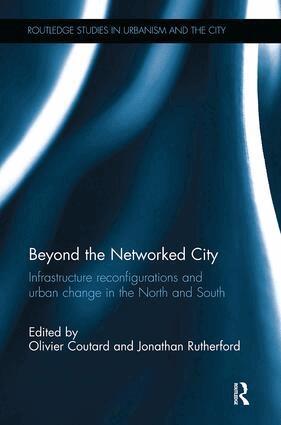
Beyond the Networked City
Infrastructure reconfigurations and urban change in the North and South
Häftad, Engelska, 2018
753 kr
Skickas inom 10-15 vardagar
Cities around the world are undergoing profound changes. In this global era, we live in a world of rising knowledge economies, digital technologies, and awareness of environmental issues. The so-called "modern infrastructural ideal" of spatially and socially ubiquitous centrally-governed infrastructures providing exclusive, homogeneous services over extensive areas, has been the standard of reference for the provision of basic essential services, such as water and energy supply. This book argues that, after decades of undisputed domination, this ideal is being increasingly questioned and that the network ideology that supports it may be waning.In order to begin exploring the highly diverse, fluid and unstable landscapes emerging beyond the networked city, this book identifies dynamics through which a ‘break’ with previous configurations has been operated, and new brittle zones of socio-technical controversy through which urban infrastructure (and its wider meaning) are being negotiated and fought over. It uncovers, across a diverse set of urban contexts, new ways in which processes of urbanization and infrastructure production are being combined with crucial sociopolitical implications: through shifting political economies of infrastructure which rework resource distribution and value creation; through new infrastructural spaces and territorialities which rebundle socio-technical systems for particular interests and claims; and through changing offsets between individual and collective appropriation, experience and mobilization of infrastructure.With contributions from leading authorities in the field and drawing on theoretical advances and original empirical material, this book is a major contribution to an ongoing infrastructural turn in urban studies, and will be of interest to all those concerned by the diverse forms and contested outcomes of contemporary urban change across North and South.
Beyond the Networked City
Infrastructure reconfigurations and urban change in the North and South
Inbunden, Engelska, 2015
2 088 kr
Skickas inom 10-15 vardagar
Cities around the world are undergoing profound changes. In this global era, we live in a world of rising knowledge economies, digital technologies, and awareness of environmental issues. The so-called "modern infrastructural ideal" of spatially and socially ubiquitous centrally-governed infrastructures providing exclusive, homogeneous services over extensive areas, has been the standard of reference for the provision of basic essential services, such as water and energy supply. This book argues that, after decades of undisputed domination, this ideal is being increasingly questioned and that the network ideology that supports it may be waning.In order to begin exploring the highly diverse, fluid and unstable landscapes emerging beyond the networked city, this book identifies dynamics through which a ‘break’ with previous configurations has been operated, and new brittle zones of socio-technical controversy through which urban infrastructure (and its wider meaning) are being negotiated and fought over. It uncovers, across a diverse set of urban contexts, new ways in which processes of urbanization and infrastructure production are being combined with crucial sociopolitical implications: through shifting political economies of infrastructure which rework resource distribution and value creation; through new infrastructural spaces and territorialities which rebundle socio-technical systems for particular interests and claims; and through changing offsets between individual and collective appropriation, experience and mobilization of infrastructure.With contributions from leading authorities in the field and drawing on theoretical advances and original empirical material, this book is a major contribution to an ongoing infrastructural turn in urban studies, and will be of interest to all those concerned by the diverse forms and contested outcomes of contemporary urban change across North and South.
1 721 kr
Skickas inom 7-10 vardagar
In recent years, interest for local energy production, supply and consumption has increased in academic and public debates. In particular, contemporary energy transition discourses and strategies often emphasize the search for increased local energy autonomy, a phrase which can refer to a diverse range of configurations, both in terms of the spaces and scales of the local territory considered and in terms of what is meant by energy autonomy. This book explores policies, projects and processes aimed at increased local energy autonomy, with a particular focus on their spatial, infrastructural and political dimensions. In doing so, the authors – Sabine Barles, Bruno Barroca, Guilhem Blanchard, Benoit Boutaud, Arwen Colell, Gilles Debizet, Ariane Debourdeau, Laure Dobigny, Florian Dupont, Zélia Hampikian, Sylvy Jaglin, Allan Jones, Raphael Ménard, Alain Nadaï, Angela Pohlmann, Cyril Roger-Lacan, Eric Vidalenc – improve our understanding of the always partial and controversial processes of energy relocation that articulate forms of local metabolic self-sufficiency, socio-technical decentralization and political empowerment. Comprising fifteen chapters, the book is divided into four parts: Governance and Actors; Urban Projects and Energy Systems; Energy Communities; and The Challenges of Energy Autonomy.
3 754 kr
Skickas inom 7-10 vardagar
Contributing towards a thriving research area, this comprehensive Handbook presents a thorough discussion of infrastructure as a social phenomenon. It compiles diverse perspectives to delineate the current ‘infrastructural turn’ and assess policy and research challenges relating to contemporary forms of infrastructural development.Providing cutting-edge insights into the field, the Handbook explores the analytical category of infrastructure, clarifying and expanding upon the importance of an infrastructural perspective within academic and policy debates. An interdisciplinary range of contributors provides an ambitious examination of infrastructures and cities, with chapters covering the transformations of traditional networked infrastructure systems; novel understandings of how infrastructures matter; socio-technical processes of infrastructuring; forms of social violence involving infrastructural developments; and the role of infrastructures in human pressures on the biosphere. Ultimately, this Handbook proposes directions for further infrastructure research, highlighting its relevance in a shifting socio-political landscape.The Handbook of Infrastructures and Cities provides valuable insight for scholars of urban studies, urban sociology, human geography, planning and regional studies. It will also prove to be a vital reference point for academics and policy-makers seeking to progress social equality and challenge current structural obstacles to the advent of more sustainable infrastructures.