
Orlando Fals-Borda – författare
Visar alla böcker från författaren . Handla med fri frakt och snabb leverans.
3 produkter
3 produkter
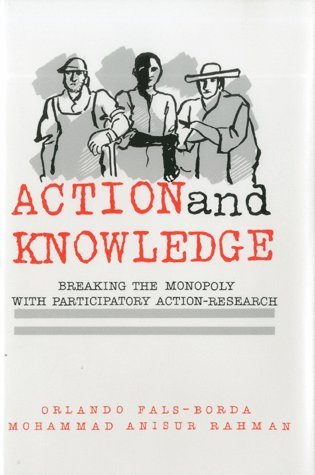
Inbunden, Engelska, 1991
792 kr
Skickas inom 10-15 vardagar
Action and Knowledge draws on twenty years of experience with the techniques and philosophy of Participatory Action-Research (PAR). PAR is an innovative approach to economic and social change, which goes beyond usual institutional boundaries in development by actively involving the people in generating knowledge about their own condition and how it can be changed. PAR requires a strong commitment by participating social scientists to deprofessionalize their expertise and share it with the people, while recognizing that the communities directly involved have the critical voice in determining the direction and goals of change as subjects rather than objects. PAR has its origins in the work of Third World social scientists more than three decades ago as they brought new ways to empower the oppressed by helping them to acquire reliable knowledge on which to construct countervailing power. It has since spread throughout the world, as reflected in this book with contributions from Asia, Africa Latin America and North America in the form of case studies of actual experience with the PAR approach. PAR is not static and fixed but dynamic and enduring, as the case studies and the theoretical chapters that precede and follow the case studies amply reveal.
Häftad, Engelska, 1998
332 kr
Skickas inom 5-8 vardagar
E-bok
PDF, Spanska, 201093 kr
Läs direkt efter köp
Esta antología es un homenaje a la Obra del maestro Orlando Fals Borda. Se trata de una selección de textos representativos de los grandes temas y problemas que formaron el objeto de sus rigurosos trabajos de investigación científica a lo largo de su vida. Son ponencias, monografías, artículos para revistas, conferencias, prólogos y manifiestos, en los cuales hace un ejercicio de divulgación de sus propias ideas para diferentes públicos. La antología está organizada en tres partes cronológicas, marcadas por un punto de partida y un punto de llegada clave en la vida académica y política del maestro. La primera parte (1950-1970) se inicia con los escritos en medio de la Maestría en Sociología de la Universidad de Minnesota. Termina en el United Nations Research Institute for Social Development (UNRISD), en Ginebra, con la edición de los materiales de campo sobre la investigación que dirigió en Venezuela, Ecuador y Colombia sobre las Instituciones Rurales y el Cambio Dirigido. La segunda parte (1971-1990) empieza por su regreso a Colombia y su trabajo de investigación-acción con los campesinos de la ANUC en el departamento de Córdoba. Finaliza con el ingreso al IEPRI (1987) y su preparación para intervenir en las elecciones de la Asamblea Constituyente. La tercera parte (1991-2008) comienza por su muy destacada intervención en la Asamblea Nacional Constituyente, sobre temas neurálgicos para la nueva Constitución de Colombia, y termina con su muerte.