Osamu Sawada - Böcker
Visar alla böcker från författaren Osamu Sawada. Handla med fri frakt och snabb leverans.
3 produkter
3 produkter
Del 69 - Oxford Studies in Theoretical Linguistics
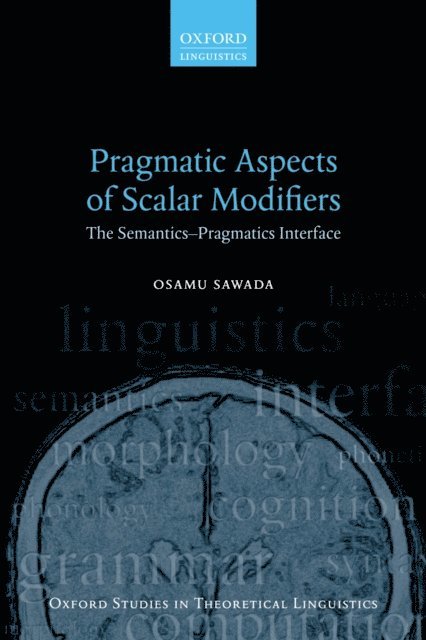
Pragmatic Aspects of Scalar Modifiers
The Semantics-Pragmatics Interface
Inbunden, Engelska, 2017
2 014 kr
Skickas inom 3-6 vardagar
This volume examines the meaning of scalar modifiers - expressions such as more than, a bit, and much - from the standpoint of the interface between semantics and pragmatics. In natural language, scalar expressions such as comparatives, intensifiers, and minimizers are used for measuring an object or event at a semantic level. However, cross-linguistically scalar modifiers can often be used to express a range of subjective feelings or discourse pragmatic information at the level of conventional implicature (CI). For example, in English more than anything can signal the degree of importance of the given utterance, and in Japanese the minimizer chotto 'a bit' can weaken the degree of imposition of the speech act. In this book, Osamu Sawada draws on data from Japanese and a range of other languages to explore the dual-use phenomenon of scalar modifiers: he claims that although semantic scalar meanings and CI scalar meanings are logically different, the relationship between the two makes it crucial to examine them both together.The volume provides a new perspective on the semantic-pragmatics interface, and will be of interest to researchers and students of Japanese linguistics, semantics and pragmatics, and theoretical linguistics more generally.
Del 69 - Oxford Studies in Theoretical Linguistics
Pragmatic Aspects of Scalar Modifiers
The Semantics-Pragmatics Interface
Häftad, Engelska, 2017
626 kr
Skickas inom 7-10 vardagar
This volume examines the meaning of scalar modifiers - expressions such as more than, a bit, and much - from the standpoint of the interface between semantics and pragmatics. In natural language, scalar expressions such as comparatives, intensifiers, and minimizers are used for measuring an object or event at a semantic level. However, cross-linguistically scalar modifiers can often be used to express a range of subjective feelings or discourse pragmatic information at the level of conventional implicature (CI). For example, in English more than anything can signal the degree of importance of the given utterance, and in Japanese the minimizer chotto 'a bit' can weaken the degree of imposition of the speech act. In this book, Osamu Sawada draws on data from Japanese and a range of other languages to explore the dual-use phenomenon of scalar modifiers: he claims that although semantic scalar meanings and CI scalar meanings are logically different, the relationship between the two makes it crucial to examine them both together.The volume provides a new perspective on the semantic-pragmatics interface, and will be of interest to researchers and students of Japanese linguistics, semantics and pragmatics, and theoretical linguistics more generally.
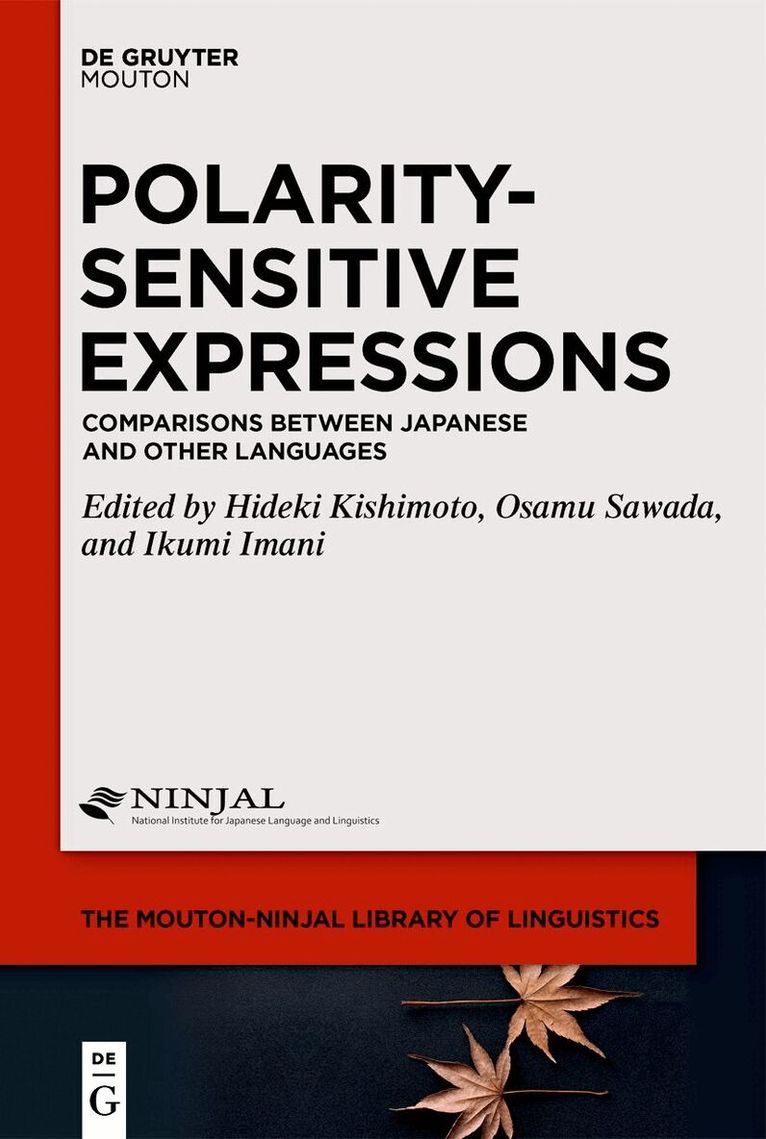
Polarity-Sensitive Expressions
Comparisons Between Japanese and Other Languages
Inbunden, Engelska, 2023
1 610 kr
Skickas inom 5-8 vardagar
Polarity (positive, negative) is one of the most fundamental concepts in the system of language and there are many expressions that are sensitive to polarity. For example, any in English and wh-mo in Japanese appear in negative contexts, but not in positive contexts. While previous studies have shown that polarity-sensitive expressions are a general phenomenon in languages, it has also become clear that there are variations in polarity-sensitive expressions. This volume explores the variations in polarity-sensitive expressions through comparisons between Japanese and other languages, such as English, German, Spanish, and Old Japanese, and examines the environments and contexts in which polarity-sensitive expressions occur, as well as the types of (cross-linguistic) variation allowed. The value of the present volume lies in its inclusion of research papers inquiring into various types of polarity-sensitive expressions, such as negative-, positive-, and discourse-sensitive polarity items as well as their variations. The research indicates new directions for the study of polarity-sensitive expressions in the fields of syntax, semantics, pragmatics, historical linguistics, corpus linguistics and psycholinguistics.