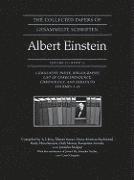
This index volume provides quick access to the most authoritative compilation of documents and information concerning Einstein's work and correspondence for the first half of his life. It offers readers a Cumulative Index to the first ten volumes of the collected papers, the first complete bibliography of Einstein's scientific and nonscientific writings until 1921, and a succinct biographical time line. This volume is an invaluable research tool for delving into Einstein's written legacy; his interactions with colleagues, institutions, friends, and family; and his scientific, political, educational, and social activities. Volume 11 presents three important and unique bibliographies: the List of Writings, 1891-1921; the Einstein Bibliography, 1901-1921; and a Cumulative Bibliography and Index of Citations for Volumes 1-10. The List of Writings includes all of Einstein's manuscripts that remained unpublished by 1921, while the Einstein Bibliography includes documents that were republished during this period. The Cumulative Bibliography and Index of Citations lists all literature written by authors cited in at least one of the first ten volumes of the series.This volume also contains two complete lists of Einstein's correspondence up through 1920, and a Chronology of Einstein's life for the years 1879-1921. The first list presents the correspondence in chronological order, while the second list presents the correspondence in alphabetical order by correspondent. The indexes and bibliographies implicitly correct inconsistencies and errata across the different volumes. Other corrections are explicitly collected in a List of Errata for the first ten volumes of the series.
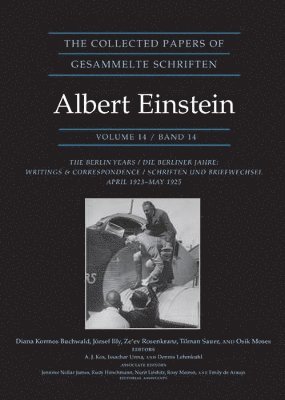
The more than one thousand letters and several dozen writings included in this volume cover the years immediately before the final formulation of new quantum mechanics. The discovery of the Compton effect in 1923 vindicates Einstein's light quantum hypothesis. Niels Bohr still criticizes Einstein's conception of light quanta and advances an alternative theory, but Walther Bothe and Hans Geiger perform a difficult experiment that decides in favor of Einstein's theory. At the same time, Satyendranath Bose sends a new quantum theoretical derivation of Planck's law to Einstein and he discovers what is now known as Bose-Einstein condensation. Einstein attempts to reformulate a unified theory of the gravitational and electromagnetic fields. In early November 1923, Einstein flees overnight to the Netherlands in the wake of threats on his life and anti-Semitic rioting in Berlin. He rejoins the International Committee on Intellectual Cooperation in June 1924, and supports the idea of a European union. He joins the board of governors of Hebrew University, which opens in April 1925, and celebrates the event in Buenos Aires while on a seven-week lecture tour of Argentina, Uruguay, and Brazil.During this period, he delivers lectures, meets with heads of state, visits major institutions, and attends receptions hosted by the local Jewish and German communities. He has a serious, but short-lived, falling out with his son Hans Albert and his first wife Mileva Maric-Einstein over how to invest part of the Nobel Prize money and he rescues his sister Maja and her husband from debt on their house. Einstein has a fourteen-month romantic relationship with his secretary, Betty Neumann, which he ends in October 1924.
In the almost one hundred writings and more than one thousand letters included in this volume, Einstein is revealed yet again as the consummate puzzler of myriad scientific problems as well as the invested participant in social and political engagements. He continues to explore the light quantum, whose reality is confirmed by new experiments, and to attempt to formulate a unified theory of gravitation and electromagnetism. He travels to South America, where he lectures widely on relativity, rejoins the International Committee on Intellectual Cooperation, and supports the idea of a European union. Einstein has a fourteen-month romantic relationship with his secretary, Betty Neumann, which ends in October 1924.