Ostman Jan-Ola Ostman – författare
Visar alla böcker från författaren Ostman Jan-Ola Ostman. Handla med fri frakt och snabb leverans.
22 produkter
22 produkter
E-bok
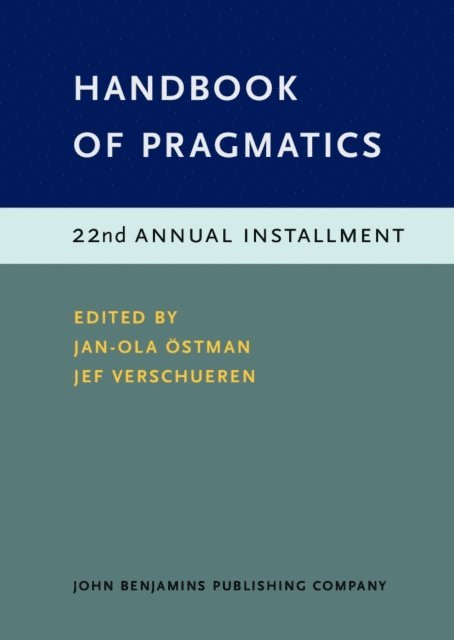
Engelska, 20221 305 kr
Läs direkt efter köp
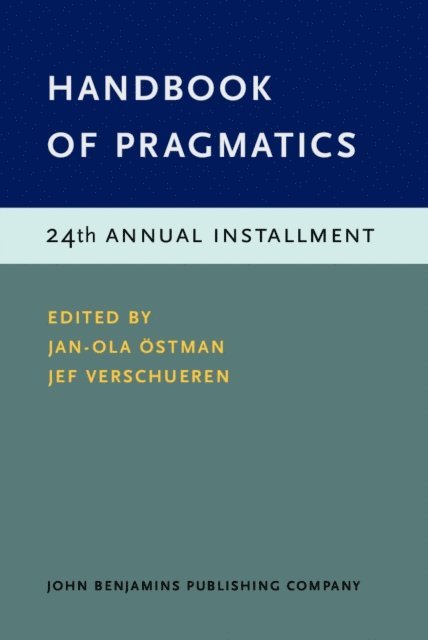
This encyclopaedia of one of the major fields of language studies is a continuously updated source of state-of-the-art information for anyone interested in language use. The IPrA Handbook of Pragmatics provides easy access - for scholars with widely divergent backgrounds but with convergent interests in the use and functioning of language - to the different topics, traditions and methods which together make up the field of pragmatics, broadly conceived as the cognitive, social and cultural study of language and communication, i.e. the science of language use. The Handbook of Pragmatics is a unique reference work for researchers, which has been expanded and updated continuously with annual installments since 1995.Also available as Online Resource: https://benjamins.com/online/hop
E-bok
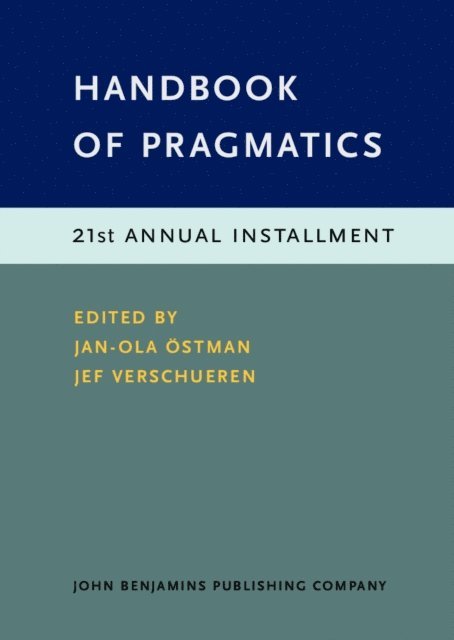
Engelska, 20231 447 kr
Läs direkt efter köp
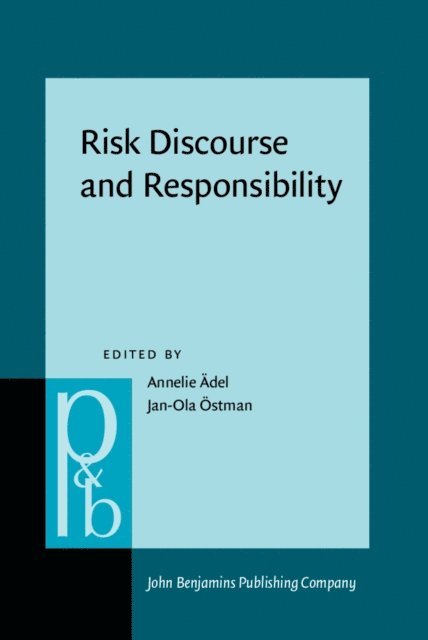
The widespread view that risk is highly relevant in late modern societies has also meant that the very study of risk has become central in many areas of social studies. The key aim of this book is to establish Risk Discourse as a field of research of its own in language studies. Risk Discourse is introduced as a field that not only targets elements of risk, safety and security, but crucially requires aspects of responsibility for in-depth analysis. Providing a rich illustration of ways in which risk and responsibility can serve as analytical tools, the volume brings together scholars from different disciplines within the study of language. An Introduction and an Epilogue highlight the intricate relationship between risk and responsibility. Part 1 deals with expert and lay perspectives on risk; Part 2 with emerging genres for risk discourse; Part 3 with risk and technology and Part 4 with ways of managing risk. The topics covered – such as COVID-19, nuclear energy, machine translation, terrorism – are socially pertinent and timely.
E-bok
Engelska, 20223 302 kr
Läs direkt efter köp
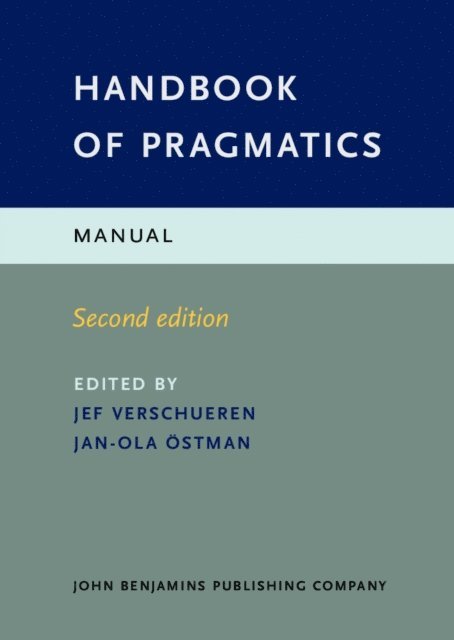
The Manual section of the Handbook of Pragmatics, produced under the auspices of the International Pragmatics Association (IPrA), is a collection of articles describing traditions, methods, and notational systems relevant to the field of linguistic pragmatics; the main body of the Handbook contains all topical articles. The first edition of the Manual was published in 1995. This second edition includes a large number of new traditions and methods articles from the 24 annual installments of the Handbook that have been published so far. It also includes revised versions of some of the entries in the first edition. In addition, a cumulative index provides cross-references to related topical entries in the annual installments of the Handbook and the Handbook of Pragmatics Online (at https://benjamins.com/online/hop/), which continues to be updated and expanded. This second edition of the Manual is intended to facilitate access to the most comprehensive resource available today for any scholar interested in pragmatics as defined by the International Pragmatics Association: “the science of language use, in its widest interdisciplinary sense as a functional (i.e. cognitive, social, and cultural) perspective on language and communication.”
E-bok
Engelska, 20201 305 kr
Läs direkt efter köp
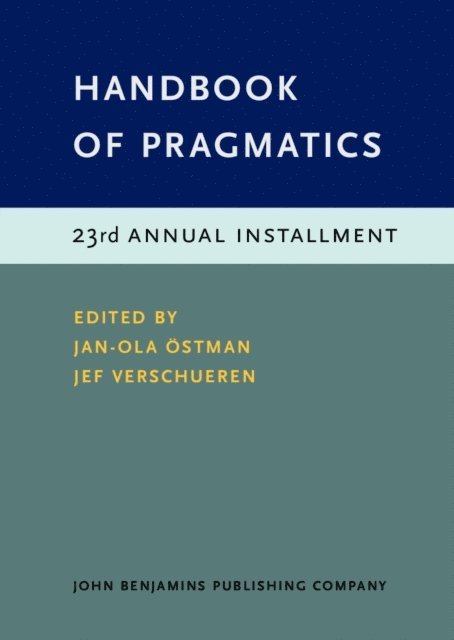
This encyclopaedia of one of the major fields of language studies is a continuously updated source of state-of-the-art information for anyone interested in language use. The IPrA Handbook of Pragmatics provides easy access - for scholars with widely divergent backgrounds but with convergent interests in the use and functioning of language - to the different topics, traditions and methods which together make up the field of pragmatics, broadly conceived as the cognitive, social and cultural study of language and communication, i.e. the science of language use. The Handbook of Pragmatics is a unique reference work for researchers, which has been expanded and updated continuously with annual installments since 1995.Also available as Online Resource: https://benjamins.com/online/hop
E-bok
Engelska, 20191 305 kr
Läs direkt efter köp
This encyclopaedia of one of the major fields of language studies is a continuously updated source of state-of-the-art information for anyone interested in language use. The IPrA Handbook of Pragmatics provides easy access - for scholars with widely divergent backgrounds but with convergent interests in the use and functioning of language - to the different topics, traditions and methods which together make up the field of pragmatics, broadly conceived as the cognitive, social and cultural study of language and communication, i.e. the science of language use. The Handbook of Pragmatics is a unique reference work for researchers, which has been expanded and updated continuously with annual installments since 1995.Also available as Online Resource: https://benjamins.com/online/hop
E-bok
Engelska, 20181 305 kr
Läs direkt efter köp
This encyclopaedia of one of the major fields of language studies is a continuously updated source of state-of-the-art information for anyone interested in language use. The IPrA Handbook of Pragmatics provides easy access - for scholars with widely divergent backgrounds but with convergent interests in the use and functioning of language - to the different topics, traditions and methods which together make up the field of pragmatics, broadly conceived as the cognitive, social and cultural study of language and communication, i.e. the science of language use. The Handbook of Pragmatics is a unique reference work for researchers, which has been expanded and updated continuously with annual installments since 1995. Also available as Online Resource: https://benjamins.com/online/hop
E-bok
Engelska, 20171 258 kr
Läs direkt efter köp
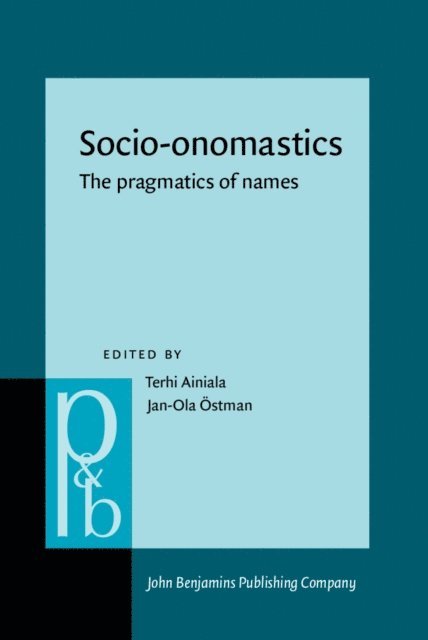
The volume seeks to establish socio-onomastics as a field of linguistic inquiry not only within sociolinguistics, but also, and in particular, within pragmatics. The linguistic study of names has a very long history, but also a history sometimes fraught with skepticism, and thus often neglected by linguists in other fields. The volume takes on the challenge of instituting onomastic study into linguistics and pragmatics by focusing on recent trends within socio-onomastics, interactional onomastics, contact onomastics, folk onomastics, and linguistic landscape studies. The volume is an introduction to these fields - with the introductory chapter giving an overview of, and an update on, recent onomastic study - and in addition offers detailed in-depth analyses of place names, person names, street names and commercial names from different perspectives: historically, as well as from the point of view of the impact of globalization and glocalization. All the chapters focus on the use and function of names and naming, on changes in name usage, and on the reasons for, processes in, and results of names in contact.
E-bok
PDF, Engelska, 20161 195 kr
Läs direkt efter köp
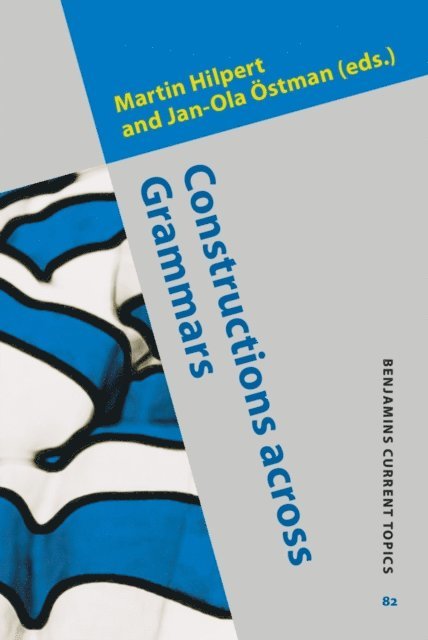
Up to now, most research in Construction Grammar has focused on single languages, most notably English. This volume aims to broaden the scope of Construction Grammar towards issues in bi- and multilingualism, second language learning, and generalizations across different languages and language varieties. The contributions in this volume show that speakers entertain generalizations across their repertoire of languages, which holds important implications for a multilingual Construction Grammar. Originally published in Constructions and Frames 6:2 (2014).
E-bok
PDF, Engelska, 20121 305 kr
Läs direkt efter köp
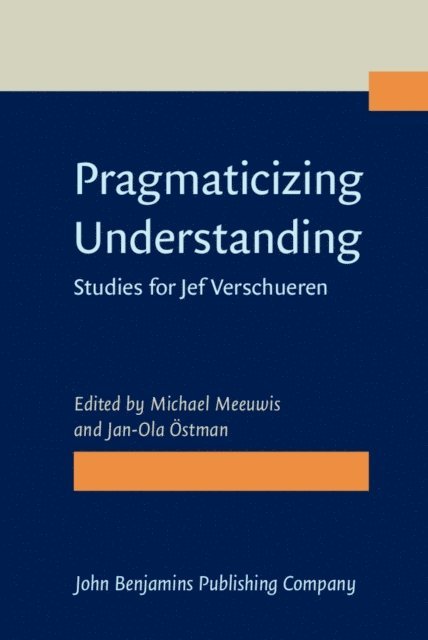
The ideas that mark modern-day pragmatics are old, but did not start to get more systematically developed until the 1960s and 1970s. Still, the very recognition of pragmatics as a self-standing academic discipline is a product of the 1980s, not least made possible by the establishment of the International Pragmatics Association. One scholar in particular has devoted his life both to IPrA and to the discipline.This volume pays homage to Jef Verschueren on the occasion of his 60th birthday. It celebrates him for his long-standing dedication as Secretary General of IPrA and for his scholarly contributions to the field. We owe to Jef Verschueren the insight that the processes through which language users (do or do not) achieve understanding among each other in communication can only be fully comprehended if approached from a pragmatic perspective, i.e. if understanding is pragmaticized. The chapters in this book are written by scholars who, like Jef Verschueren, have played a key role in the genesis and development of the field, and who still actively contribute to its advancement today. Each author looks back, evaluates the present, and takes on new challenges.
E-bok
PDF, Engelska, 1981897 kr
Läs direkt efter köp
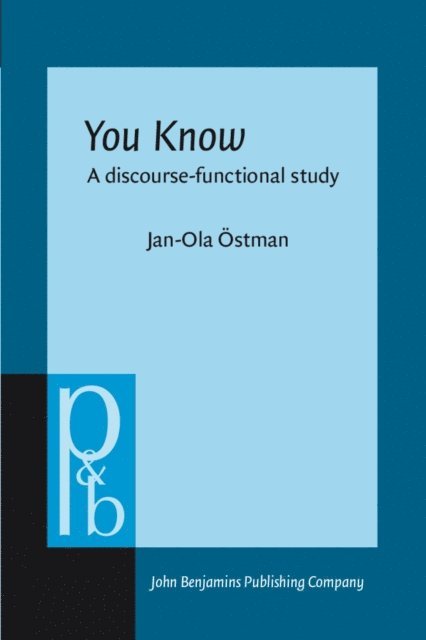
The basic function the expression you know serves in conversational discourse is said to be that of a pragmatic particle used when the speaker wants the addressee to accept as mutual knowledge (or at least be cooperative with respect to) the propositional content of his utterance. The fact that you know is even used when the addressee is assumed not to know what the speaker is talking about, suggests that it functions at the deference level of politeness, as a striving towards attaining a camaraderie relationship between speaker and hearer. You know is found to be more often used by women than by men in spontaneous conversation, and the manner in which it is used is significantly different from male usage. Ontogenetically, the age of four seems to be crucial for initial steps to use and master pragmatic particles including you know. Data for the study were derived from tape-recorded conversations and interviews.
E-bok
PDF, Engelska, 2011519 kr
Läs direkt efter köp
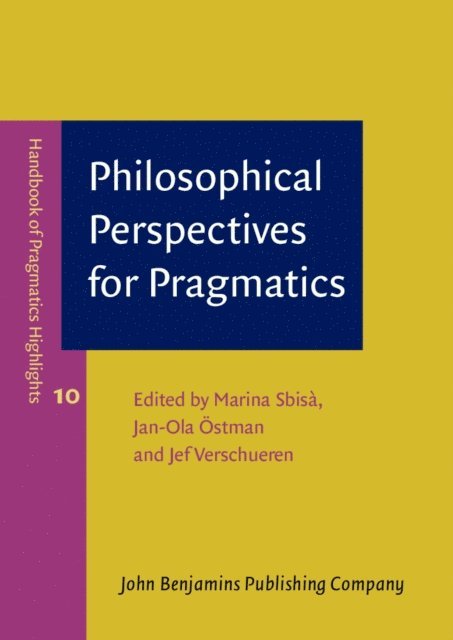
The ten volumes of Handbook of Pragmatics Highlights focus on the most salient topics in the field of pragmatics, thus dividing its wide interdisciplinary spectrum in a transparent and manageable way. While the other volumes select specific cognitive, grammatical, social, cultural, variational, interactional, or discursive angles, this 10th volume focuses on the interface between pragmatics and philosophy and reviews the philosophical background from which pragmatics has taken inspiration and with which it is constantly confronted. It provides the reader with information about authors relevant to the development of pragmatics, trends or areas in philosophy that are relevant for the definition of the main concepts in pragmatics or the characterization of its cultural context, the neighbouring field of semantics (with particular respect to truth-conditional semantics and some main branches of formal semantics), and recent philosophical debates that involve pragmatic notions such as indexicality and context. While most of the references are to the analytic philosophical field, also perspectives in so-called continental philosophy are taken into account. The introductory chapter outlines some unifying routes of reflection as regards meaning, speech as action, and self and mind, and suggests some connections between doing pragmatics and doing philosophy.
E-bok
PDF, Engelska, 2011519 kr
Läs direkt efter köp
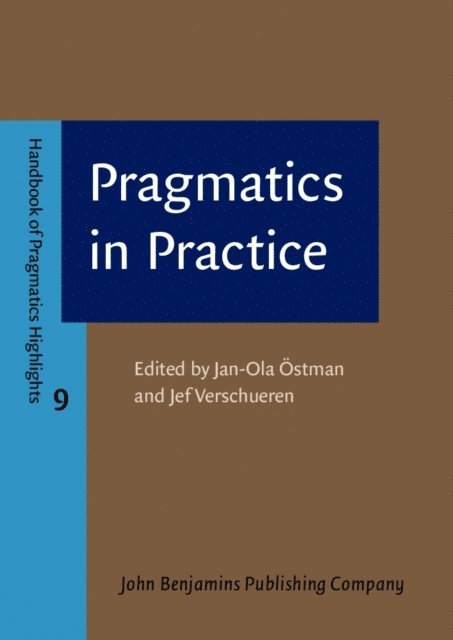
The ten volumes of Handbook of Pragmatics Highlights focus on the most salient topics in the field of pragmatics, thereby attempting to divide up its wide interdisciplinary spectrum in a transparent and manageable way. While the other volumes select specific philosophical, cognitive, grammatical, social, cultural, discursive, variational, or interactional angles, this 9th volume focuses on what pragmatics is good for – beyond the very discipline of pragmatics as such. The chapters in the volume thus address the importance of taking a pragmatic perspective on traditional fields of applied linguistics (contrastive and error analysis, translation), and they address the core of pragmatics as the study of language use (with phenomena ranging from irony and emphasis to literacy and mass media, and with approaches to the function of language like rhetoric, stylistics, corpus analysis, and general semantics). The volume contains chapters not only on the spoken and written modes of communication, but also on signed language pragmatics and on computer-mediated communication. The impact and usefulness of taking a pragmatic perspective on language for a deeper understanding of clinical and rehabilitation practices has recently received ever more focus; in this volume, aspects of this direction of research are dealt with in the chapter on clinical pragmatics. In most of the chapters in the volume, ethics has a core role to play, not only in issues of authenticity in general in relation to research on language use, but also in issues that have a direct influence on the (linguistic) culture and society we live in, irrespective of whether we are part of a (linguistic) majority or a minority, or a minority within a minority: language policy and language planning, language ecology, and language in relation to legal matters. In all of these fields, we see the importance of research within pragmatics as a discipline dealing with how language influences our everyday lives. All in all, the volume presents different perspectives on how research in pragmatics not only can be put to practice, but how pragmatics is used as a tool to gain a better understanding of the world we live in.
E-bok
PDF, Engelska, 2011519 kr
Läs direkt efter köp
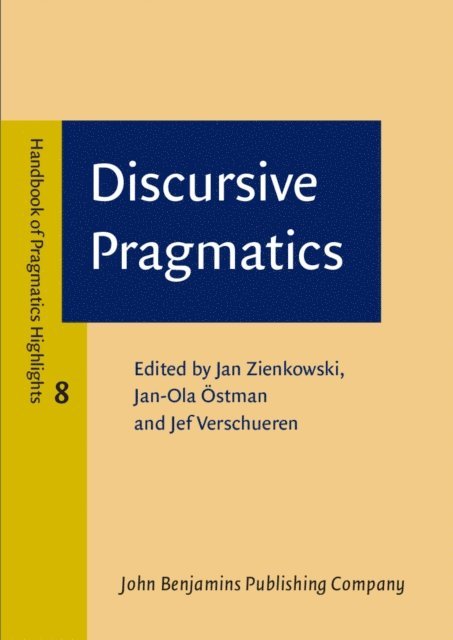
The ten volumes of Handbook of Pragmatics Highlights focus on the most salient topics in the field of pragmatics, thus dividing its wide interdisciplinary spectrum in a transparent and manageable way. While the other volumes select specific philosophical, cognitive, grammatical, social, cultural, variational, or interactional angles, this 8th volume focuses on theories and phenomena at the level of discourse, but leaving aside conversational interaction. It provides the reader with pragmatics-oriented information on discourse analysis, critical discourse analysis and critical linguistics, as well as text linguistics and appraisal theory, while introducing other specific approaches to discourse through concepts such as polyphony, intertextuality, genre, and énonciation. Furthermore, topics such as public discourse, narrative, figures of speech, cohesion and coherence, pragmatic markers, manipulation, and humor, are all dealt with in separate chapters. The binding idea, explained in the introduction, is that ´discursive pragmatics´ may serve as a platform for a diversity of perspectives on discourse, as they have emerged not only in the language sciences but also in the humanities and social sciences in general.
E-bok
PDF, Engelska, 2010519 kr
Läs direkt efter köp
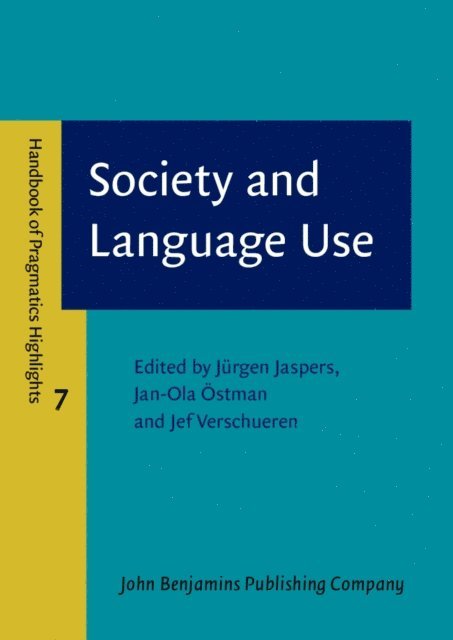
The ten volumes of Handbook of Pragmatics Highlights focus on the most salient topics in the field of pragmatics, thus dividing its wide interdisciplinary spectrum in a transparent and manageable way. While the other volumes select specific philosophical, cognitive, grammatical, cultural, variational, interactional, or discursive angles, this seventh volume underlines the mutually constitutive relation between society and language use. It highlights a number of the most prominent approaches of this relation and it draws attention to a selected number of topics that the study of language in its social context has characteristically brought to bear. Despite their theoretical and methodological differences, each of the chapters in this book assumes that it is necessary to look at society and language use as interdependent phenomena, and that by attending to microscopic linguistic phenomena one is also keeping a finger on the pulse of broader, macroscopic social tendencies that at the same time facilitate and constrain language use. The introduction provides a sketch of the intellectual antecedents of the volume’s two ‘mother disciplines’, viz., linguistics and social theory before pointing at recent common ground in the rising attention for discourse and what has come to be called ‘late-modernity’.
E-bok
PDF, Engelska, 2010519 kr
Läs direkt efter köp
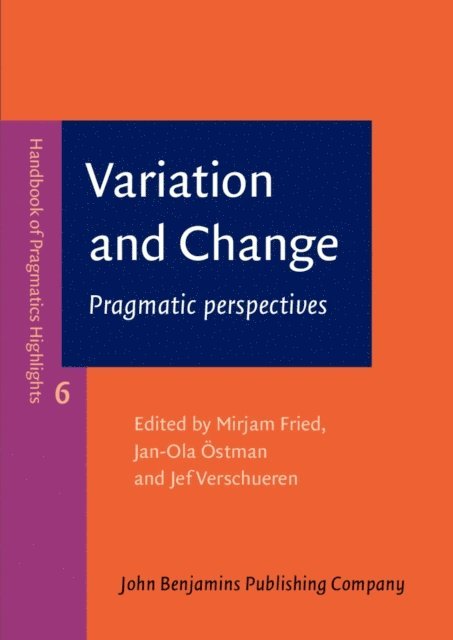
The ten volumes of the Handbook of Pragmatics Highlights focus on the most salient topics in the field of pragmatics, thus dividing its wide interdisciplinary spectrum in a transparent and manageable way. While the other volumes select specific philosophical, cognitive, grammatical, cultural, interactional, or discursive angles, this sixth volume focuses on the dynamic aspects of language and reviews the relevant developments in variationist and diachronic scholarship. The areas explored in the volume concern several general themes: specific methodological approaches, from comparative reconstruction to evolutionary pragmatics; issues in intra-lingual variation in terms of standard and non-standard varieties; cross-linguistic variation, including its cross-cultural dimension; and the study of diachronic relations across linguistic patterns, including changes in all areas of pragmatic patterns and categories. The contributions document two prominent and interrelated trends that shape contemporary variationist and diachronic research. One, it has moved from situating change within context-independent systems toward incorporating patterns of language use and the speaker’s role in language change. And two, it has reoriented its focus away from cataloguing instances of variation and toward seeking theoretically informed accounts that aim at explaining variation and change. On the whole, the volume argues for accepting and developing actively a systematic connection between research in diachrony, synchronic variation, and typology, while also incorporating the socio-cognitive perspective in linguistic analysis as a particularly promising source of useful methodology and explanatory models.
E-bok
PDF, Engelska, 2009519 kr
Läs direkt efter köp
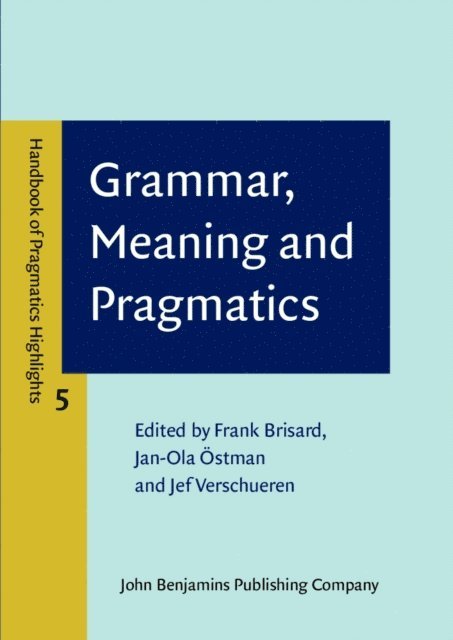
The ten volumes of Handbook of Pragmatics Highlights focus on the most salient topics in the field of pragmatics, thus dividing its wide interdisciplinary spectrum in a transparent and manageable way. While other volumes select philosophical, cognitive, cultural, social, variational, interactional, or discursive points of view, this fifth volume looks at the field of linguistic pragmatics from a primarily grammatical angle. That is, it asks in which particular sense a variety of older and more recent functional (rather than generative) models of grammar relate to the study of language in use: how this affects their general outlook on language structure, whether issues of language use inform the very makeup of these models or are merely included as possible research themes, and how far the actual integration of pragmatics ultimately goes (is it a module/layer or is the model truly “usage-based”?). Each of the authors presenting these models has taken systematic care to highlight the relevant problems and focus on the implications of considering pragmatic phenomena from the point of view of grammar. Furthermore, a limited number of chapters deal with traditional topics in the grammatical literature, and specifically those which are called pragmatic because they either are not strictly concerned with truth (semantics), or receive their (truth) value only from an interaction with context. In the introduction, these theories and topics are set up against the historical background of a gradually changing attitude, on the part of grammarians, towards questions of linguistic knowledge and behavior, and the role of learning in their relationship.
E-bok
PDF, Engelska, 2009519 kr
Läs direkt efter köp
The ten volumes of Handbook of Pragmatics Highlights focus on the most salient topics in the field of pragmatics, thus dividing its wide interdisciplinary spectrum in a transparent and manageable way. While the other volumes select specific philosophical, cognitive, grammatical, social, cultural, variational, or discursive angles, this fourth volume is dedicated to the empirical investigation of the way human beings organize their interaction in natural environments and how they use talk for accomplishing actions and their contexts. Starting from Goffman’s observation that interaction exhibits a structure in its own right that cannot be reduced to the psychological properties of the individual nor to society, it contains a selection of articles documenting the various levels of interactional organization. In addition to treatments of basic concepts such as sequence, participation, prosody and style and some topical articles on phenomena like reported speech and listener response, it also includes overviews of specific traditions (conversation analysis, ethnomethodology) and articles on eminent authors (Goffman, Sacks) who had a formative influence on the field.
E-bok
PDF, Engelska, 2009519 kr
Läs direkt efter köp
The ten volumes of Handbook of Pragmatics Highlights focus on the most salient topics in the field of pragmatics, thus dividing its wide interdisciplinary spectrum in a transparent and manageable way. While other volumes select philosophical, grammatical, social, variational, interactional, or discursive angles, this third volume focuses on the interface between language and cognition. Language use is impossible without the mobilization of a large variety of cognitive processes, each serving a different purpose. During the last half century cognitive approaches to language have been particularly successful, and the broad spectrum of contributions to this volume testify to this success. As cognitive approaches to language are by definition a subset of the larger enterprise of cognitive science, a contribution on this general topic sets the stage. This is joined by a chapter on cognitive grammar, a theoretical study of the architecture of human language that is deeply inspired by general cognitive principles. A chapter on experimentation offers a crash-course on basic issues of experimental design and on the rationale behind statistical testing in general and the most important statistical tests in particular, offering a methodological toolkit for understanding many of the other contributions. Different chapters cover a broad range of topics: language acquisition, psycholinguistics, specialized topics within the latter field (e.g. the bilingual mental lexicon, categorization), and aspects of language awareness. Some chapters home in on what have become indispensible perspectives on the cognitive underpinnings of language: the way language is represented and processed in the human brain and simulation studies. The ever-growing success of the latter type of studies is exemplified, for instance, by the highly flourishing connectionist tradition and the more general paradigm of artificial intelligence, each of which is dealt with in a separate contribution.
E-bok
PDF, Engelska, 2009519 kr
Läs direkt efter köp
The ten volumes of Handbook of Pragmatics Highlights focus on the most salient topics in the field of pragmatics, thus dividing its wide interdisciplinary spectrum in a transparent and manageable way. While other volumes select philosophical, cognitive, grammatical, social, variational, interactional, or discursive angles, this second volume reviews basic topics and traditions that place language use in its cultural context. As emphasized in the introduction, and as revealed in the choice of articles, ‘culture’ is by no means to be seen as standing in opposition to society and cognition; on the contrary, the notion cannot be understood without insight into the intricate interactions of social and cognitive structures and processes. In addition to the topical articles, a number of contributions to this volume is devoted to aspects of methodology. Others highlight the role of eminent scholars who have made the study of cultural dimensions of language use into what it is today.
E-bok
PDF, Engelska, 2009519 kr
Läs direkt efter köp
The ten volumes of Handbook of Pragmatics Highlights focus on the most salient topics in the field of pragmatics, thus dividing its wide interdisciplinary spectrum in a transparent and manageable way. While the other volumes select specific philosophical, cognitive, grammatical, social, cultural, variational, interactional, or discursive angles, this first volume reviews basic notions that pervade the pragmatic literature, such as deixis, implicitness, speech acts, context, and the like. It situates the field of pragmatics, broadly defined as the cognitive, social, and cultural science of language use, in relation to a general concept of communication and the discipline of semiotics. It also touches upon the non-verbal aspects of language use and even ventures a comparison with non-human forms of communication. The introductory chapter, moreover, explains why a highly diversified field of scholarship such as pragmatics can be regarded as a potentially coherent enterprise.
E-bok
PDF, Engelska, 20051 525 kr
Läs direkt efter köp
The notion ‘construction’ has become indispensable in present-day linguistics and in language studies in general. This volume extends the traditional domain of Construction Grammar (CxG) in several directions, all with a cognitive basis. Addressing a number of issues (such as coercion, discourse patterning, language change), the contributions show how CxG must be part and parcel of cognitively oriented studies of language, including language universals. The volume also gives informative accounts of how the notion ‘construction’ is developed in approaches that are conceptually close to, and relatively compatible with, CxG: Conceptual Semantics, Word Grammar, Cognitive Grammar, Embodied Construction Grammar, and Radical Construction Grammar.
E-bok
PDF, Engelska, 20041 258 kr
Läs direkt efter köp
This volume gives an easily accessible, yet comprehensive, sophisticated, and example-rich introduction to Construction Grammar as it has been developed from the early 1980’s by Charles J. Fillmore and his associates. It also provides a succinct account of the historical and intellectual background of the model and shows how Construction Grammar can easily be applied to typologically very different languages and to a variety of language-specific phenomena. All of the contributors to the volume came out of the Fillmorean school at UC-Berkeley and have worked consistently on applying and further developing the model in various domains of linguistic analysis.The ''Thumbnail sketch'' by Fried & Östman is the only extensive introduction published so far to Fillmorean Construction Grammar.