Osvaldo Martin - Böcker
Visar alla böcker från författaren Osvaldo Martin. Handla med fri frakt och snabb leverans.
4 produkter
4 produkter
Bayesian Analysis with Python: Unleash the power and flexibility of the Bayesian framework
Häftad, Engelska, 2016
630 kr
Skickas inom 5-8 vardagar
Bayesian Analysis with Python
Introduction to statistical modeling and probabilistic programming using PyMC3 and ArviZ
Häftad, Engelska, 2018
589 kr
Skickas inom 5-8 vardagar
Bayesian modeling with PyMC3 and exploratory analysis of Bayesian models with ArviZ Key FeaturesA step-by-step guide to conduct Bayesian data analyses using PyMC3 and ArviZA modern, practical and computational approach to Bayesian statistical modelingA tutorial for Bayesian analysis and best practices with the help of sample problems and practice exercises.Book DescriptionThe second edition of Bayesian Analysis with Python is an introduction to the main concepts of applied Bayesian inference and its practical implementation in Python using PyMC3, a state-of-the-art probabilistic programming library, and ArviZ, a new library for exploratory analysis of Bayesian models.The main concepts of Bayesian statistics are covered using a practical and computational approach. Synthetic and real data sets are used to introduce several types of models, such as generalized linear models for regression and classification, mixture models, hierarchical models, and Gaussian processes, among others. By the end of the book, you will have a working knowledge of probabilistic modeling and you will be able to design and implement Bayesian models for your own data science problems. After reading the book you will be better prepared to delve into more advanced material or specialized statistical modeling if you need to.What you will learnBuild probabilistic models using the Python library PyMC3Analyze probabilistic models with the help of ArviZAcquire the skills required to sanity check models and modify them if necessaryUnderstand the advantages and caveats of hierarchical modelsFind out how different models can be used to answer different data analysis questionsCompare models and choose between alternative onesDiscover how different models are unified from a probabilistic perspectiveThink probabilistically and benefit from the flexibility of the Bayesian frameworkWho this book is forIf you are a student, data scientist, researcher, or a developer looking to get started with Bayesian data analysis and probabilistic programming, this book is for you. The book is introductory so no previous statistical knowledge is required, although some experience in using Python and NumPy is expected.
621 kr
Skickas inom 5-8 vardagar
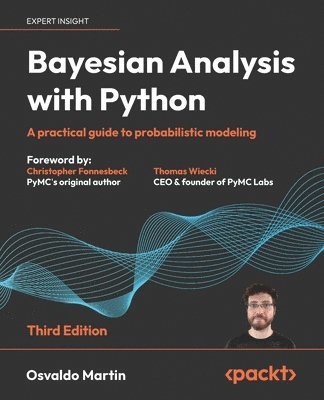
Learn the fundamentals of Bayesian modeling using state-of-the-art Python libraries, such as PyMC, ArviZ, Bambi, and more, guided by an experienced Bayesian modeler who contributes to these libraries.Free with your book: DRM-free PDF version + access to Packt's next-gen Reader*Key FeaturesConduct Bayesian data analysis with step-by-step guidanceGain insight into a modern, practical, and computational approach to Bayesian statistical modelingEnhance your learning with best practices through sample problems and practice exercisesPurchase of the print or Kindle book includes a free PDF eBook.Book DescriptionThe third edition of Bayesian Analysis with Python serves as an introduction to the main concepts of applied Bayesian modeling using PyMC, a state-of-the-art probabilistic programming library, and other libraries that support and facilitate modeling like ArviZ, for exploratory analysis of Bayesian models; Bambi, for flexible and easy hierarchical linear modeling; PreliZ, for prior elicitation; PyMC-BART, for flexible non-parametric regression; and Kulprit, for variable selection.In this updated edition, a brief and conceptual introduction to probability theory enhances your learning journey by introducing new topics like Bayesian additive regression trees (BART), featuring updated examples. Refined explanations, informed by feedback and experience from previous editions, underscore the book's emphasis on Bayesian statistics. You will explore various models, including hierarchical models, generalized linear models for regression and classification, mixture models, Gaussian processes, and BART, using synthetic and real datasets.By the end of this book, you’ll understand probabilistic modeling and be able to design and implement Bayesian models for data science, with a strong foundation for more advanced study.*Email sign-up and proof of purchase requiredWhat you will learnBuild probabilistic models using PyMC and BambiAnalyze and interpret probabilistic models with ArviZAcquire the skills to sanity-check models and modify them if necessaryBuild better models with prior and posterior predictive checksLearn the advantages and caveats of hierarchical modelsCompare models and choose between alternative onesInterpret results and apply your knowledge to real-world problemsExplore common models from a unified probabilistic perspectiveApply the Bayesian framework's flexibility for probabilistic thinkingWho this book is forIf you are a student, data scientist, researcher, or developer looking to get started with Bayesian data analysis and probabilistic programming, this book is for you. The book is introductory, so no previous statistical knowledge is required, although some experience in using Python and scientific libraries like NumPy is expected.
861 kr
Skickas inom 5-8 vardagar
Learn the fundamentals of Bayesian modeling using state-of-the-art Python libraries, such as PyMC, ArviZ, Bambi, and more, guided by an experienced Bayesian modeler who contributes to these librariesKey FeaturesConduct Bayesian data analysis with step-by-step guidanceGain insight into a modern, practical, and computational approach to Bayesian statistical modelingEnhance your learning with best practices through sample problems and practice exercisesPurchase of the print or Kindle book includes a free PDF eBook.Book DescriptionThe third edition of Bayesian Analysis with Python serves as an introduction to the main concepts of applied Bayesian modeling using PyMC, a state-of-the-art probabilistic programming library, and other libraries that support and facilitate modeling like ArviZ, for exploratory analysis of Bayesian models; Bambi, for flexible and easy hierarchical linear modeling; PreliZ, for prior elicitation; PyMC-BART, for flexible non-parametric regression; and Kulprit, for variable selection.In this updated edition, a brief and conceptual introduction to probability theory enhances your learning journey by introducing new topics like Bayesian additive regression trees (BART), featuring updated examples. Refined explanations, informed by feedback and experience from previous editions, underscore the book's emphasis on Bayesian statistics. You will explore various models, including hierarchical models, generalized linear models for regression and classification, mixture models, Gaussian processes, and BART, using synthetic and real datasets.By the end of this book, you will possess a functional understanding of probabilistic modeling, enabling you to design and implement Bayesian models for your data science challenges. You'll be well-prepared to delve into more advanced material or specialized statistical modeling if the need arises.What you will learnBuild probabilistic models using PyMC and BambiAnalyze and interpret probabilistic models with ArviZAcquire the skills to sanity-check models and modify them if necessaryBuild better models with prior and posterior predictive checksLearn the advantages and caveats of hierarchical modelsCompare models and choose between alternative onesInterpret results and apply your knowledge to real-world problemsExplore common models from a unified probabilistic perspectiveApply the Bayesian framework's flexibility for probabilistic thinkingWho this book is forIf you are a student, data scientist, researcher, or developer looking to get started with Bayesian data analysis and probabilistic programming, this book is for you. The book is introductory, so no previous statistical knowledge is required, although some experience in using Python and scientific libraries like NumPy is expected.