Otto Wildi – författare
1 587 kr
Läs direkt efter köp
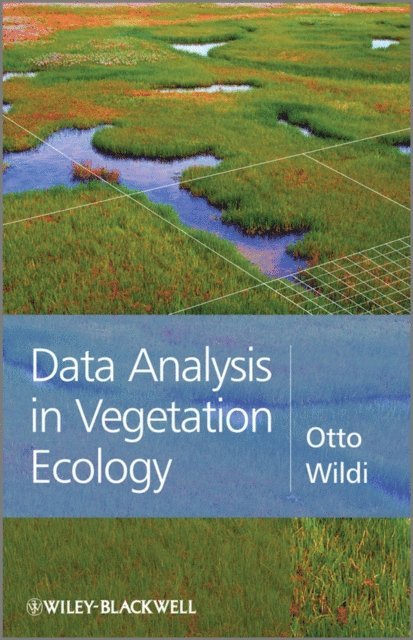
The book lays out the basic operations involved in the analysis, the underlying hypotheses, aims and points of views. It conveys the message that each step in the calculations has a specific, straightforward meaning and that patterns and processes known by ecologists often find their counterpart in mathematical operations and functions. The first chapters introduce the elementary concepts and operations and relate them to real-world phenomena and problems. Later chapters concentrate on combinations of methods to reveal surprising features in data sets. Showing how to find patterns in time series, how to generate simple dynamic models, how to reveal spatial patterns and related occurrence probability maps.
671 kr
Läs direkt efter köp
The first edition of Data Analysis in Vegetation Ecology provided an accessible and thorough resource for evaluating plant ecology data, based on the author’s extensive experience of research and analysis in this field. Now, the Second Edition expands on this by not only describing how to analyse data, but also enabling readers to follow the step-by-step case studies themselves using the freely available statistical package R.
The addition of R in this new edition has allowed coverage of additional methods for classification and ordination, and also logistic regression, GLMs, GAMs, regression trees as well as multinomial regression to simulate vegetation types. A package of statistical functions, specifically written for the book, covers topics not found elsewhere, such as analysis and plot routines for handling synoptic tables. All data sets presented in the book are now also part of the R package ‘dave’, which is freely available online at the R Archive webpage.
The book and data analysis tools combined provide a complete and comprehensive guide to carrying out data analysis students, researchers and practitioners in vegetation science and plant ecology. Summary:
A completely revised and updated edition of this popular introduction to data analysis in vegetation ecology Now includes practical examples using the freely available statistical package ‘R’ Written by a world renowned expert in the field Complex concepts and operations are explained using clear illustrations and case studies relating to real world phenomena Highlights both the potential and limitations of the methods used, and the final interpretations Gives suggestions on the use of the most widely used statistical software in vegetation ecology and how to start analysing dataPraise for the first edition:
"This book will be a valuable addition to the shelves of early postgraduate candidates and postdoctoral researchers. Through the excellent background material and use of real world examples, Wildi has taken the fear out of trying to understand these much needed data analysis techniques in vegetation ecology."—Austral Ecology
794 kr
Läs direkt efter köp
The book lays out the basic operations involved in the analysis, the underlying hypotheses, aims and points of views. It conveys the message that each step in the calculations has a specific, straightforward meaning and that patterns and processes known by ecologists often find their counterpart in mathematical operations and functions. The first chapters introduce the elementary concepts and operations and relate them to real-world phenomena and problems. Later chapters concentrate on combinations of methods to reveal surprising features in data sets. Showing how to find patterns in time series, how to generate simple dynamic models, how to reveal spatial patterns and related occurrence probability maps.
1 630 kr
Skickas inom 10-15 vardagar
1 977 kr
Läs direkt efter köp
Landscape Research has been established as an interdisciplinary field dealing with complex environmental processes at multiple spatial and temporal scales. During the course of its history, various societal, technological and philosophical stimuli have shaped Landscape Research, e.g. the declaration of Landscape Ecology in the 1930s and contemporary global technological and societal developments.
Modern landscape research presently uses mathematics, statistics and advanced simulation techniques to combine empirical observations with known theories from ecology, physics, geography, social science and so on. Knowledge is thus updated and quantified via models that are used for estimation, hypothesis testing, prediction and assessment of scenarios. Advances in the computational sciences (e.g. fast computers and vast array of software), space science (e.g. remote sensing) and biological sciences (e.g. genetics) as well as new perspectives in the social sciences play important roles. Research findings are implemented in conservation management, urban planning and global change mitigation strategies.
This book identifies emerging fields and new challenges that are discussed within the framework of the ‘driving forces’ of Landscape Development. Rather than offering a comprehensive overview of all fields of Landscape Research, the book addresses ‘hot topics’ emphasizing major contemporary trends in these fields.
611 kr
Skickas
668 kr
Läs direkt efter köp
668 kr
Läs direkt efter köp
1 619 kr
Skickas inom 10-15 vardagar