oystein Tunsjo – författare
665 kr
Läs direkt efter köp
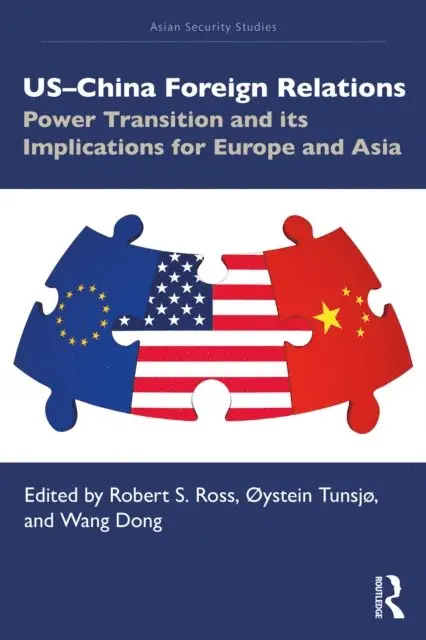
This book examines the power transition between the US and China, and the implications for Europe and Asia in a new era of uncertainty.
The volume addresses the impact that the rise of China has on the United States, Europe, transatlantic relations, and East Asia. China is seeking to use its enhanced power position to promote new ambitions; the United States is adjusting to a new superpower rivalry; and the power shift from the West to the East is resulting in a more peripheral role for Europe in world affairs. Featuring essays by prominent Chinese and international experts, the book examines the US–China rivalry, the changing international system, grand strategies and geopolitics, foreign policy, geo-economics and institutions, and military and technological developments. The chapters examine how strategic, security, and military considerations in this triangular relationship are gradually undermining trade and economics, reversing the era of globalization, and contributing to the breakdown of the US-led liberal order and institutions that will be difficult to rebuild. The volume also examines whether the adversarial antagonism in US–China relations, the tension in transatlantic ties, and the increasing rivalry in Europe–China relations are primarily resulting from leaders’ ambitions or structural power shifts.
This book will be of much interest to students of Asian security, US foreign policy, European politics, and International Relations in general.
665 kr
Läs direkt efter köp
This book examines the power transition between the US and China, and the implications for Europe and Asia in a new era of uncertainty.
The volume addresses the impact that the rise of China has on the United States, Europe, transatlantic relations, and East Asia. China is seeking to use its enhanced power position to promote new ambitions; the United States is adjusting to a new superpower rivalry; and the power shift from the West to the East is resulting in a more peripheral role for Europe in world affairs. Featuring essays by prominent Chinese and international experts, the book examines the US–China rivalry, the changing international system, grand strategies and geopolitics, foreign policy, geo-economics and institutions, and military and technological developments. The chapters examine how strategic, security, and military considerations in this triangular relationship are gradually undermining trade and economics, reversing the era of globalization, and contributing to the breakdown of the US-led liberal order and institutions that will be difficult to rebuild. The volume also examines whether the adversarial antagonism in US–China relations, the tension in transatlantic ties, and the increasing rivalry in Europe–China relations are primarily resulting from leaders’ ambitions or structural power shifts.
This book will be of much interest to students of Asian security, US foreign policy, European politics, and International Relations in general.
892 kr
Läs direkt efter köp
944 kr
Läs direkt efter köp
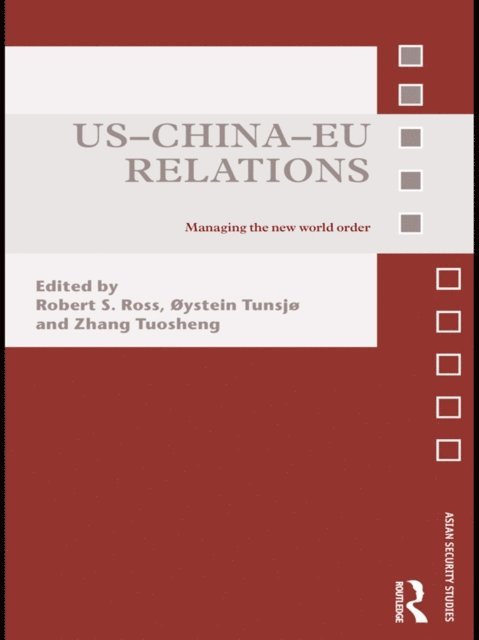
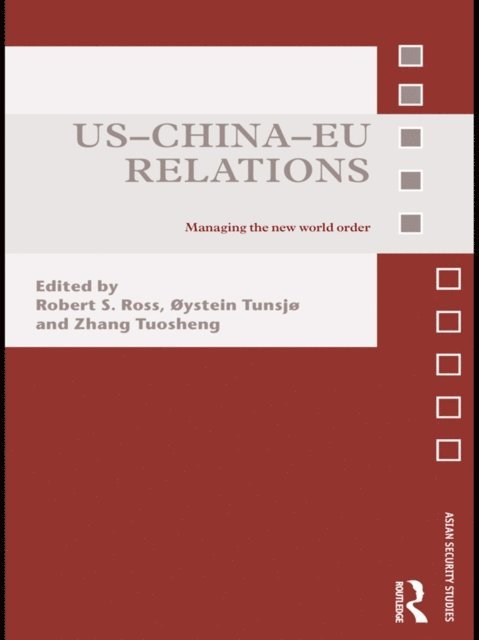
This volume brings together a group of leading international scholars to discuss how US-China-EU relations will shape the future of international politics.
Arguing that these three powers will play a key role in establishing and managing a new world order, the contributors examine how a future global order is developed by the interaction of these leading actors in the international system. The authors also address how the US, China and the EU promote cooperation and manage conflict of interests on a wide spectrum of issues including new security challenges. By linking the management of international affairs to specific policy issues, the book shows that the US-China-EU triangular configuration is a pivotal relationship for understanding contemporary international relations.
This book offers a comprehensive assessment of US-China-EU interactions and will be of great interest to students of Asian politics, US foreign policy, EU politics and security studies and IR in general.
Robert S. Ross is Professor of Political Science at Boston College, Associate, John King Fairbank Center for East Asian Research, Harvard University, Associated Professor at the Norwegian Institute for Defence Studies, Senior Advisor, Security Studies Program, Massachusetts Institute of Technology and a member of the Council on Foreign Relations.
Øystein Tunsjø is Senior Research Fellow at the Norwegian Institute for Defence Studies.
Zhang Tuosheng is director of the research department and senior fellow at the China Foundation for International and Strategic Studies.
952 kr
Läs direkt efter köp
This volume brings together a group of leading international scholars to discuss how US-China-EU relations will shape the future of international politics.
Arguing that these three powers will play a key role in establishing and managing a new world order, the contributors examine how a future global order is developed by the interaction of these leading actors in the international system. The authors also address how the US, China and the EU promote cooperation and manage conflict of interests on a wide spectrum of issues including new security challenges. By linking the management of international affairs to specific policy issues, the book shows that the US-China-EU triangular configuration is a pivotal relationship for understanding contemporary international relations.
This book offers a comprehensive assessment of US-China-EU interactions and will be of great interest to students of Asian politics, US foreign policy, EU politics and security studies and IR in general.
Robert S. Ross is Professor of Political Science at Boston College, Associate, John King Fairbank Center for East Asian Research, Harvard University, Associated Professor at the Norwegian Institute for Defence Studies, Senior Advisor, Security Studies Program, Massachusetts Institute of Technology and a member of the Council on Foreign Relations.
Øystein Tunsjø is Senior Research Fellow at the Norwegian Institute for Defence Studies.
Zhang Tuosheng is director of the research department and senior fellow at the China Foundation for International and Strategic Studies.
828 kr
Läs direkt efter köp
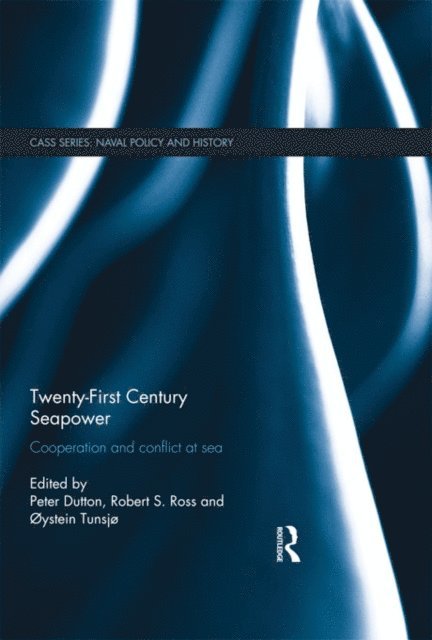
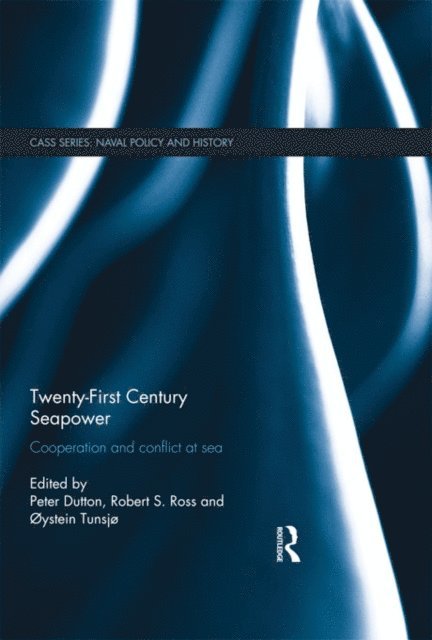
This book offers an assessment of the naval policies of emerging naval powers, and the implications for maritime security relations and the global maritime order.
Since the end of the Cold War, China, Japan, India and Russia have begun to challenge the status quo with the acquisition of advanced naval capabilities. The emergence of rising naval powers is a cause for concern, as the potential for great power instability is exacerbated by the multiple maritime territorial disputes among new and established naval powers.
This work explores the underlying sources of maritime ambition through an analysis of various historical cases of naval expansionism. It analyses both the sources and dynamics of international naval competition, and looks at the ways in which maritime stability and the widespread benefits of international commerce and maritime resource extraction can be sustained through the twenty-first century.
This book will be of much interest to students of naval power, Asian security and politics, strategic studies, security studies and IR in general.
828 kr
Läs direkt efter köp
This book offers an assessment of the naval policies of emerging naval powers, and the implications for maritime security relations and the global maritime order.
Since the end of the Cold War, China, Japan, India and Russia have begun to challenge the status quo with the acquisition of advanced naval capabilities. The emergence of rising naval powers is a cause for concern, as the potential for great power instability is exacerbated by the multiple maritime territorial disputes among new and established naval powers.
This work explores the underlying sources of maritime ambition through an analysis of various historical cases of naval expansionism. It analyses both the sources and dynamics of international naval competition, and looks at the ways in which maritime stability and the widespread benefits of international commerce and maritime resource extraction can be sustained through the twenty-first century.
This book will be of much interest to students of naval power, Asian security and politics, strategic studies, security studies and IR in general.