P. Sagaut – författare
Visar alla böcker från författaren P. Sagaut. Handla med fri frakt och snabb leverans.
7 produkter
7 produkter
Inbunden, Engelska, 2005
1 622 kr
Skickas inom 10-15 vardagar
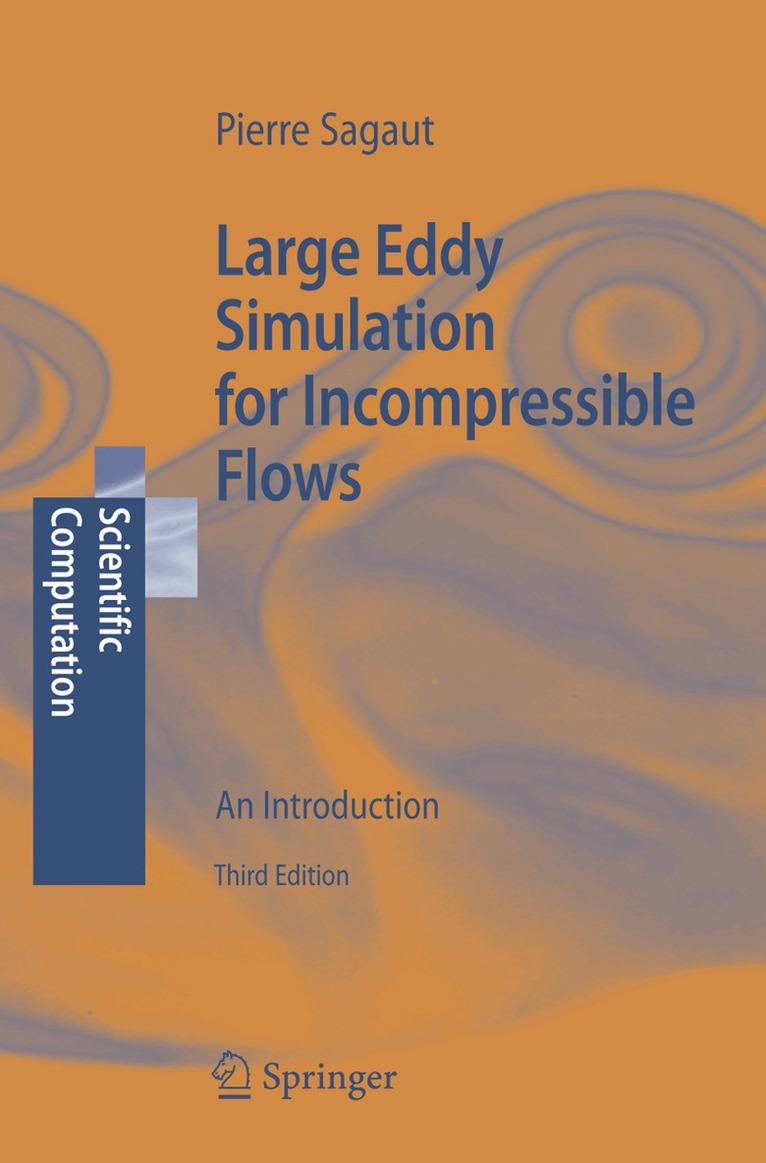
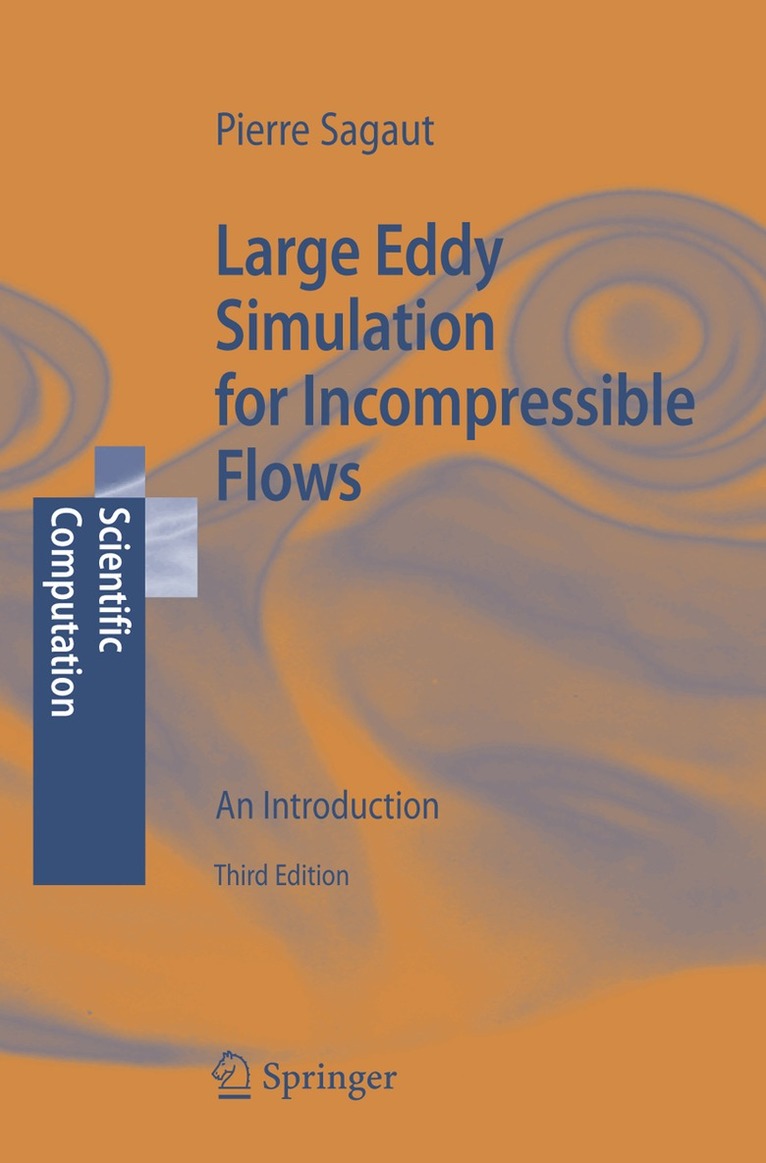
From the foreword to the third edition written by Charles Meneveau: "... a most welcome addition to the bookshelves of scientists and engineers in fluid mechanics, LES practitioners, and students of turbulence in general."The only reference devoted entirely to the subject, Large Eddy Simulation presents a comprehensive and unified view of this young but very rich discipline. The coverage focuses on incompressible fluids and thoroughly examines both the mathematical ideas and the practical applications with care. This 3rd edition adds much new material, including careful error analysis of filtered density function models and multiscale models. It also contains two new chapters on the prediction of scalars using LES which are of considerable interest in engineering and geophysical modeling.
E-bok
PDF, Engelska, 20052 049 kr
Läs direkt efter köp
From the foreword to the third edition written by Charles Meneveau: "e;... a most welcome addition to the bookshelves of scientists and engineers in fluid mechanics, LES practitioners, and students of turbulence in general."e;The only reference devoted entirely to the subject, Large Eddy Simulation presents a comprehensive and unified view of this young but very rich discipline. The coverage focuses on incompressible fluids and thoroughly examines both the mathematical ideas and the practical applications with care. This 3rd edition adds much new material, including careful error analysis of filtered density function models and multiscale models. It also contains two new chapters on the prediction of scalars using LES which are of considerable interest in engineering and geophysical modeling.
Häftad, Engelska, 2010
1 622 kr
Skickas inom 10-15 vardagar
From the foreword to the third edition written by Charles Meneveau: "... a most welcome addition to the bookshelves of scientists and engineers in fluid mechanics, LES practitioners, and students of turbulence in general."The only reference devoted entirely to the subject, Large Eddy Simulation presents a comprehensive and unified view of this young but very rich discipline. The coverage focuses on incompressible fluids and thoroughly examines both the mathematical ideas and the practical applications with care. This 3rd edition adds much new material, including careful error analysis of filtered density function models and multiscale models. It also contains two new chapters on the prediction of scalars using LES which are of considerable interest in engineering and geophysical modeling.
E-bok
PDF, Engelska, 20131 100 kr
Läs direkt efter köp
The astonishingly rapid development of the Large-Eddy Simulation technique during the last two or three years, both from the theoretical and applied points of view, have rendered the first edition of this book lacunary in some ways. Three to four years ago, when I was working on the manuscript of the first edition, coupling between LES and multiresolution/multilevel techniques was just an emerging idea. Nowadays, several applications of this approach "ave been succesfully developed and applied to several flow configurations. Another example of interest from this exponentially growing field is the de velopment of hybrid RANS /LES approaches, which have been derived under many different forms. Because these topics are promising and seem to be possible ways of enhancing the applicability of LES, I felt that they should be incorporated in a general presentation of LES. Recent developments in LES theory also deal with older topics which have been intensely revisited by reseachers: a unified theory for deconvolution and scale similarity ways of modeling have now been established; the "no model" approach, popularized as the MILES approach, is now based on a deeper theoretical analysis; a lot of attention has been paid to the problem of the definition of boundary conditions for LES; filtering has been extended to N avier-Stokes equations in general coordinates and to Eulerian time-domain filtering.
Inbunden, Engelska, 2009
1 514 kr
Skickas inom 10-15 vardagar
Turbulent ?ows are ubiquitous in most application ?elds, ranging from - gineering to earth sciences and even life sciences. Therefore, simulation of turbulent ?ows has become a key tool in both fundamental and applied - search. The complexity of Navier-Stokes turbulence, which is illustrated by the fact that the number of degrees of freedom of turbulence grows faster 11/4 thanO(Re ), where Re denotes the Reynolds number, renders the Direct Numerical Simulation (DNS) of turbulence inapplicable to most ?ows of - terest. To alleviate this problem, truncated solutions in both frequency and wavenumbermaybesought,whosecomputationalcostismuchlowerandmay ideally be arbitrarily adjusted. The most suitable approach to obtain such a low-cost three-dimensional unsteady simulation of a turbulent ?ow is Large- EddySimulation(LES),whichwaspioneeredtocomputemeteorological?ows in the late 1950s and the early 1960s. One of the main issues raised by LES is a closure problem: because of the non-linearity of the Navier-Stokes equations, the e?ect of unresolved scales must be taken into account to recover a reliable description of resolved scales of motion (Chap. 2).This need to close the governing equations of LES has certainly been the main area of investigation since the 1960s, and numerous closures,alsoreferredtoassubgridmodels,havebeenproposed. Mostexisting subgrid models have been built using simpli?ed viewsof turbulence dynamics, the main physical phenomenon taken into account being the direct kinetic - ergycascade from largeto small scales that is observed in isotropic turbulence and high-Reynolds fully developed turbulent ?ows. The most popular pa- digm for interscale energy transfer modeling is subgrid viscosity (Chap.
E-bok
PDF, Engelska, 20091 891 kr
Läs direkt efter köp
Häftad, Engelska, 2012
1 514 kr
Skickas inom 10-15 vardagar
Turbulent ?ows are ubiquitous in most application ?elds, ranging from - gineering to earth sciences and even life sciences. Therefore, simulation of turbulent ?ows has become a key tool in both fundamental and applied - search. The complexity of Navier-Stokes turbulence, which is illustrated by the fact that the number of degrees of freedom of turbulence grows faster 11/4 thanO(Re ), where Re denotes the Reynolds number, renders the Direct Numerical Simulation (DNS) of turbulence inapplicable to most ?ows of - terest. To alleviate this problem, truncated solutions in both frequency and wavenumbermaybesought,whosecomputationalcostismuchlowerandmay ideally be arbitrarily adjusted. The most suitable approach to obtain such a low-cost three-dimensional unsteady simulation of a turbulent ?ow is Large- EddySimulation(LES),whichwaspioneeredtocomputemeteorological?ows in the late 1950s and the early 1960s. One of the main issues raised by LES is a closure problem: because of the non-linearity of the Navier-Stokes equations, the e?ect of unresolved scales must be taken into account to recover a reliable description of resolved scales of motion (Chap. 2).This need to close the governing equations of LES has certainly been the main area of investigation since the 1960s, and numerous closures,alsoreferredtoassubgridmodels,havebeenproposed. Mostexisting subgrid models have been built using simpli?ed viewsof turbulence dynamics, the main physical phenomenon taken into account being the direct kinetic - ergycascade from largeto small scales that is observed in isotropic turbulence and high-Reynolds fully developed turbulent ?ows. The most popular pa- digm for interscale energy transfer modeling is subgrid viscosity (Chap.