Paivi Tynjala – författare
Visar alla böcker från författaren Paivi Tynjala. Handla med fri frakt och snabb leverans.
5 produkter
Higher Education and Working Life
Collaborations, Confrontations and Challenges
Av Paivi Tynjala, Jussi Välimaa m. fl.
Inbunden, 2006
1600 kr
Lägg i varukorg
This book provides a comprehensive discussion of the relationship between higher education and working life from three different perspectives: society, higher education and the world of work. The purpose of the volume is twofold: first, to critically analyse the relationship between higher …
Peer-Group Mentoring for Teacher Development
Av Paivi Tynjala, Hannu Jokinen m. fl.
E-bok, 2012
1004 kr
Lägg i varukorg
Supporting new teachers is a common challenge globally and the European Commission has recently emphasised the need to promote a lifelong continuum of teachers professional development by building bridges between pre-service and in-service teacher education.Peer-Group Mentoring for Teacher …
Towards Integration of Work and Learning
Strategies for Connectivity and Transformation
Av Paivi Tynjala, Marja-Leena Stenstrom
E-bok, 2008
1387 kr
Lägg i varukorg
Marja-Leena Stenstrom ¨ and Pai ¨ vi Tynjal ¨ a ¨ Changing Working Life as a Challenge to Education Recentmacro-leveltrends,suchaseconomicglobalisation,thedevelopmentofthe- formationsociety,changesinmethodsofproductionandtheorganisationofwork,and the growing signi?cance of knowledge as a factor of …
Transitions and Transformations in Learning and Education
Av Marjatta Saarnivaara, Marja-Leena Stenstrom m. fl.
E-bok, 2012
1418 kr
Lägg i varukorg
The breakneck speed of change in today’s societies creates enormous challenges for educational institutions at all levels. This volume explores ways how to manage change in educational processes and contexts, focusing, in particular, on the concepts of transition and transformation. How do we …
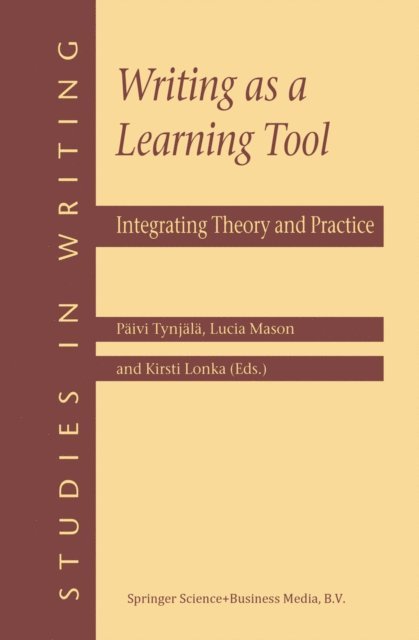
Writing as a Learning Tool
Integrating Theory and Practice
E-bok, 2012
1418 kr
Lägg i varukorg
In a brief summary, the debate concerning the nature of writing processes is about whether the essential characteristic of expertise in writing is a matter of mastering problem-solving strategies. In this respect, the role of social and interactive factors, such as writers'' familiarity with the …