Panagiotis Zervos – författare
Visar alla böcker från författaren Panagiotis Zervos. Handla med fri frakt och snabb leverans.
5 produkter
5 produkter
Inbunden, Tyska, 2008
894 kr
Skickas inom 10-15 vardagar
Das Wägelexikon ist ein umfassendes Nachschlagewerk der Wägepraxis für alle Nutzer von Waagen in Industrie und Wissenschaft. Es erläutert über 1000 Begriffe aus der Wägetechnik und verwandten Gebieten; zahlreiche Abbildungen tragen zum besseren Verständnis bei. Entstanden ist das Lexikon als Gemeinschaftswerk der Physikalisch-Technischen Bundesanstalt (PTB) und des Waagenherstellers METTLER TOLEDO.
E-bok
PDF, Tyska, 2008881 kr
Läs direkt efter köp
Das Wägelexikon ist ein umfassendes Nachschlagewerk der Wägepraxis für alle Nutzer von Waagen in Industrie und Wissenschaft. Es erläutert über 1000 Begriffe aus der Wägetechnik und verwandten Gebieten; zahlreiche Abbildungen tragen zum besseren Verständnis bei. Entstanden ist das Lexikon als Gemeinschaftswerk der Physikalisch-Technischen Bundesanstalt (PTB) und des Waagenherstellers METTLER TOLEDO.
Inbunden, Engelska, 2009
1 092 kr
Skickas inom 10-15 vardagar
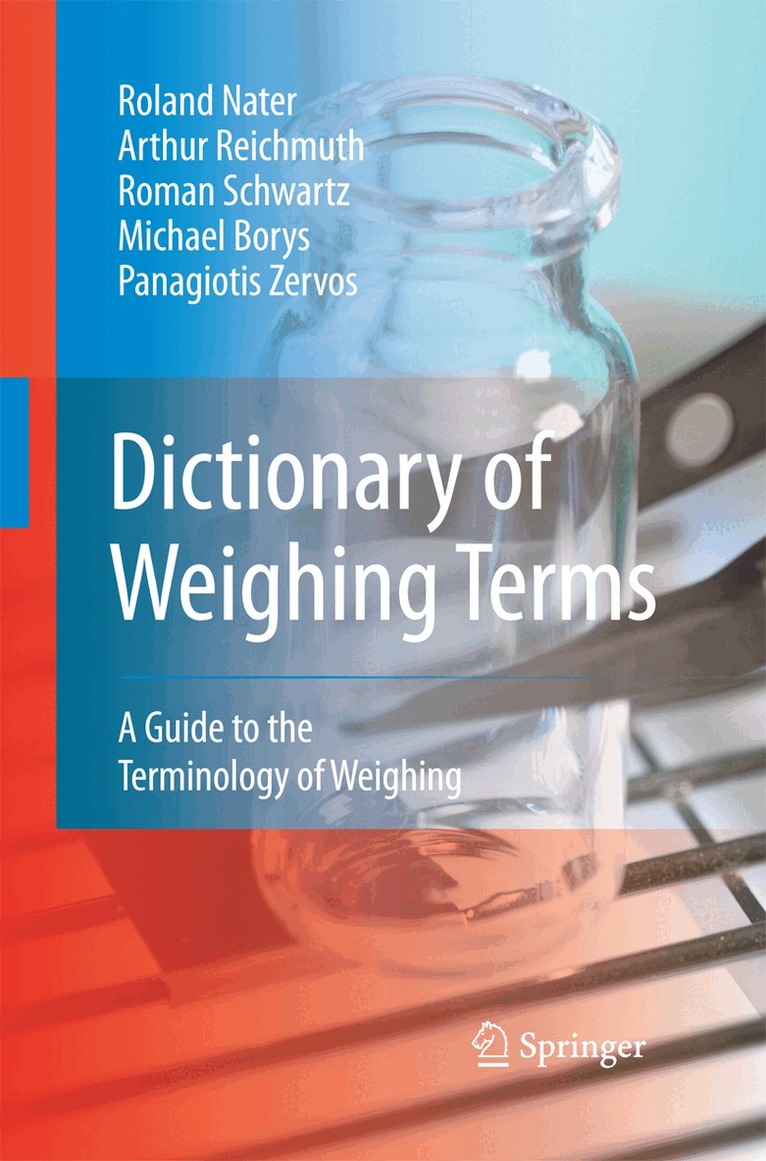
This Dictionary of Weighing Terms is a comprehensive practical guide to the terminology of weighing for all users of weighing instruments in industry and science. It explains more than 1000 terms of weighing technology and related areas; numerous illustrations assist understanding. The Dictionary of Weighing Terms is a joint work of the German Federal Institute of Physics and Metrology (PTB) and METTLER TOLEDO, the weighing instruments manufacturer. Special thanks go to Peter Brandes, Michael Denzel, and Dr. Oliver Mack of PTB, and to Richard Davis of BIPM, who with their technical knowledge have contributed to the success of this work. The Dictionary contains terms from the following fields: fundamentals of weighing, application and use of weighing instruments, international standards, legal requirements for weighing instruments, weighing accuracy. An index facilitates rapid location of the required term. The authors welcome suggestions and corrections at www.mt.com/w eighing-terms. Braunschweig (DE) and Greifensee (CH), The Authors Summer 2009 Foreword Since its founding in 1875, the International Bureau of Weights and Measures (BIPM) has had a unique role in mass metrology. The definition of the kilogram depends on an artefact conserved and used within our laboratories. The mass embodied in this - tefact defines the kilogram, and this information is disseminated throughout the world to promote uniformity of measurements. Although the definition of the kilogram may change in the re- tively near future, reflecting the success of new technologies and new requirements, the task of ensuring world-wide uniformity of mass measurements will remain.
E-bok
PDF, Engelska, 2009978 kr
Läs direkt efter köp
This Dictionary of Weighing Terms is a comprehensive practical guide to the terminology of weighing for all users of weighing instruments in industry and science. It explains more than 1000 terms of weighing technology and related areas; numerous illustrations assist understanding. The Dictionary of Weighing Terms is a joint work of the German Federal Institute of Physics and Metrology (PTB) and METTLER TOLEDO, the weighing instruments manufacturer. Special thanks go to Peter Brandes, Michael Denzel, and Dr. Oliver Mack of PTB, and to Richard Davis of BIPM, who with their technical knowledge have contributed to the success of this work. The Dictionary contains terms from the following fields: fundamentals of weighing, application and use of weighing instruments, international standards, legal requirements for weighing instruments, weighing accuracy. An index facilitates rapid location of the required term. The authors welcome suggestions and corrections at www.mt.com/w eighing-terms. Braunschweig (DE) and Greifensee (CH), The Authors Summer 2009 Foreword Since its founding in 1875, the International Bureau of Weights and Measures (BIPM) has had a unique role in mass metrology. The definition of the kilogram depends on an artefact conserved and used within our laboratories. The mass embodied in this - tefact defines the kilogram, and this information is disseminated throughout the world to promote uniformity of measurements. Although the definition of the kilogram may change in the re- tively near future, reflecting the success of new technologies and new requirements, the task of ensuring world-wide uniformity of mass measurements will remain.
Häftad, Engelska, 2014
790 kr
Skickas inom 10-15 vardagar
This Dictionary of Weighing Terms is a comprehensive practical guide to the terminology of weighing for all users of weighing instruments in industry and science. It explains more than 1000 terms of weighing technology and related areas; numerous illustrations assist understanding. The Dictionary of Weighing Terms is a joint work of the German Federal Institute of Physics and Metrology (PTB) and METTLER TOLEDO, the weighing instruments manufacturer. Special thanks go to Peter Brandes, Michael Denzel, and Dr. Oliver Mack of PTB, and to Richard Davis of BIPM, who with their technical knowledge have contributed to the success of this work. The Dictionary contains terms from the following fields: fundamentals of weighing, application and use of weighing instruments, international standards, legal requirements for weighing instruments, weighing accuracy. An index facilitates rapid location of the required term. The authors welcome suggestions and corrections at www.mt.com/w eighing-terms. Braunschweig (DE) and Greifensee (CH), The Authors Summer 2009 Foreword Since its founding in 1875, the International Bureau of Weights and Measures (BIPM) has had a unique role in mass metrology. The definition of the kilogram depends on an artefact conserved and used within our laboratories. The mass embodied in this - tefact defines the kilogram, and this information is disseminated throughout the world to promote uniformity of measurements. Although the definition of the kilogram may change in the re- tively near future, reflecting the success of new technologies and new requirements, the task of ensuring world-wide uniformity of mass measurements will remain.