Panther Klaus-Uwe Panther – författare
Visar alla böcker från författaren Panther Klaus-Uwe Panther. Handla med fri frakt och snabb leverans.
7 produkter
7 produkter
E-bok
Engelska, 20221 195 kr
Läs direkt efter köp
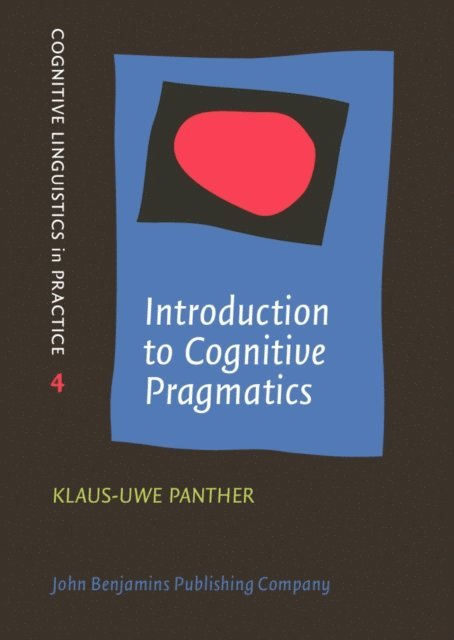
This textbook is designed for advanced (graduate and postgraduate) students, and will also be of interest to scholars. It blends a cognitive linguistic approach to language and language use with insights from contemporary pragmatics, the ultimate aim being to advance a unified model of cognitive pragmatics. Basic themes in cognitive linguistics and pragmatics are covered ranging from figurative language and thought, e.g. conceptual metaphor and metonymy, the role of inferencing in the construction of meaning, in particular, indirect speech acts, to the conceptual and functional motivation of morphosyntactic structure. Finally, the book offers many suggestions and ideas for student papers as well as larger research projects that promise to reveal new insights into conceptual structure, communicative function, and their influence on the grammatical structure of language.
E-bok
PDF, Engelska, 20121 233 kr
Läs direkt efter köp
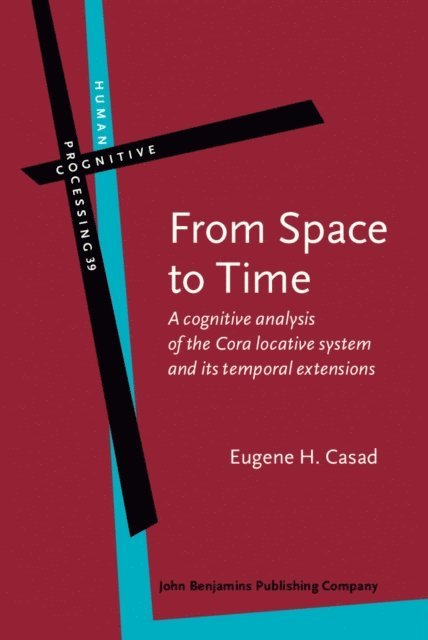
Eugene Casad's posthumous monograph is an in-depth study of the TIME IS SPACE metaphor in Cora - an Uto-Aztecan language spoken in the state of Nayarit, Mexico - within the framework of Ronald Langacker's Cognitive Grammar. The author provides an introduction to Cora speakers and their history, and traces the evolution of Cora locative expressions, comparing them with cognate or corresponding expressions in other Uto-Aztecan languages, e.g. Huichol, to reconstruct the development of Cora temporal meanings. Based on a meticulous analysis of synchronic and diachronic data, Casad postulates distinct Cora models of time, grammatical aspect, and event structure, among which the topographically based model of time is especially prominent. This important book can be regarded as the opus magnum of the author. It should be of interest to scholars working in conceptual metaphor theory, grammaticalization, and the history and typology of Uto-Aztecan languages.
E-bok
PDF, Engelska, 20031 714 kr
Läs direkt efter köp
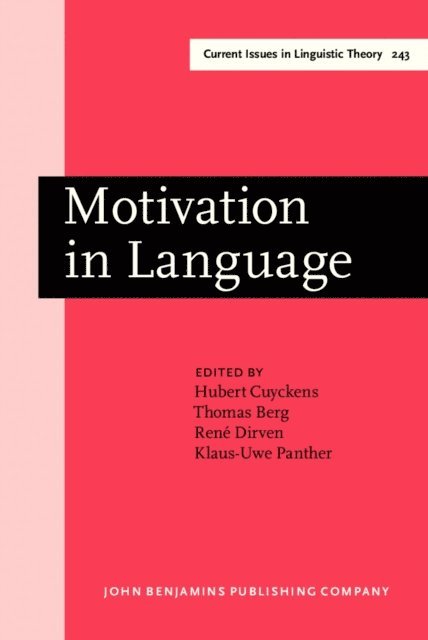
This volume contributes to the now one-century old question, ‘Is the link between forms and meanings in language essentially arbitrary, as Saussure put it, or is it on the contrary also considerably motivated?’ The greater part of the papers (Sections 1–3) analyze linguistic phenomena in which not arbitrary, but cognitively motivated links between form and meaning play a role. As such, the contributions in Section 1 examine selected aspects of motivation in the continuum between lexicon and grammar; the contributions in Section 2 study the factors underlying the range of (semantic) variants that attach to a particular lexical item; and papers in Section 3 look at motivating factors in linguistic items situated in and conceptualizing the socio-cultural domain. A smaller set of papers in Section 4 point to the role which learner motivation and attitudinal motivation may play in applied linguistics domains.
E-bok
PDF, Engelska, 20111 195 kr
Läs direkt efter köp
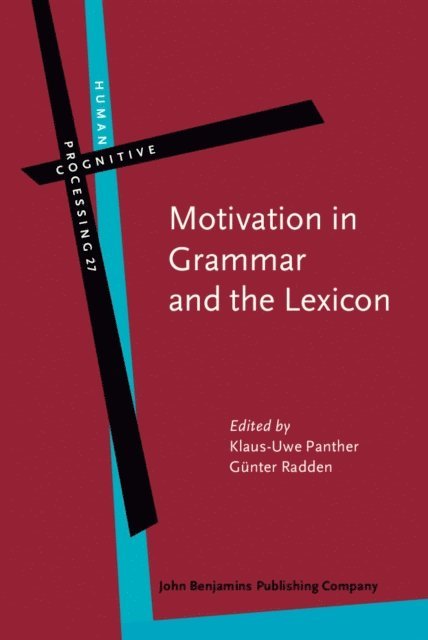
Language structure and use are largely shaped by cognitive processes such as categorizing, framing, inferencing, associative (metonymic), and analogical (metaphorical) thinking, and - mediated through cognition - by bodily experience, emotion, perception, action, social/communicative interaction, culture, and the internal ecology of the linguistic system itself. The contributors to the present volume demonstrate how these language-independent factors motivate grammar and the lexicon in a variety of languages such as English, German, French, Italian, Hungarian, Russian, Croatian, Japanese, and Korean. The volume will be of great interest to students and scholars in cognitive and functional linguistics.
E-bok
PDF, Engelska, 20091 305 kr
Läs direkt efter köp
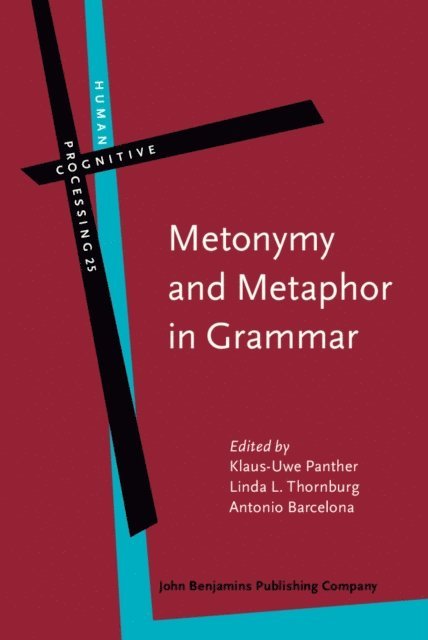
Figurative language has been regarded traditionally as situated outside the realm of grammar. However, with the advent of Cognitive Linguistics, metonymy and metaphor are now recognized as being not only ornamental rhetorical tropes but fundamental figures of thought that shape, to a considerable extent, the conceptual structure of languages. The present volume goes even beyond this insight to propose that grammar itself is metonymical in nature (Langacker) and that conceptual metonymy and metaphor leave their imprints on lexicogrammatical structure. This thesis is developed and substantiated for a wide array of languages and lexicogrammatical phenomena, such as word class meaning and word formation, case and aspect, proper names and noun phrases, predicate and clause constructions, and other metonymically and metaphorically motivated grammatical meanings and forms. The volume should be of interest to scholars and students in cognitive and functional linguistics, in particular, conceptual metonymy and metaphor theory, cognitive typology, and pragmatics.
E-bok
PDF, Engelska, 20031 447 kr
Läs direkt efter köp
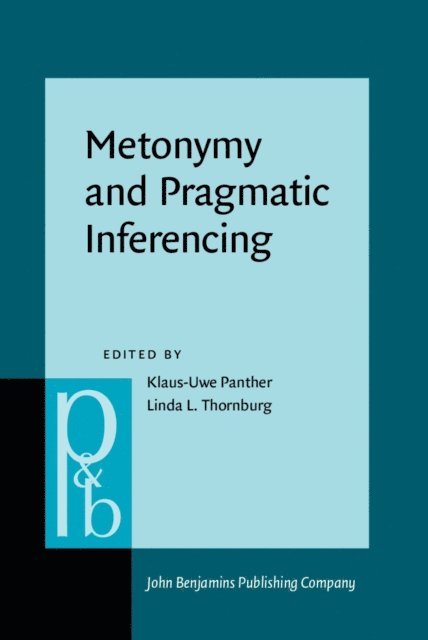
In recent years, conceptual metonymy has been recognized as a cognitive phenomenon that is as fundamental as metaphor for reasoning and the construction of meaning. The thoroughly revised chapters in the present volume originated as presentations in a workshop organized by the editors for the 7th International Pragmatics Conference held in Budapest in 2000. They constitute, according to an anonymous reviewer, "e;an interesting contribution to both cognitive linguistics and pragmatics."e; The contributions aim to bridge the gap, and encourage discussion, between cognitive linguists and scholars working in a pragmatic framework. Topics include the metonymic basis of explicature and implicature, the role of metonymically-based inferences in speech act and discourse interpretation, the pragmatic meaning of grammatical constructions, the impact of metonymic mappings on and their interaction with grammatical structure, the role of metonymic inferencing and implicature in linguistic change, and the comparison of metonymic principles across languages and different cultural settings.
E-bok
PDF, Engelska, 19991 527 kr
Läs direkt efter köp
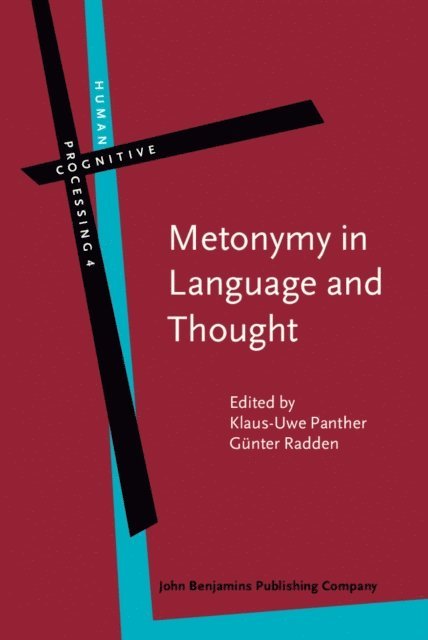
Metonymy in Language and Thought gives a state-of-the-art account of metonymic research. The contributions have different disciplinary and theoretical backgrounds in linguistics, psycholinguistics, psychology and literary studies. However, they share the assumption that metonymy is a cognitive phenomenon, a “figure of thought,” underlying much of our ordinary conceptualization that may be even more fundamental than metaphor. The use of metonymy in language is a reflection of this conceptual status. The framework within which metonymy is understood in this volume is that of scenes, frames, scenarios, domains or idealized cognitive models.The chapters are revised papers given at the Metonymy Workshop held in Hamburg, 1996.