Paolo Gasparini - Böcker
Visar alla böcker från författaren Paolo Gasparini. Handla med fri frakt och snabb leverans.
7 produkter
7 produkter
Del 4 - Future City
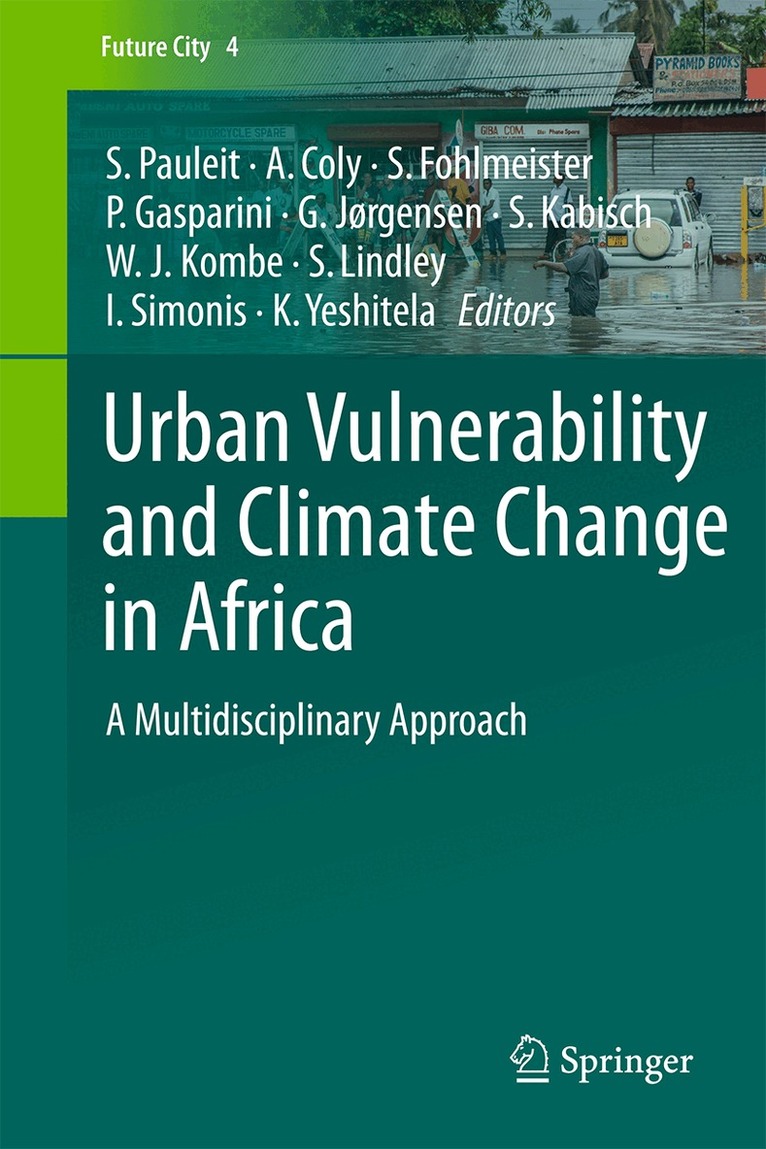
Urban Vulnerability and Climate Change in Africa
A Multidisciplinary Approach
Häftad, Engelska, 2015
1 578 kr
Skickas inom 10-15 vardagar
Urbanisation and climate change are among the major challenges for sustainable development in Africa. The overall aim of this book is to present innovative approaches to vulnerability analysis and for enhancing the resilience of African cities against climate change-induced risks. Locally adapted IPCC climate change scenarios, which also consider possible changes in urban population, have been developed. Innovative strategies to land use and spatial planning are proposed that seek synergies between the adaptation to climate change and the need to solve social problems. Furthermore, the book explores the role of governance in successfully coping with climate-induced risks in urban areas. The book is unique in that it combines: a top-down perspective of climate change modeling with a bottom-up perspective of vulnerability assessment; quantitative approaches from engineering sciences and qualitative approaches of the social sciences; a novel multi-risk modeling methodology; and strategic approaches to urban and green infrastructure planning with neighborhood perspectives of adaptation.
Del 4 - Future City
Urban Vulnerability and Climate Change in Africa
A Multidisciplinary Approach
Inbunden, Engelska, 2015
1 578 kr
Skickas inom 10-15 vardagar
Urbanisation and climate change are among the major challenges for sustainable development in Africa. The overall aim of this book is to present innovative approaches to vulnerability analysis and for enhancing the resilience of African cities against climate change-induced risks. Locally adapted IPCC climate change scenarios, which also consider possible changes in urban population, have been developed. Innovative strategies to land use and spatial planning are proposed that seek synergies between the adaptation to climate change and the need to solve social problems. Furthermore, the book explores the role of governance in successfully coping with climate-induced risks in urban areas. The book is unique in that it combines: a top-down perspective of climate change modeling with a bottom-up perspective of vulnerability assessment; quantitative approaches from engineering sciences and qualitative approaches of the social sciences; a novel multi-risk modeling methodology; and strategic approaches to urban and green infrastructure planning with neighborhood perspectives of adaptation.
Resilience and Sustainability in Relation to Natural Disasters: A Challenge for Future Cities
Häftad, Engelska, 2014
536 kr
Skickas inom 10-15 vardagar
As a result, cities and their inhabitants are becoming increasingly vulnerable to the effects of catastrophic natural events such as extreme weather events (recently more frequent and intense as a result of the ongoing climate changes), earthquakes, tsunamis or man-induced events such as terrorist attacks or accidents.
Del 4 - Future City
Urban Vulnerability and Climate Change in Africa
A Multidisciplinary Approach
Häftad, Engelska, 2016
1 625 kr
Skickas inom 10-15 vardagar
Urbanisation and climate change are among the major challenges for sustainable development in Africa. The overall aim of this book is to present innovative approaches to vulnerability analysis and for enhancing the resilience of African cities against climate change-induced risks. Locally adapted IPCC climate change scenarios, which also consider possible changes in urban population, have been developed. Innovative strategies to land use and spatial planning are proposed that seek synergies between the adaptation to climate change and the need to solve social problems. Furthermore, the book explores the role of governance in successfully coping with climate-induced risks in urban areas. The book is unique in that it combines: a top-down perspective of climate change modeling with a bottom-up perspective of vulnerability assessment; quantitative approaches from engineering sciences and qualitative approaches of the social sciences; a novel multi-risk modeling methodology; and strategic approaches to urban and green infrastructure planning with neighborhood perspectives of adaptation.
1 578 kr
Skickas inom 10-15 vardagar
During the past few decades of the 20th and the first years of the present Century, economic losses and human casualties due to natural disasters increased exponentially on our planet, mainly because of the increased density of population and industry in high hazard areas. Although the prediction of earthquakes is not practicable yet, the present technology allows a prompt identification of the onset of any dangerous seismic event before it hits an urban area. Hence early warning- and rapid disaster information systems are becoming important means for strengthening the resilience of our society against the negative consequences of extreme seismic events. Earthquake early warning can provide an alert within a few tens of seconds in advance. This small lead time may be used to minimize property damage and loss of lives in metropolitan areas and to aid emergency response. The book provides information on the major EEW systems in operation and on the state of the art of the different blocks forming an EW system: the rapid detection and estimation of the earthquake’s focal parameters, the signal transmission, the engineering interface and the information reliability/false alarm problem.
1 578 kr
Skickas inom 10-15 vardagar
During the past few decades of the 20th and the first years of the present Century, economic losses and human casualties due to natural disasters increased exponentially on our planet, mainly because of the increased density of population and industry in high hazard areas. Although the prediction of earthquakes is not practicable yet, the present technology allows a prompt identification of the onset of any dangerous seismic event before it hits an urban area. Hence early warning- and rapid disaster information systems are becoming important means for strengthening the resilience of our society against the negative consequences of extreme seismic events. Earthquake early warning can provide an alert within a few tens of seconds in advance. This small lead time may be used to minimize property damage and loss of lives in metropolitan areas and to aid emergency response. The book provides information on the major EEW systems in operation and on the state of the art of the different blocks forming an EW system: the rapid detection and estimation of the earthquake’s focal parameters, the signal transmission, the engineering interface and the information reliability/false alarm problem.
1 064 kr
Skickas inom 10-15 vardagar
For many centuries people living on volcanoes have known that the outset of seismic activity is often a forerunner of a volcanic eruption. This understand ing allowed people living close to the sites of the Mt. Nuovo 1538 eruption at Campi Flegrei, Italy, and of the Mt. Usu 1663 eruption, in Hokkaido, Japan (to quote only two examples) to flee before the eruptions started. During the second half of the 19th century seismographs were installed on some volcanoes, and the link between seismic and eruptive activity started to be assessed on a firmer scientific basis. The first systematic observations of the correlations existing between seismic activity and volcanic eruptions were probably those carried out at Mt. Vesuvius by Luigi Palmieri in 1856. Palmieri was the Director of Osservatorio Vesuviano and built an electromagnetic seismograph with the aim of "making visible the smallest ground motions by recording them on paper and indicating direction, intensity and duration". He was able to show the relationship between earthquakes and the different phases of volcanic activity. He identified the harmonic tremor which he indicated was a precursor of volcanic activity: "the characteristic feature of the ground mo tions preceding eruption is its continuity . . . (before the eruption of 1861) the electromagnetic seismograph began to show a continuous tremor". The Palmieri seismograph was also utilized in Japan until 1883, when it was replaced by the new Gray-Milne seismographs, and, later, by the Omori in struments.