Parkinson Dilworth B. Parkinson – författare
Visar alla böcker från författaren Parkinson Dilworth B. Parkinson. Handla med fri frakt och snabb leverans.
3 produkter
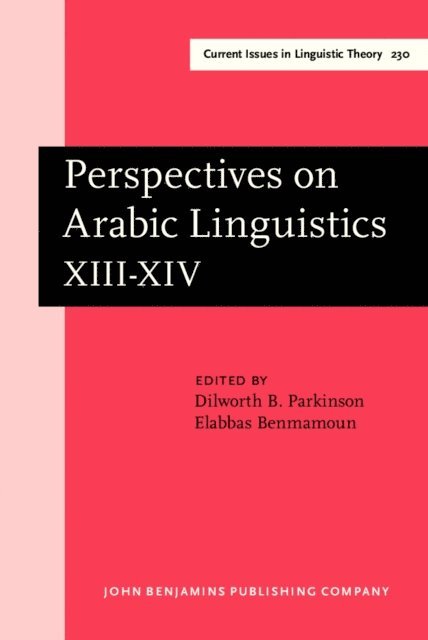
Perspectives on Arabic Linguistics
Papers from the Annual Symposium on Arabic Linguistics. Volume XIII-XIV: Stanford, 1999 and Berkeley, California 2000
Av Benmamoun Elabbas Benmamoun, Parkinson Dilworth B. Parkinson
E-bok, 2002
1544 kr
Lägg i varukorg
The papers in this collection derive from the Annual Symposia on Arabic Linguistics held in Stanford (1999) and Berkeley (2000). The selection is noteworthy for its diversity of approach, and for a noticeable broadening of the kinds of questions that are being asked and the kind of data being …
Perspectives on Arabic Linguistics
Papers from the Annual Symposium on Arabic Linguistics. Volume IX: Washington D.C., 1995
Av Parkinson Dilworth B. Parkinson, Eid Mushira Eid
E-bok, 1996
1544 kr
Lägg i varukorg
This volume includes twelve papers selected from the Ninth Annual Symposium on Arabic Linguistics, held at Georgetown University, Washington D.C., 1995. Three of the papers deal with codeswitching with Arabic, two with the acquisition of Arabic, and four with different aspects of Arabic grammatical …
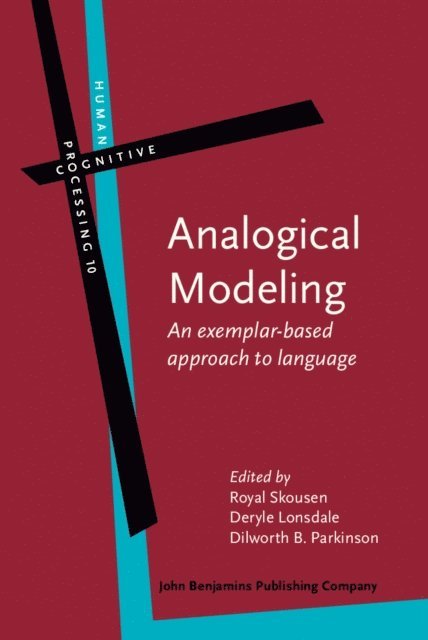
Analogical Modeling
An exemplar-based approach to language
Av Parkinson Dilworth B. Parkinson, Lonsdale Deryle Lonsdale m. fl.
E-bok, 2002
1663 kr
Lägg i varukorg
Analogical Modeling (AM) is an exemplar-based general theory of description that uses both neighbors and non-neighbors (under certain well-defined conditions of homogeneity) to predict language behavior. This book provides a basic introduction to AM, compares the theory with nearest-neighbor …