Pascal Acot – författare
836 kr
Läs direkt efter köp
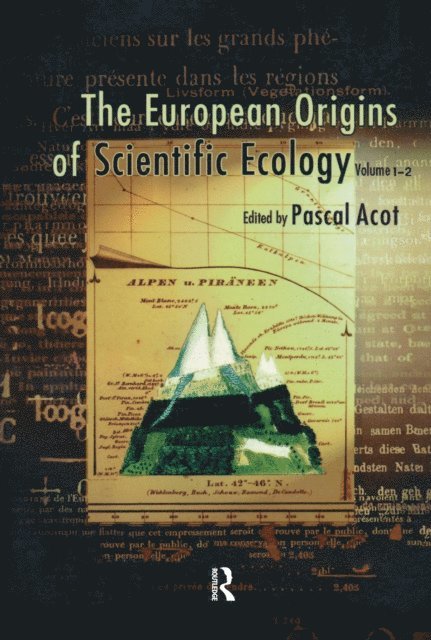
Over the last few decades, historians of scientific ecology have brought to light the role of the European scientists who have laid the basic cornerstones of modern ecology between the end of the eighteenth century and the beginning of the twentieth century. The foundations of geobotany were laid by Alexander von Humboldt (1769-1859), Augustin-Pyramus de Candolle (1778-1841), Alphonse Jules Dureau de la Malle (1777-1857), Gaston Bonnier (1853-1922) and Charles Flahault (1852-1935); biocenotics, by Erasmus Darwin (1731-1802), Charles Lyell (1797-1875), Pierre-François Verhulst (1804-1849), Charles Darwin (1809-1882), Karl Moebius (1825-1908), Charles Valentine-Riley (1843-1895), and François-Alphonse Forel (1841-1912); agrochemistry and microbiology by Justus von Liebig (1803-1873), Jean-Baptiste Boussingault (1802-1887), and Stanislas Winogradski (1856-1953); the taxonomy of communities by August Heinrich Grisebach (1813-1879), Anton Kerner von Marilaün (1831-1898), Alphonse de Candolle (1806-1893), and Charles Flahault; and anthropogeography by Karl Ritter (1779-1859), Elisée Reclus (1830-1905), and Friederich Ratzel (1844-1904). Together, they created the conditions that, with Eugenius Warming (1841-1924), gave birth to the autonomous discipline of scientific ecology, thirty years after the German biologist Ernst Haeckel (1834-1919) had christened this new branch of biology.Up to now, the writings of these scientists have been scattered in various publications that were often not accessible, which made a comparative study almost impossible. There was thus a need to bring together the primary sources in their original form, pagination, and language (whenever possible, a version of the text has been made available in a second language as well). They are gathered here in two volumes, in an analytical framework that aids in understanding their relevant historical context and significance.To deal with the complex multidisciplinary roots of the history of ecology, Pascal Acot has brought together a group of historians with authoritative knowledge of the field''s various sub-branches, without ever losing sight of ecology''s relationship to the broader history of biology and the environmental sciences.
341 kr
Läs direkt efter köp
Depuis les années 1960, les recherches d’Emmanuel Le Roy Ladurie occupent une place centrale dans les développements de l’histoire du climat, discipline née des travaux d’historiens et de scientifiques européens.En pionnier de la climatologie historique, Emmanuel Le Roy Ladurie offre ici au lecteur le récit de l’émergence de cette discipline lors de la seconde moitié du XXe siècle. Ce récit, inévitablement autobiographique, envisage la prise de conscience climatique de l’auteur depuis sa jeunesse agricole jusqu’à l’élaboration de ses thèses sur le passé des glaciers alpins et leur dramatique recul.Plus factuelle, la seconde partie de l’ouvrage présente cette histoire de façon périodique. Elle est ponctuée par des considérations sur les méthodes de recherche (contribution de l’histoire des vendanges à la connaissance du passé climatique multi séculaire, séries thermométriques, périodisation du petit âge glaciaire et du réchauffement contemporain, vives controverses à notre époque sur le sujet…) et appuyée par la partie statistique et graphique conçue par Daniel Rousseau.