Pascal Laugier – Författare
Visar alla böcker från författaren Pascal Laugier. Handla med fri frakt och snabb leverans.
4 produkter
4 produkter
Del 1364 - Advances in Experimental Medicine and Biology
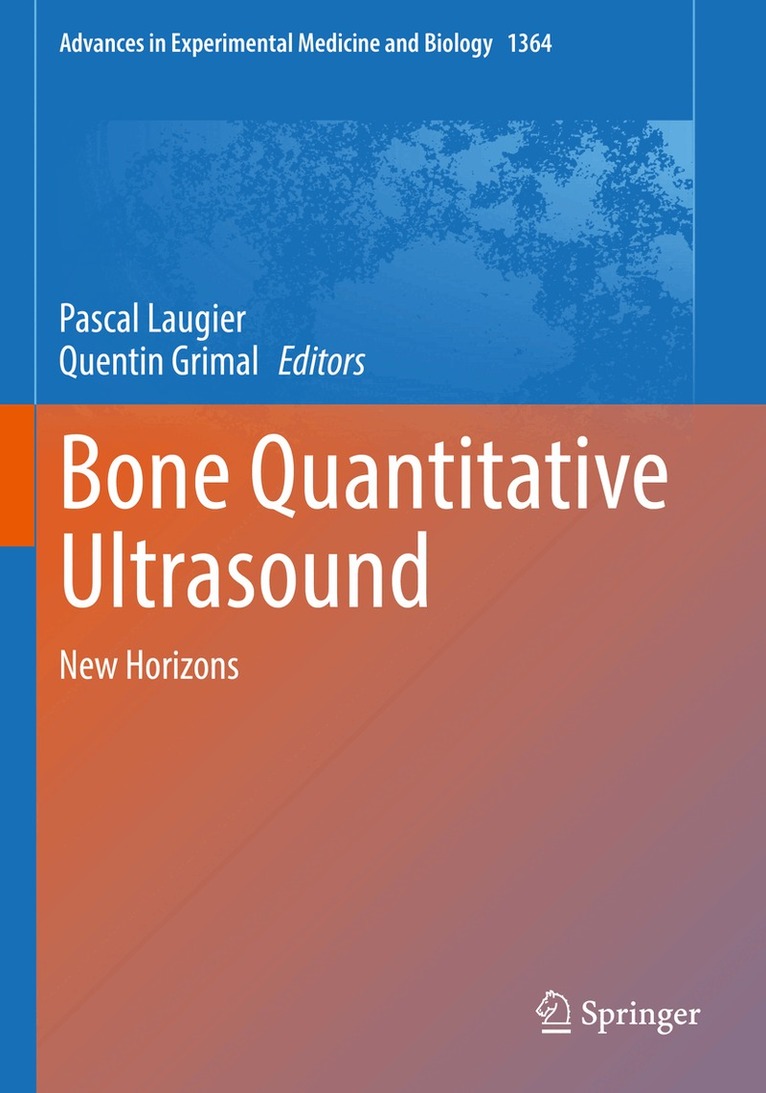
Bone Quantitative Ultrasound
New Horizons
Inbunden, Engelska, 2022
1 745 kr
Skickas inom 10-15 vardagar
Many significant achievements in new ultrasound technologies to measure bone and models to elucidate the interaction and the propagation of ultrasonic waves in complex bone structures have been reported over the past ten years. Impaired bone remodeling affects not only the trabecular compartment but also the cortical one. Despite the crucial contribution of the cortical structure to the whole bone mechanical competence, cortical bone was understudied for a long time. A paradigm shift occurred around 2010, with a special focus placed on the importance of cortical bone. This has sparkled a great deal of interest in new ultrasound techniques to assess cortical bone. While our book ‘Bone Quantitative Ultrasound’ published in 2011 emphasized techniques to measure trabecular bone, this new book is devoted for a large part to the technologies introduced recently to measure cortical bone. These include resonant ultrasound spectroscopy, guided waves, scattering, and pulse-echo and tomographyimaging techniques. Instrumentation, signal processing techniques and models used are detailed. Importantly, the data accumulated in recent years such as anisotropic stiffness, elastic engineering moduli, compression and shear wave speeds of cortical bones from various skeletal sites are presented comprehensively. A few chapters deal with the recent developments achieved in quantitative ultrasound of trabecular bone. These include (i) scattering-based approaches and their application to measure skeletal sites such as the spine and proximal femur and (ii) approaches exploiting the poro-elastic nature of bone. While bone fragility and osteoporosis are still the main motivation for developing bone QUS, this Book also includes chapters reporting ultrasound techniques developed for other applications of high interest such as 3-D imaging of the spine, assessment of implant stability and transcranial brain imaging.This book, together with the book ‘Bone Quantitative Ultrasound’ published in 2011 will provide a comprehensive overview of the methods and principles used in bone quantitative ultrasound and will be a benchmark for all novice or experienced researchers in the field.The book will offer recent experimental results and theoretical concepts developed so far and would be intended for researchers, graduate or undergraduate students, engineers, and clinicians who are involved in the field.The book should be considered as a complement to the first book publisher in 2011, rather than a second edition, in the sense that basic notions already presented in the first book are not repeated.
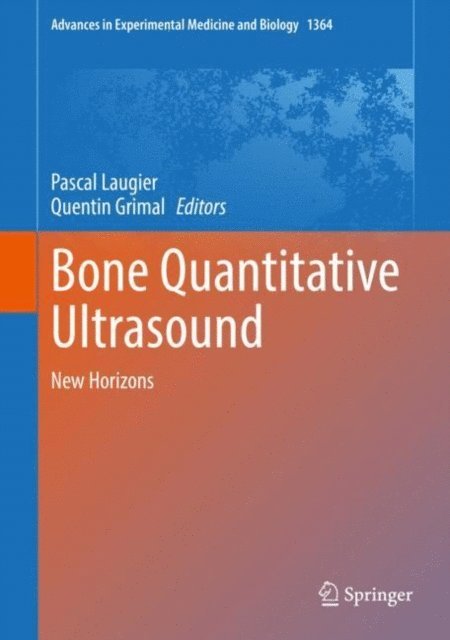
Del 1364 - Advances in Experimental Medicine and Biology
Bone Quantitative Ultrasound
New Horizons
Häftad, Engelska, 2023
1 745 kr
Skickas inom 10-15 vardagar
Many significant achievements in new ultrasound technologies to measure bone and models to elucidate the interaction and the propagation of ultrasonic waves in complex bone structures have been reported over the past ten years. Impaired bone remodeling affects not only the trabecular compartment but also the cortical one. Despite the crucial contribution of the cortical structure to the whole bone mechanical competence, cortical bone was understudied for a long time. A paradigm shift occurred around 2010, with a special focus placed on the importance of cortical bone. This has sparkled a great deal of interest in new ultrasound techniques to assess cortical bone. While our book ‘Bone Quantitative Ultrasound’ published in 2011 emphasized techniques to measure trabecular bone, this new book is devoted for a large part to the technologies introduced recently to measure cortical bone. These include resonant ultrasound spectroscopy, guided waves, scattering, and pulse-echo and tomographyimaging techniques. Instrumentation, signal processing techniques and models used are detailed. Importantly, the data accumulated in recent years such as anisotropic stiffness, elastic engineering moduli, compression and shear wave speeds of cortical bones from various skeletal sites are presented comprehensively. A few chapters deal with the recent developments achieved in quantitative ultrasound of trabecular bone. These include (i) scattering-based approaches and their application to measure skeletal sites such as the spine and proximal femur and (ii) approaches exploiting the poro-elastic nature of bone. While bone fragility and osteoporosis are still the main motivation for developing bone QUS, this Book also includes chapters reporting ultrasound techniques developed for other applications of high interest such as 3-D imaging of the spine, assessment of implant stability and transcranial brain imaging.This book, together with the book ‘Bone Quantitative Ultrasound’ published in 2011 will provide a comprehensive overview of the methods and principles used in bone quantitative ultrasound and will be a benchmark for all novice or experienced researchers in the field.The book will offer recent experimental results and theoretical concepts developed so far and would be intended for researchers, graduate or undergraduate students, engineers, and clinicians who are involved in the field.The book should be considered as a complement to the first book publisher in 2011, rather than a second edition, in the sense that basic notions already presented in the first book are not repeated.
2 397 kr
Skickas inom 10-15 vardagar
Quantitative ultrasound (QUS) of bone is a relatively recent research field. The research community is steadily growing, with interdisciplinary branches in acoustics, medical imaging, biomechanics, biomedical engineering, applied mathematics, bone biology and clinical sciences, resulting in significant achievements in new ultrasound technologies to measure bone, as well as models to elucidate the interaction and the propagation of ultrasonic wave in complex bone structures. Hundreds of articles published in specialists journals are accessible from the Web and from electronic libraries. However, no compilation and synthesis of the most recent and significant research exist. The only book on QUS of bone has been published in 1999 at a time when the propagation mechanisms of ultrasound in bone were still largely unknown and the technology was immature. The research community has now reached a critical size, special sessions are organized in major international meetings (e.g., at the World Congress of Biomechanics, the annual meetings of the Acoustical Society of America, International Bone Densitometry Workshop, etc...). Consequently, the time has come for a completely up to date, comprehensive review of the topic. The book will offer the most recent experimental results and theoretical concepts developed so far and is intended for researchers, graduate or undergraduate students, engineers, and clinicians who are involved in the field. The central part of the book covers the physics of ultrasound propagation in bone. Our goal is to give the reader an extensive view of the mathematical and numerical models as an aid to understand the QUS potential and the types of variables that can be determined by QUS in order to characterize bone strength. The propagation of sound in bone is still subject of intensive research. Different models have been proposed (for example, the Biot theory of poroelasticity and the theory of scattering have been used to describe wave propagation in cancellous bone, whereas propagation in cortical bone falls in the scope of guided waves theories). An extensive review of the models has not been published so far. We intend in this book to present in details the models that are used to solve the direct problem and strategies that are currently developed to address the inverse problem. This will include analytical theories and numerical approaches that have grown exponentially in recent years. Most recent experimental findings and technological developments will also be comprehensively reviewed.
2 397 kr
Skickas inom 10-15 vardagar
Quantitative ultrasound (QUS) of bone is a relatively recent research field. The research community is steadily growing, with interdisciplinary branches in acoustics, medical imaging, biomechanics, biomedical engineering, applied mathematics, bone biology and clinical sciences, resulting in significant achievements in new ultrasound technologies to measure bone, as well as models to elucidate the interaction and the propagation of ultrasonic wave in complex bone structures. Hundreds of articles published in specialists journals are accessible from the Web and from electronic libraries. However, no compilation and synthesis of the most recent and significant research exist. The only book on QUS of bone has been published in 1999 at a time when the propagation mechanisms of ultrasound in bone were still largely unknown and the technology was immature. The research community has now reached a critical size, special sessions are organized in major international meetings (e.g., at the World Congress of Biomechanics, the annual meetings of the Acoustical Society of America, International Bone Densitometry Workshop, etc...). Consequently, the time has come for a completely up to date, comprehensive review of the topic. The book will offer the most recent experimental results and theoretical concepts developed so far and is intended for researchers, graduate or undergraduate students, engineers, and clinicians who are involved in the field. The central part of the book covers the physics of ultrasound propagation in bone. Our goal is to give the reader an extensive view of the mathematical and numerical models as an aid to understand the QUS potential and the types of variables that can be determined by QUS in order to characterize bone strength. The propagation of sound in bone is still subject of intensive research. Different models have been proposed (for example, the Biot theory of poroelasticity and the theory of scattering have been used to describe wave propagation in cancellous bone, whereas propagation in cortical bone falls in the scope of guided waves theories). An extensive review of the models has not been published so far. We intend in this book to present in details the models that are used to solve the direct problem and strategies that are currently developed to address the inverse problem. This will include analytical theories and numerical approaches that have grown exponentially in recent years. Most recent experimental findings and technological developments will also be comprehensively reviewed.