
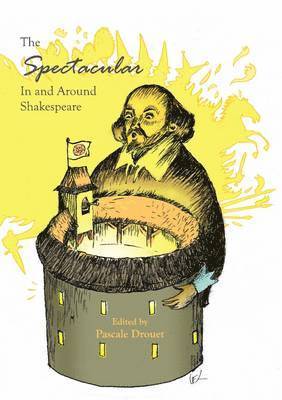
This volume addresses the economy of the spectacular in and around Shakespeare's plays, both in early modern England and in late-twentieth/twenty-first-century adaptations and appropriations. Apart from addressing issues such as (im)plausibility, tours de force arousing amazement, and excess for the sake of entertainment, it raises the question of intentionality—what is behind the spectacular? Is there always a manipulative purpose? How far-reaching are the political and ideological stakes?The contributors to this volume investigate a broad spectrum of particular phenomena: the spectacular sound effects and pyrotechnics displayed for the opening of the Globe theatre with Julius Caesar on performance; George Gascoigne's lavish 1575 pageant commissioned by the Earl of Leicester for the queen at Kenilworth (The Princely Pleasures); the relationship between the spectacular and scientific discoveries, as well as their dialectics of appropriation; the impact of Mannerist art on The Winter's Tale; Coriolanus' resistance to ostentation and political shows; the anti-spectacular counter-current running through Timon of Athens; Julia Pascal's innovative 2007 stage production of The Merchant of Venice; apocalyptic screen adaptations of turn-of-the-century Jacobean tragedies, and Richard III's potential to be graphically interpreted in 2008 as political satire and as a danse macabre.
This book analyses three Shakespearean plays that particularly deal with abusive forms of banishment: King Richard II, Coriolanus, and King Lear. In these plays, the abuses of power are triggered by fearless speeches that question the legitimacy of power and are misinterpreted as breaches of allegiance; in these plays, both the bold speech of the fearless speaker and the performative sentence of the banisher trigger the relentless dynamics of what Deleuze and Guattari termed ‘deterritorialisation’. This book approaches the central question of the abusive denial of territory from various angles: linguistic, legal and ethical, physical and psychological. Various strategies of resistance are explored: illegal return, which takes the form of a frontal counterattack employing a ‘war machine’; ruse and the experience of internal(ised) exile; and mental escape, which nonetheless may lead to madness, exhaustion or heartbreak.
This volume addresses the economy of the spectacular in and around Shakespeare's plays, both in early modern England and in late-twentieth/twenty-first-century adaptations and appropriations. Apart from addressing issues such as (im)plausibility, tours de force arousing amazement, and excess for the sake of entertainment, it raises the question of intentionality—what is behind the spectacular? Is there always a manipulative purpose? How far-reaching are the political and ideological stakes?The contributors to this volume investigate a broad spectrum of particular phenomena: the spectacular sound effects and pyrotechnics displayed for the opening of the Globe theatre with Julius Caesar on performance; George Gascoigne's lavish 1575 pageant commissioned by the Earl of Leicester for the queen at Kenilworth (The Princely Pleasures); the relationship between the spectacular and scientific discoveries, as well as their dialectics of appropriation; the impact of Mannerist art on The Winter's Tale; Coriolanus' resistance to ostentation and political shows; the anti-spectacular counter-current running through Timon of Athens; Julia Pascal's innovative 2007 stage production of The Merchant of Venice; apocalyptic screen adaptations of turn-of-the-century Jacobean tragedies, and Richard III's potential to be graphically interpreted in 2008 as political satire and as a danse macabre.

This book analyses three Shakespearean plays that particularly deal with abusive forms of banishment: King Richard II, Coriolanus, and King Lear. In these plays, the abuses of power are triggered by fearless speeches that question the legitimacy of power and are misinterpreted as breaches of allegiance; in these plays, both the bold speech of the fearless speaker and the performative sentence of the banisher trigger the relentless dynamics of what Deleuze and Guattari termed ‘deterritorialisation’. This book approaches the central question of the abusive denial of territory from various angles: linguistic, legal and ethical, physical and psychological. Various strategies of resistance are explored: illegal return, which takes the form of a frontal counterattack employing a ‘war machine’; ruse and the experience of internal(ised) exile; and mental escape, which nonetheless may lead to madness, exhaustion or heartbreak.