Patrice Degoulet – författare
Visar alla böcker från författaren Patrice Degoulet. Handla med fri frakt och snabb leverans.
6 produkter
6 produkter
E-bok
PDF, Engelska, 20061 367 kr
Läs direkt efter köp
This series is directed to healthcare professionals who are leading the tra- formation of health care by using information and knowledge. Launched in 1988 as Computers in Health Care, the series offers a broad range of titles: some addressed to specific professions such as nursing, medicine, and health administration; others to special areas of practice such as trauma and radiology. Still other books in the series focus on interdisciplinary issues, such as the computer-based patient record, electronic health records, and networked healthcare systems. Renamed Health Informatics in 1998 to reflect the rapid evolution in the discipline now known as health informatics, the series will continue to add titles that contribute to the evolution of the field. In the series, eminent experts, serving as editors or authors, offer their accounts of innovations in health informatics. Increasingly, these accounts go beyond hardware and software to address the role of information in influencing the transformation of healthcare delivery systems around the world. The series also incre- ingly focuses on “peopleware” and the organizational, behavioral, and so- etal changes that accompany the diffusion of information technology in health services environments.
Inbunden, Engelska, 1996
1 116 kr
Skickas inom 10-15 vardagar
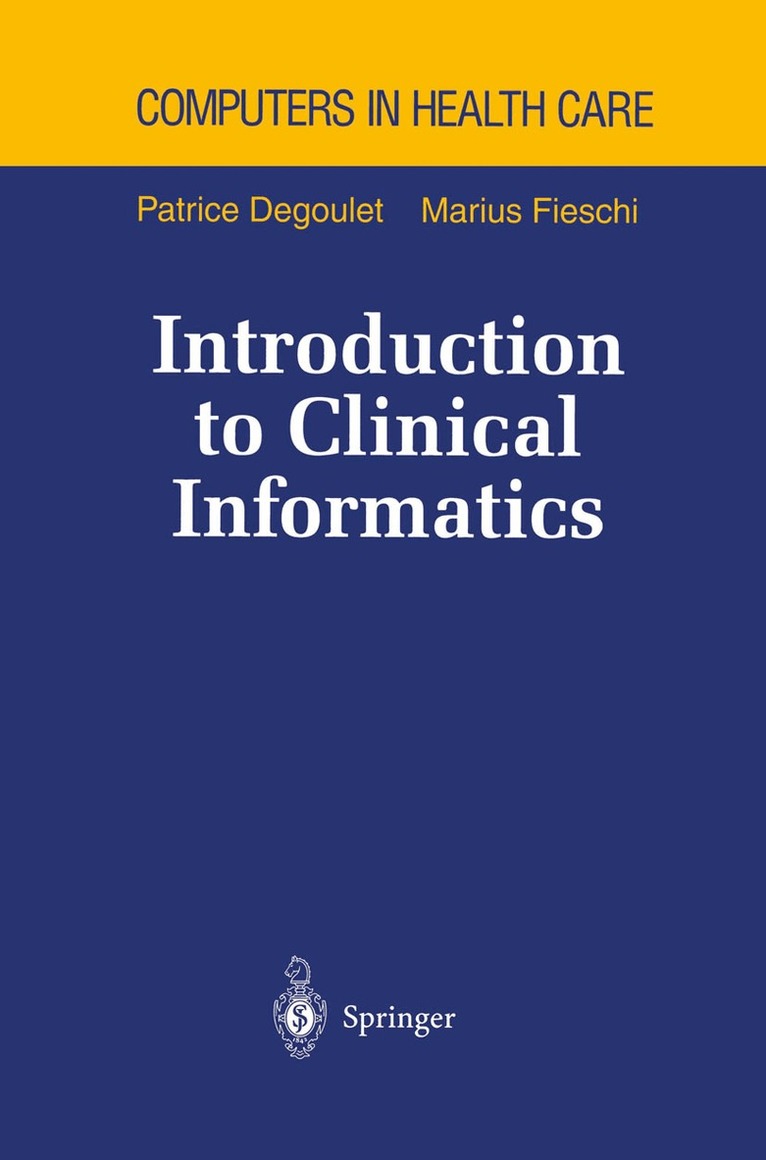
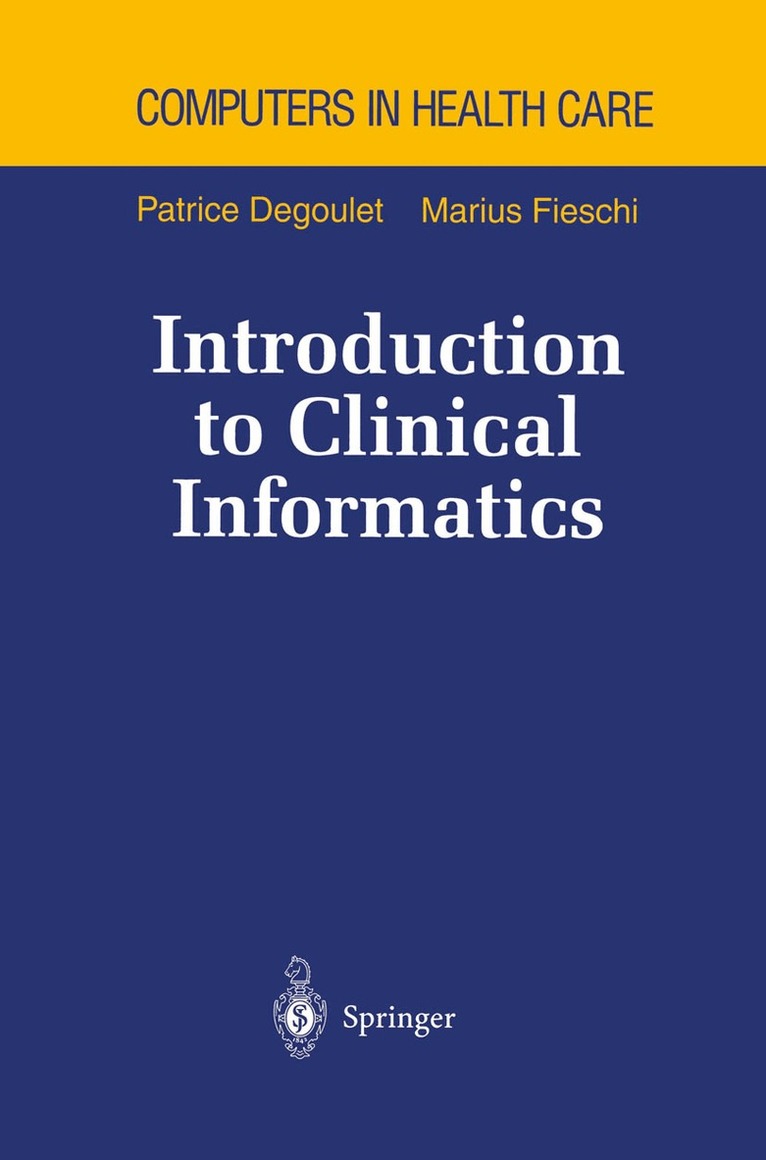
Introduction to Clinical Informatics fills a void in the Computer in Health Care series. With this volume, Patrice Degoulet and Marius Fieschi provide a comprehensive view of medical informatics and carry that concept forward into the realm of clinical informatics. The authors draw upon their experi ences as medical school faculty members in France, where informatics has long been integrated into the curriculum and where the French version of this very book has been used, tested, and revised. In intent and content, this volume stands as the companion volume to Introduction to Nursing Informatics, one of the series' best selling titles. For practitioners and students of medicine, pharmacy, and other health profes sions, Introduction to Clinical Informatics offers an essential understanding how computing can support patient care, clarifying practical uses and critical issues. Today medical schools in the United States are making informatics a part of their curriculum, with required medical informatics blocks at the onset of training serving as the base for problem-based learning throughout the course of study. In an increasingly networked and computerized environ ment, health-care providers are having to alter how they practice. Whether in the office, the clinic, or the hospital, health-care professionals have access to a growing array of capabilities and tools as they deliver care. Learning to use these becomes a top priority, and this volume becomes a valuable resource.
Inbunden, Engelska, 2003
1 084 kr
Skickas inom 10-15 vardagar
This series is directed to healthcare professionals who are leading the tra- formation of health care by using information and knowledge. Launched in 1988 as Computers in Health Care, the series offers a broad range of titles: some addressed to specific professions such as nursing, medicine, and health administration; others to special areas of practice such as trauma and radiology. Still other books in the series focus on interdisciplinary issues, such as the computer-based patient record, electronic health records, and networked healthcare systems. Renamed Health Informatics in 1998 to reflect the rapid evolution in the discipline now known as health informatics, the series will continue to add titles that contribute to the evolution of the field. In the series, eminent experts, serving as editors or authors, offer their accounts of innovations in health informatics. Increasingly, these accounts go beyond hardware and software to address the role of information in influencing the transformation of healthcare delivery systems around the world. The series also incre- ingly focuses on “peopleware” and the organizational, behavioral, and so- etal changes that accompany the diffusion of information technology in health services environments.
Häftad, Engelska, 2010
1 299 kr
Skickas inom 10-15 vardagar
This series is directed to healthcare professionals who are leading the tra- formation of health care by using information and knowledge. Launched in 1988 as Computers in Health Care, the series offers a broad range of titles: some addressed to specific professions such as nursing, medicine, and health administration; others to special areas of practice such as trauma and radiology. Still other books in the series focus on interdisciplinary issues, such as the computer-based patient record, electronic health records, and networked healthcare systems. Renamed Health Informatics in 1998 to reflect the rapid evolution in the discipline now known as health informatics, the series will continue to add titles that contribute to the evolution of the field. In the series, eminent experts, serving as editors or authors, offer their accounts of innovations in health informatics. Increasingly, these accounts go beyond hardware and software to address the role of information in influencing the transformation of healthcare delivery systems around the world. The series also incre- ingly focuses on “peopleware” and the organizational, behavioral, and so- etal changes that accompany the diffusion of information technology in health services environments.
E-bok
PDF, Engelska, 20121 379 kr
Läs direkt efter köp
Introduction to Clinical Informatics fills a void in the Computer in Health Care series. With this volume, Patrice Degoulet and Marius Fieschi provide a comprehensive view of medical informatics and carry that concept forward into the realm of clinical informatics. The authors draw upon their experi ences as medical school faculty members in France, where informatics has long been integrated into the curriculum and where the French version of this very book has been used, tested, and revised. In intent and content, this volume stands as the companion volume to Introduction to Nursing Informatics, one of the series'' best selling titles. For practitioners and students of medicine, pharmacy, and other health profes sions, Introduction to Clinical Informatics offers an essential understanding how computing can support patient care, clarifying practical uses and critical issues. Today medical schools in the United States are making informatics a part of their curriculum, with required medical informatics blocks at the onset of training serving as the base for problem-based learning throughout the course of study. In an increasingly networked and computerized environ ment, health-care providers are having to alter how they practice. Whether in the office, the clinic, or the hospital, health-care professionals have access to a growing array of capabilities and tools as they deliver care. Learning to use these becomes a top priority, and this volume becomes a valuable resource.
Häftad, Engelska, 2012
1 192 kr
Skickas inom 10-15 vardagar
Introduction to Clinical Informatics fills a void in the Computer in Health Care series. With this volume, Patrice Degoulet and Marius Fieschi provide a comprehensive view of medical informatics and carry that concept forward into the realm of clinical informatics. The authors draw upon their experi ences as medical school faculty members in France, where informatics has long been integrated into the curriculum and where the French version of this very book has been used, tested, and revised. In intent and content, this volume stands as the companion volume to Introduction to Nursing Informatics, one of the series' best selling titles. For practitioners and students of medicine, pharmacy, and other health profes sions, Introduction to Clinical Informatics offers an essential understanding how computing can support patient care, clarifying practical uses and critical issues. Today medical schools in the United States are making informatics a part of their curriculum, with required medical informatics blocks at the onset of training serving as the base for problem-based learning throughout the course of study. In an increasingly networked and computerized environ ment, health-care providers are having to alter how they practice. Whether in the office, the clinic, or the hospital, health-care professionals have access to a growing array of capabilities and tools as they deliver care. Learning to use these becomes a top priority, and this volume becomes a valuable resource.