Patrice Geoffron – författare
Visar alla böcker från författaren Patrice Geoffron. Handla med fri frakt och snabb leverans.
4 produkter
4 produkter
Häftad, Franska, 2017
222 kr
Skickas inom 5-8 vardagar
E-bok
Franska, 2013190 kr
Läs direkt efter köp
Ce livre dresse l’inventaire des atouts et des faiblesses du modèle énergétique français. Côté atouts : une expertise et un patrimoine énergétiques sans équivalent ; côté faiblesses : une trop forte dépendance aux hydrocarbures, une part insuffisante du renouvelable, des prix qui ne reflètent pas la réalité du marché. Alors comment reconstruire notre modèle : faut-il lever l’interdiction sur les gaz de schiste pour réduire nos importations ? Quelle place pour le nucléaire face au réchauffement climatique ? Qui va payer le développement des énergies renouvelables et les transformations associées ? Enfin, comment rendre notre système énergétique plus efficace et lutter contre la précarité énergétique grandissante ? Citoyen, consommateur, professionnel, nous sommes tous concernés à un degré ou un autre par ces questions. Brisant un certain nombre de tabous – sur les prix, les gaz de schiste, le nucléaire –, ce livre éclaire les enjeux du débat et souligne les opportunités de la nécessaire transition qui s’ouvre à nous. Jean-Marie Chevalier est professeur d’économie et senior associate au Cambridge Energy Research Associates (IHS-CERA). Ses ouvrages sur l’énergie font autorité. Michel Cruciani, après avoir exercé diverses responsabilités au sein d’EDF et de GDF jusqu’en 2007, est aujourd’hui conseiller auprès du Centre de géopolitique de l’énergie et des matières premières (CGEMP) de l’université Paris-Dauphine. Patrice Geoffron est professeur d’économie et dirige le CGEMP de l’université Paris-Dauphine.
Inbunden, Engelska, 2026
2 186 kr
Skickas inom 10-15 vardagar
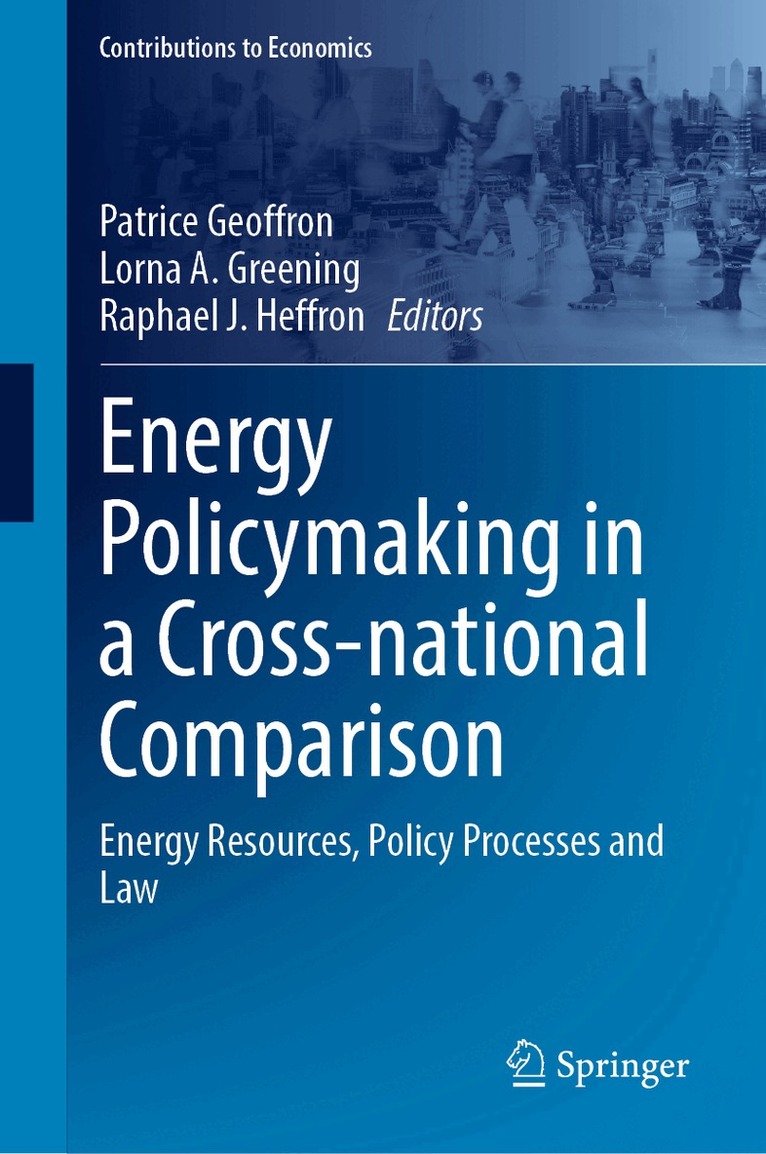
This book examines energy policymaking processes from a cross-national perspective. It presents 19 in-depth country studies written by experts with extensive experience in the respective country or region. Each study explores the country’s unique approach to energy policymaking, which is shaped by various factors, including domestic energy endowments, formal governance structures, environmental laws and regulations, cultural attributes, and historical experiences. All the studies employ a unique, flexible framework, adapted from the work of Elinor Ostrom. The framework has no behavioral assumptions, and allows for consideration of greater numbers of variables than other theories of policymaking. This approach has an advantage over previous theories particularly when comparing developed and developing economies.With the applied policymaking framework, the book highlights commonalities of successful energy policymaking efforts, and offers practical guidance on cooperation at the international level. Given the breadth of coverage, it offers valuable insights for social scientists researching energy policy and policymaking processes, and for policymakers pursuing international efforts such as the 2015 Paris agreement.
E-bok
Engelska, 20263 157 kr
Läs direkt efter köp
This book examines energy policymaking processes from a cross-national perspective. It presents 19 in-depth country studies written by experts with extensive experience in the respective country or region. Each study explores the country’s unique approach to energy policymaking, which is shaped by various factors, including domestic energy endowments, formal governance structures, environmental laws and regulations, cultural attributes, and historical experiences. All the studies employ a unique, flexible framework, adapted from the work of Elinor Ostrom. The framework has no behavioral assumptions, and allows for consideration of greater numbers of variables than other theories of policymaking. This approach has an advantage over previous theories particularly when comparing developed and developing economies.With the applied policymaking framework, the book highlights commonalities of successful energy policymaking efforts, and offers practical guidance on cooperation at the international level. Given the breadth of coverage, it offers valuable insights for social scientists researching energy policy and policymaking processes, and for policymakers pursuing international efforts such as the 2015 Paris agreement.