
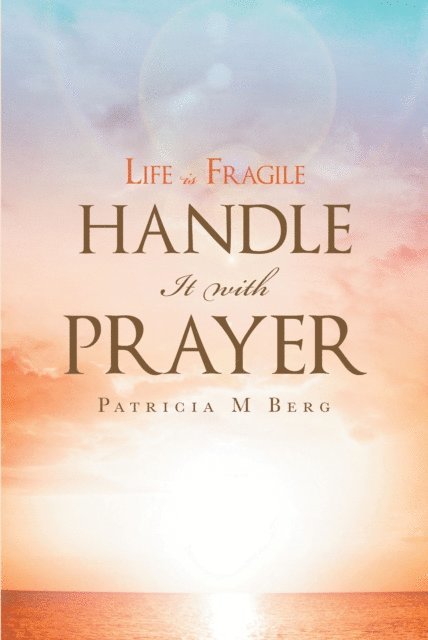
Life is a journey filled with many up and downs. By the time I was in my early thirties, I had lost my sister, my father, my three-year-old godson/nephew, my brother-in-law, and my mother-five immediate family members in four years. In the midst of all this, I had dealt with alcoholism and then divorce, having to start over again with two small children, no child support, and making only minimum wage at the time. This was just the beginning of many trials and tribulations. How did I handle it, you ask? Prayer, of course; when life gets fragile, handle it with prayer. This is not just something I say; it is something I live by. I have found that God gives you direction if you just trust him. It may be something as simple as a feeling or as concrete as an eight-foot statue of Jesus on a cloud. It was through these tragedies that I not only survived but actually was strengthened in my faith and spirit. It seems these things that strengthened me actually prepared me for what lay ahead and allowed God to bless and use me to help others. God gives us what we need when we need it; we only have to ask. You can contact the author at handlelifewithprayer@gmail.com.

I was so excited to be having my faith stories published. It seemed everything fell into place. The very first publisher, I sent it to approved the book for publishing. Life Is Fragile Handle It with Prayer was now in the editing or publishing process. This time period began a series of problems, obstacles, and issues. I think they were meant to distract me, slow me down, or get me to forget about publishing the book altogether. I soon realized after doing some research and talking to other Christian authors and clergy that the devil was the culprit. I handled it, as all things in my life, with prayer. The joke was on the devil because the worse things got the more I prayed. I even enlisted friends, family, and some clergy to join in and pray for me and with me. It was a long six months with many trials and tribulations. Looking back at events in my life, the things that at the time I thought were horrific, scary, or crazy really were mostly funny later. That was the case here, and the name of the book is Everything Is Funny Later.
In the 1840s the Finnish Orientalist Georg August Wallin travelled in the Middle East, where he collected material on Arabic dialects. In order to make contact with the local inhabitants he assumed a Muslim identity and disguised himself as the physician 'Abd al-Wali from Central Asia. As an observer he was both inquisitive and sharp-eyed, and therefore well able to document daily life among the urban dwellers of Cairo and the Bedouin of the northern Arabian Peninsula. His unique material is preserved in diaries and letters which he wrote in his native language, Swedish -- sometimes, however, with Arabic script to evade detection. By his contemporaries he was considered an eminent scholar, but he died shortly after his seven-year journey, and was therefore able to publish only a fraction of his material, which was subsequently obscured from the international research community by the language barrier. Wallin's life and travels in Egypt, the Arabian Peninsula and Persia are described here by four scholars of Middle Eastern culture and history. They also highlight Wallin's importance as an ethnographic observer and linguistic researcher.
Life is a journey filled with many up and downs. By the time I was in my early thirties, I had lost my sister, my father, my three-year-old godson/nephew, my brother-in-law, and my mother-five immediate family members in four years. In the midst of all this, I had dealt with alcoholism and then divorce, having to start over again with two small children, no child support, and making only minimum wage at the time. This was just the beginning of many trials and tribulations. How did I handle it, you ask? Prayer, of course; when life gets fragile, handle it with prayer. This is not just something I say; it is something I live by. I have found that God gives you direction if you just trust him. It may be something as simple as a feeling or as concrete as an eight-foot statue of Jesus on a cloud. It was through these tragedies that I not only survived but actually was strengthened in my faith and spirit. It seems these things that strengthened me actually prepared me for what lay ahead and allowed God to bless and use me to help others. God gives us what we need when we need it; we only have to ask. You can contact the author at handlelifewithprayer@gmail.com.
I was so excited to be having my faith stories published. It seemed everything fell into place. The very first publisher, I sent it to approved the book for publishing. Life Is Fragile Handle It with Prayer was now in the editing or publishing process. This time period began a series of problems, obstacles, and issues. I think they were meant to distract me, slow me down, or get me to forget about publishing the book altogether. I soon realized after doing some research and talking to other Christian authors and clergy that the devil was the culprit. I handled it, as all things in my life, with prayer. The joke was on the devil because the worse things got the more I prayed. I even enlisted friends, family, and some clergy to join in and pray for me and with me. It was a long six months with many trials and tribulations. Looking back at events in my life, the things that at the time I thought were horrific, scary, or crazy really were mostly funny later. That was the case here, and the name of the book is Everything Is Funny Later.
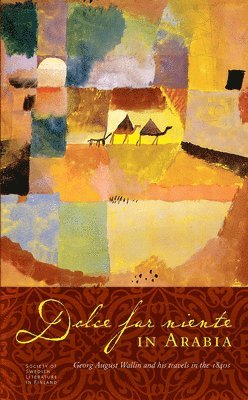
In the 1840s the Finnish Orientalist Georg August Wallin travelled in the Middle East, where he collected material on Arabic dialects. In order to make contact with the local inhabitants he assumed a Muslim identity and disguised himself as the physician 'Abd al-Wali from Central Asia. As an observer he was both inquisitive and sharp-eyed, and therefore well able to document daily life among the urban dwellers of Cairo and the Bedouin of the northern Arabian Peninsula. His unique material is preserved in diaries and letters which he wrote in his native language, Swedish -- sometimes, however, with Arabic script to evade detection. By his contemporaries he was considered an eminent scholar, but he died shortly after his seven-year journey, and was therefore able to publish only a fraction of his material, which was subsequently obscured from the international research community by the language barrier. Wallin's life and travels in Egypt, the Arabian Peninsula and Persia are described here by four scholars of Middle Eastern culture and history. They also highlight Wallin's importance as an ethnographic observer and linguistic researcher.