
Patrick MAller – författare
812 kr
Läs direkt efter köp
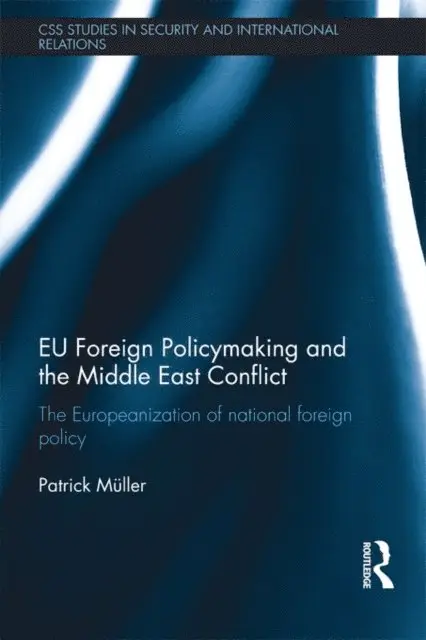
This book examines the interplay between the national and the European levels in EU foreign policymaking, focusing on the Middle East.
European engagement in peacemaking in the Middle East dates back to foreign-policy cooperation in the early 1970s. Following the launch of the peace process in 1991, the EU and its Member States further stepped up their involvement in conflict resolution, focusing on one central area of EU engagement – the Israeli-Palestinian conflict. This book covers the period from the beginning of the peace process in 1991 until 2008, and focuses on the actions of the big three Member States: Germany, France and the UK.
Using the Europeanization concept as framework of analysis, the book examines the problematic dynamics between these Member States’ national foreign-policy models and the construction of a common European conflict-resolution policy. It also provides interesting new insights into the EU’s international role and potential, addressing the often neglected question of how Europeanization effects help to mitigate some of the classical limitations of European foreign policymaking.
The book will be of great interest to students of EU policy, Middle Eastern Politics, peace and conflict resolution, security studies and IR.
320 kr
Läs direkt efter köp
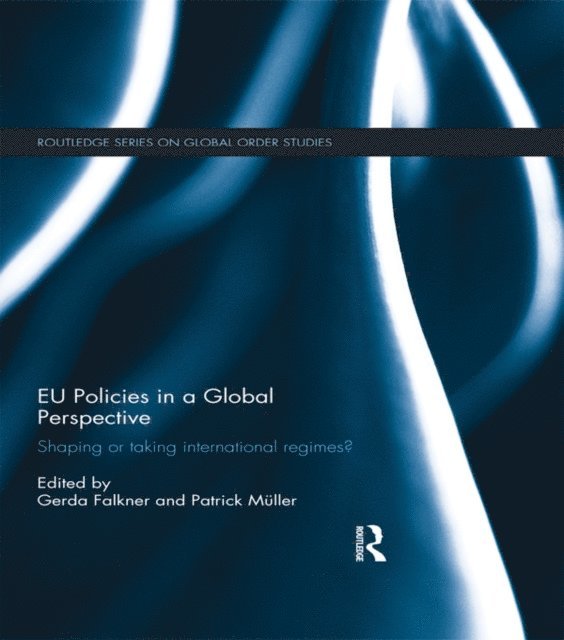
Recent decades have seen a rise in the significance of governance layers beyond the nation state and even Europe. Nonetheless, few efforts have been made thus far to systematically examine the EU’s interaction with global policy regimes. This book maps the relative importance of EU policies in the multi-level global governance system, in comparison with national and global activities. It provides a unique comparative analysis of the EU’s capacity for projecting its policies outward. Focusing on trade policy, agriculture, food safety, competition, social rights, environmental policy, transport, migration, nuclear non-proliferation, or financial regulation, each chapter contributes to a better understanding of the EU’s role in shaping global policies, the mechanisms it uses and the conditions leading to success or failure.
The contributors’ comparative research highlights that policy export is a demanding phenomenon that faces severe limitations and frequently comes with drawbacks. Still, EU policy export played a key role in shaping the rules of the global trade regime and influenced global policy outcomes – at least to a minor extent or in technical aspects – in the majority of the covered policy areas. Overall however, this book reveals that the EU not only aims to export its policies, but interacts with its global environment in a number of distinct ways, including policy import and policy protection, to shield it from global pressures.
Concluding with a comparison of all policies on the meta-level and relevant policy recommendations, this book will be of interest to students, scholars and practitioners of European politics, European public policy, global governance and international relations.
320 kr
Läs direkt efter köp
Recent decades have seen a rise in the significance of governance layers beyond the nation state and even Europe. Nonetheless, few efforts have been made thus far to systematically examine the EU’s interaction with global policy regimes. This book maps the relative importance of EU policies in the multi-level global governance system, in comparison with national and global activities. It provides a unique comparative analysis of the EU’s capacity for projecting its policies outward. Focusing on trade policy, agriculture, food safety, competition, social rights, environmental policy, transport, migration, nuclear non-proliferation, or financial regulation, each chapter contributes to a better understanding of the EU’s role in shaping global policies, the mechanisms it uses and the conditions leading to success or failure.
The contributors’ comparative research highlights that policy export is a demanding phenomenon that faces severe limitations and frequently comes with drawbacks. Still, EU policy export played a key role in shaping the rules of the global trade regime and influenced global policy outcomes – at least to a minor extent or in technical aspects – in the majority of the covered policy areas. Overall however, this book reveals that the EU not only aims to export its policies, but interacts with its global environment in a number of distinct ways, including policy import and policy protection, to shield it from global pressures.
Concluding with a comparison of all policies on the meta-level and relevant policy recommendations, this book will be of interest to students, scholars and practitioners of European politics, European public policy, global governance and international relations.