Patsy Kraeger - Böcker
Visar alla böcker från författaren Patsy Kraeger. Handla med fri frakt och snabb leverans.
6 produkter
6 produkter
2 348 kr
Skickas inom 7-10 vardagar
Combining theoretical and empirical research with global case studies, this innovative book examines the complex relationships between social (in)equality, community well-being and quality of life. Insightful and forward-thinking, it explores strategies for fostering strong communities, focusing on the importance of social connections, shared resources and a sense of belonging.Centred on Sustainable Development Goal (SDG) 10, which advocates reducing income inequality, promoting social inclusion, ensuring equal opportunities and advocating for egalitarian policies, the book explores the interconnectedness between these targets and quality of life and community well-being. Chapters address critical issues such as income disparities, access to healthcare and education, community philanthropy, reforms in historic preservation recognizing inequalities and systemic barriers that perpetuate inequality. SDG 10 is a baseline in some chapters, connecting to one or more of the other 16 SDGs as collective indicators for global change.Extensive and multidisciplinary in its analysis, Social (In)equality, Community Well-being and Quality of Life will be an enlightening read for students, researchers and academics in the fields of development studies, human geography, public policy, sociology, planning and urban studies. It will also benefit international practitioners and policymakers working in sustainable development, social policy and public policy.
18 769 kr
Skickas inom 7-10 vardagar
Community development refers to planned efforts aimed at producing assets to increase the ability and capacity of inhabitants to enhance quality of life. There are many types of assets recognized in community development, including social, physical, human, financial and environmental. Community development can be considered both as a process of developing the ability to act collectively, and an outcome: 1) taking collective action and 2) the result of that action for improvement in a community in any or all realms. A key feature within community development is the notion of social capital or social capacity, generally recognized by both researchers and practitioners as the resources embedded within relationships among people and organizations that help facilitate collaboration and cooperation. A rich history of community development shows the connection to engagement, advocacy, housing rights, anti-poverty and other socially focused concerns. The focus of planning entails the establishment of goals, policies, and procedures for a social or economic unit, such as in a city, community, region or nation. Community planning and development thus seeks to foster viable communities by promoting integrated approaches that provide decent housing, a suitable living environment, and expand economic opportunities for low and moderate income persons. This four-volume set covers the wide social, economic, political, environmental and urban contexts for community planning and development. Providing both foundation contexts as well as addressing current issues, the collection brings together the most relevant overviews and critiques of community planning and development, applicable to both developing and developed countries. The set is fully indexed, and provides a comprehensive overview newly written by the editor as well as an introduction for each volume. It provides an essential work of reference, designed to be useful to scholars, students, and researchers as a vital research resource.
1 989 kr
Kommande
Should foundations be committed to participatory processes from stakeholder engagement to listening to grantees? Large institutional foundations are beginning to have conversations that are hinged on listening to grantees, engaging stakeholder forums, being open to feedback for programmatic work. Concerns about philanthropic behaviors range from being financial accountability to driving public policy initiatives. A different perspective for philanthropic accountability is needed. Philanthropic Accountability uses models of democracy as well as stakeholder theory to understand the role of philanthropy in public policy making in the United States, and how philanthropic organizations capture diversity of goals and interests.Moving beyond performance metric testing to examine and analyze the central logics that inform foundations as they engage in public policy initiatives, Kraeger and Robichau use institutional logic theory to provide a framework to combine participatory democracy theories and philanthropic theories. Case studies and content analysis from the Foundation Center’s Glass Pockets Initiative, Robert Wood Johnson Foundation, and the David and Lucille Packard Foundations, Krager and Robichau help illustrate the foundation stakeholder engagement and outcomes from materials on website, reports and interviews.Philanthropic Accountability presents a unique starting place to bridge siloed theories and provide an avenue to assess philanthropic engagement in the public policy arena from both a theoretical perspective as well as to be empirically tested. A rich and valuable resource for students, scholars, foundation leaders and practitioners interested in community democracy, philanthropy, the larger social sector and measurement.
3 754 kr
Skickas inom 7-10 vardagar
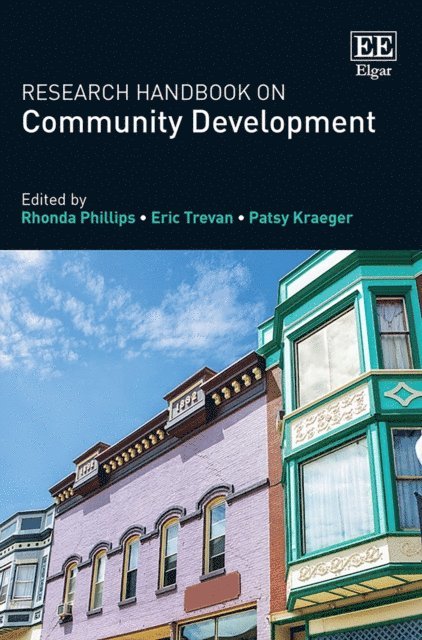
This timely Research Handbook offers new ways in which to navigate the diverse terrain of community development research. Contributions from leading experts unpack the foundations and history of community development research and look to its future, exploring innovative frameworks for conceptualizing community development.Chapters consider the trajectories and impact of global community development research, offering critical insight into the methods and frameworks that are currently being used in the field. Covering varied topics, from housing and food availability, to revitalization and faith-based regeneration, this Research Handbook provides a broad and in-depth exploration of the state of the field today. Comprehensive and unequivocally progressive, this is key reading for social and public policy researchers in need of an understanding of the current trends in community development research as well as practitioners and policymakers working on urban, rural and regional development.Contributors include: N. Al Sader, K. Anacker, C.J.L. Balsas, L.J. Beaulieu, G. Bonilla-Santiago, E.A. Dobis, B.M. Elias, K. Flowers, S. Frimpong, J. Fursova, I. Garcia, F. Handy, B. Hofstedt, J.B. Hollander, J.G. Huff Jr., M.R. Islam, S. Khademi, R. Kleinhans, R.C. Knopf, P. Kraeger, I. Kumar, R. Lewis, D. Mason, J. McGrath, A. Meshkini, M. Norouzi, M. Page, C.B. Peterson, J. Reece, K.A. Rouf, M. Roseland, A.R. Russell, R.M. Silverman, M. Spiliotopoulou, C. Sutton-Brown-Fox, C.A. Talmage, H.L. Taylor, Jr., T.D. Thomas, G.H. Tonon, L. Townsend, D.P. Varady, C. Wallace, L. Yin
1 095 kr
Skickas inom 10-15 vardagar
This volume addresses new innovations in quality of life and well-being from the perspectives of the individual, society and community. It aggregates the perspectives, research questions, methods and results that consider how quality of life is influenced in our modern society. Chapters in this volume present theoretical and practical examples on different aspects of quality of life and community well-being representing American, European, Native American and African perspectives. This volume is of interest to scholars in sociology, psychology, economy, philosophy, health research as well as practitioners across the social sciences.
1 095 kr
Skickas inom 10-15 vardagar
This volume addresses new innovations in quality of life and well-being from the perspectives of the individual, society and community. Chapters in this volume present theoretical and practical examples on different aspects of quality of life and community well-being representing American, European, Native American and African perspectives.