Paul C. Fife - Böcker
Visar alla böcker från författaren Paul C. Fife. Handla med fri frakt och snabb leverans.
3 produkter
3 produkter
Del 35 - IMA Volumes in Mathematics and its Applications
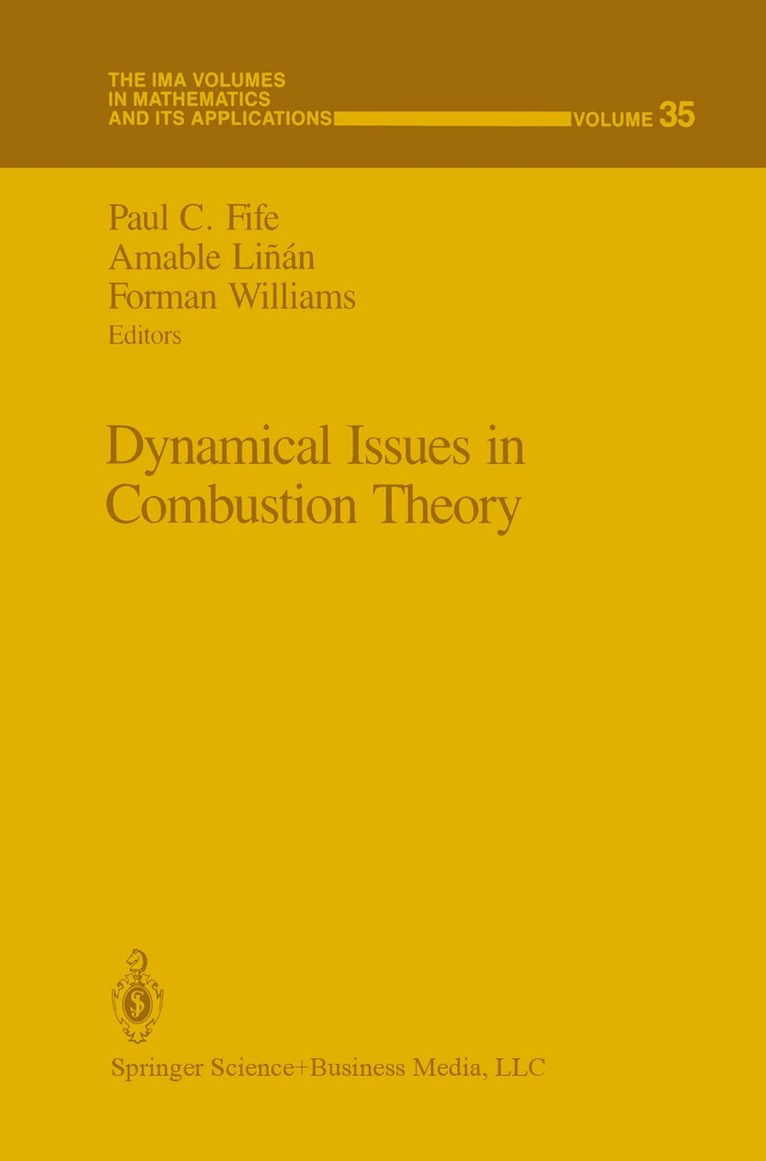
Dynamical Issues in Combustion Theory
Inbunden, Engelska, 1991
2 101 kr
Skickas inom 10-15 vardagar
The world of combustion phenomena is rich in problems intriguing to the mathematical scientists, offering challenges on several fronts: mathematical modeling, devising appropriate asymptotic and computational methods, and developing sound mathematical theories. Papers in this volume describe how all of these challenges have been met for particular examples within a number of common combustion scenarios: reactive shocks, low mach number premixed reactive flow, nonpremixed phenomena, and solid propellants. The types of phenomena they examine are also diverse: properties of interfaces and shocks, including curvature effects, the stability and other properties of steady structures, the long time dynamics of evolving solutions, and spatio-temporal patterns. These issues are foremost in combustion research; the papers collected here provide a good representative sampling of contemporary activity in this field.
599 kr
Skickas inom 7-10 vardagar
Interfacial phenomena are commonplace in physics, chemistry, biology, and in various disciplines bridging these fields. They occur whenever a continuum is present which can exist in at least two different chemical or physical ""states"", and there is some mechanism which generates or enforces a spatial separation between these states. The separation boundary is then called an interface. In the examples studied here, the separation boundary, and its internal structure, result from the balance between two opposing tendencies: a diffusive effect which attempts to mix and smooth the properties of the material, and a physical or chemical mechanism which works to drive it to one or the other pure state.This volume is unique in that the treatment of flames, as well as internal layer dynamics ""including curvature effects"", is more detailed and systematic than in most other publications. Mathematicians and natural scientists interested in interfacial phenomena, especially flame theory, the mathematics of excitable media, electrophoresis, and phase change problems, will find Dynamics of Internal Layers and Diffusive Interfaces exceptionally useful.
Del 35 - IMA Volumes in Mathematics and its Applications
Dynamical Issues in Combustion Theory
Häftad, Engelska, 2012
2 101 kr
Skickas inom 10-15 vardagar
This IMA Volume in Mathematics and its Applications DYNAMICAL ISSUES IN COMBUSTION THEORY is based on the proceedings of a workshop which was an integral part of the 1989-90 IMA program on "Dynamical Systems and their Applications." The aim of this workshop was to cross-fertilize research groups working in topics of current interest in combustion dynamics and mathematical methods applicable thereto. We thank Shui-Nee Chow, Martin Golubitsky, Richard McGehee, George R. Sell, Paul Fife, Amable Liiian and Foreman Williams for organizing the meeting. We especially thank Paul Fife, Amable Liiilin and Foreman Williams for editing the proceedings. We also take this opportunity to thank those agencies whose financial support made the workshop possible: the Army Research Office, the National Science Foundation and the Office of Naval Research. Avner Friedman Willard Miller, Jr. ix PREFACE The world ofcombustion phenomena is rich in problems intriguing to the math ematical scientist. They offer challenges on several fronts: (1) modeling, which involves the elucidation of the essential features of a given phenomenon through physical insight and knowledge of experimental results, (2) devising appropriate asymptotic and computational methods, and (3) developing sound mathematical theories. Papers in the present volume, which are based on talks given at the Workshop on Dynamical Issues in Combustion Theory in November, 1989, describe how all of these challenges have been met for particular examples within a number of common combustion scenarios: reactiveshocks, low Mach number premixed reactive flow, nonpremixed phenomena, and solid propellants.