Paul Groner - Böcker
Visar alla böcker från författaren Paul Groner. Handla med fri frakt och snabb leverans.
5 produkter
5 produkter
380 kr
Skickas inom 10-15 vardagar
967 kr
Skickas inom 10-15 vardagar
Saicho (767-822), the founder of the Tendai School, is one of the great masters of Japanese Buddhism. This edition, which includes a new preface by the author, makes available again a classic work on this important figure’s life and accomplishments. Groner’s study focuses on Saicho’s founding of the great monastic center on Mount Hiei, the leading religious institution of medieval Japan, and his radical move to adopt for purposes of ordination the Mahayana bodhisattva precepts--a decision that had far-reaching consequences for the future of Japanese Buddhist ethical thought, monastic training and organization, lay-clerical relations, philosophical developments, and Buddhism-state relations.
196 kr
Skickas inom 11-20 vardagar
Ryogen and Mount Hiei focuses on the transformation of the Tendai School from a small and impoverished group of monks in the early ninth century to its emergence as the most powerful and influential school of Japanese Buddhism in the last half of the tenth century—a position it would maintain throughout the medieval period. This is the first study in a Western language of the institutional factors that lay behind the school's success. At its core is a biography of a major figure behind this transformation, Ryogen (912–985). The discussion, however, extends well beyond a simple biography as Ryogen's activities are placed in their historical and institutional context.Unlike the recluses and eccentrics that have so often attracted Western readers of Buddhism, Ryogen was a consummate politician and builder. Because he lost his major monastic sponsor at an early age, he was forced to find ways to advance his career with little support. His activities reveal much about the path to success for monks during the tenth century. Skill in debate, the performance of Esoteric Buddhist ritual, and strategic alliances with powerful lay and monastic figures were important to his advance. In 966 Ryogen was appointed head of the Tendai School and served until his death nineteen years later. He has been vilified at times for his loyalty to his own faction within Tendai at the expense of other groups. Careful analysis of the political and social factors behind his attitudes, however, places his activities in their appropriate context.The study concludes with a discussion of the ordinations and roles of nuns during the early Heian period. An examination of Ryogen's close relation with his mother helps define the ambiguities of a school that prohibited women from the precincts of its temple yet performed rituals to insure safe childbirth and frequently attracted their patronage. A number of primary sources are translated in the appendices.
730 kr
Skickas inom 7-10 vardagar
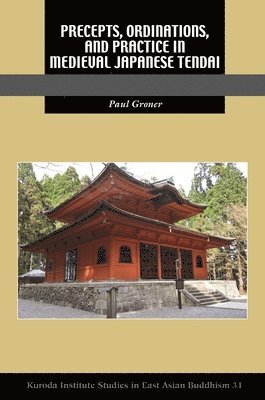
Modern Japanese Buddhist monks of all denominations differ from those in other Asian countries because they frequently marry, drink alcohol, and eat meat. This has caused Buddhist scholars and practitioners generally to assume that early Japanese monastics had little interest in precepts and ordinations. Some medieval Japanese exegetes, however, were obsessively concerned with these topics as they strove to understand what it meant to be a Buddhist. This landmark collection of essays by Paul Groner, one of the leading authorities on Tendai Buddhism, examines the medieval Tendai School, which dominated Japanese Buddhism at that time, to uncover the differences in understanding and interpreting monastic precepts and ordinations. Rather than provide an unbroken narrative account—made virtually impossible due to the number of undated apocryphal texts and those lost in the numerous fires and warfare that beset Tendai temples as well as the difficulties of tracing how texts were used—Groner employs a multifaceted approach, focusing on individual monks, texts, ceremonies, exegetical problems, and institutional issues. Early chapters look at a major source of Tendai precepts, the apocryphal Brahma’s Net Sutra; the Tendai scholar Annen’s (b. 841) interpretations of the universal bodhisattva precept ordination and the historical background of his commentary on the subject; Tendai perfect-sudden precepts and the Vinaya; and the role of confession in the bodhisattva ordination. Groner goes on to discuss the Lotus Sutra, another key text for Tendai precepts, and the monk Koen (1262–1317) and his role in developing the consecrated ordination, which is still performed today. Later essays introduce Jitsudo Ninku’s (1307–1388) system of training by doctrinal debate and his commentary on ordinations; doctrinal discussions of killing; and Tendai discussions among several lineages on whether the precepts can be lost or violated. Many of the issues discussed in the volume—particularly how to distinguish various types of Buddhist practitioners and how to conduct ordinations—continue to preoccupy Tendai monks centuries later. The book concludes with an examination of the effects of early Tendai precepts on modern practice.
204 kr
Skickas inom 7-10 vardagar
Modern Japanese Buddhist monks of all denominations differ from those in other Asian countries because they frequently marry, drink alcohol, and eat meat. This has caused Buddhist scholars and practitioners generally to assume that early Japanese monastics had little interest in precepts and ordinations. Some medieval Japanese exegetes, however, were obsessively concerned with these topics as they strove to understand what it meant to be a Buddhist. This landmark collection of essays by Paul Groner, one of the leading authorities on Tendai Buddhism, examines the medieval Tendai School, which dominated Japanese Buddhism at that time, to uncover the differences in understanding and interpreting monastic precepts and ordinations. Rather than provide an unbroken narrative account—made virtually impossible due to the number of undated apocryphal texts and those lost in the numerous fires and warfare that beset Tendai temples as well as the difficulties of tracing how texts were used—Groner employs a multifaceted approach, focusing on individual monks, texts, ceremonies, exegetical problems, and institutional issues. Early chapters look at a major source of Tendai precepts, the apocryphal Brahma’s Net Sutra; the Tendai scholar Annen’s (b. 841) interpretations of the universal bodhisattva precept ordination and the historical background of his commentary on the subject; Tendai perfect-sudden precepts and the Vinaya; and the role of confession in the bodhisattva ordination. Groner goes on to discuss the Lotus Sutra, another key text for Tendai precepts, and the monk Kōen (1262–1317) and his role in developing the consecrated ordination, which is still performed today. Later essays introduce Jitsudō Ninkū’s (1307–1388) system of training by doctrinal debate and his commentary on ordinations; doctrinal discussions of killing; and Tendai discussions among several lineages on whether the precepts can be lost or violated. Many of the issues discussed in the volume—particularly how to distinguish various types of Buddhist practitioners and how to conduct ordinations—continue to preoccupy Tendai monks centuries later. The book concludes with an examination of the effects of early Tendai precepts on modern practice.