Paul K. Feyerabend - Böcker
Visar alla böcker från författaren Paul K. Feyerabend. Handla med fri frakt och snabb leverans.
9 produkter
9 produkter
360 kr
Skickas inom 7-10 vardagar
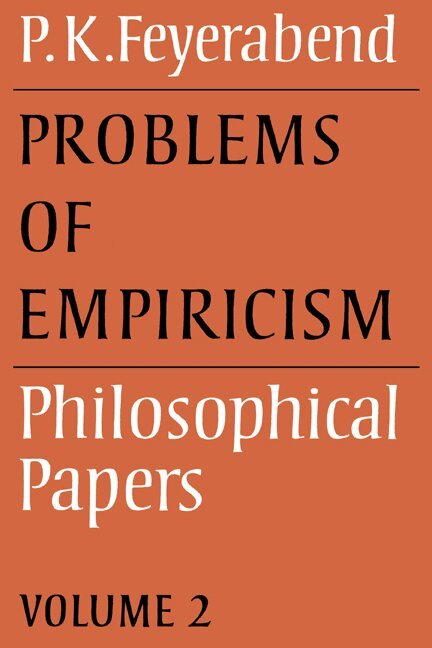
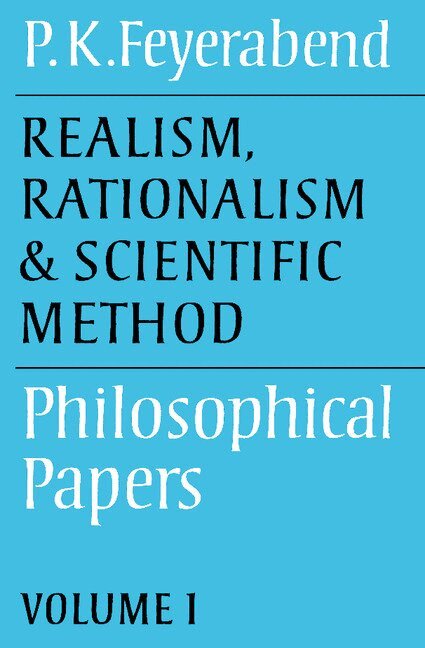
Over the past thirty years Paul Feyerabend has developed an extremely distinctive and influentical approach to problems in the philosophy of science. The most important and seminal of his published essays are collected here in two volumes, with new introductions to provide an overview and historical perspective on the discussions of each part. Volume 1 presents papers on the interpretation of scientific theories, together with papers applying the views developed to particular problems in philosophy and physics. The essays in volume 2 examine the origin and history of an abstract rationalism, as well as its consequences for the philosophy of science and methods of scientific research. Professor Feyerabend argues with great force and imagination for a comprehensive and opportunistic pluralism. In doing so he draws on extensive knowledge of scientific history and practice, and he is alert always to the wider philosophical, practical and political implications of conflicting views. These two volumes fully display the variety of his ideas, and confirm the originality and significance of his work.
360 kr
Skickas inom 7-10 vardagar
Over the past thirty years Paul Feyerabend has developed an extremely distinctive and influentical approach to problems in the philosophy of science. The most important and seminal of his published essays are collected here in two volumes, with new introductions to provide an overview and historical perspective on the discussions of each part. Volume 1 presents papers on the interpretation of scientific theories, together with papers applying the views developed to particular problems in philosophy and physics. The essays in volume 2 examine the origin and history of an abstract rationalism, as well as its consequences for the philosophy of science and methods of scientific research. Professor Feyerabend argues with great force and imagination for a comprehensive and opportunistic pluralism. In doing so he draws on extensive knowledge of scientific history and practice, and he is alert always to the wider philosophical, practical and political implications of conflicting views. These two volumes fully display the variety of his ideas, and confirm the originality and significance of his work.
1 442 kr
Skickas inom 7-10 vardagar
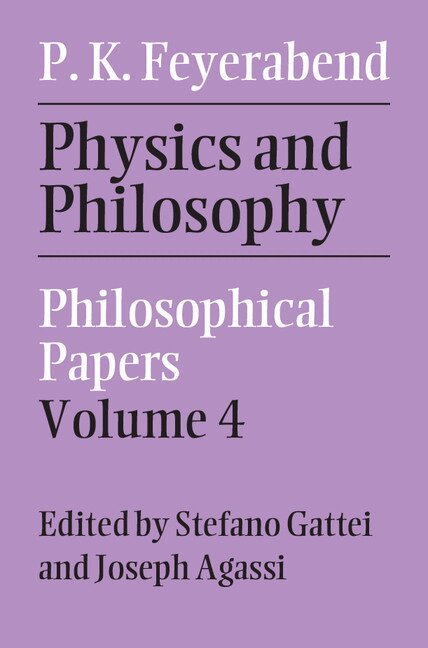
This collection of the writings of Paul Feyerabend is focused on his philosophy of quantum physics, the hotbed of the key issues of his most debated ideas. Written between 1948 and 1970, these writings come from his first and most productive period. These early works are important for two main reasons. First, they document Feyerabend's deep concern with the philosophical implications of quantum physics and its interpretations. These ideas were paid less attention in the following two decades. Second, the writings provide the crucial background for Feyerabend's critiques of Karl Popper and Thomas Kuhn. Although rarely considered by scholars, Feyerabend's early work culminated in the first version of Against Method. These writings guided him on all the key issues of his most well-known and debated theses, such as the incommensurability thesis, the principles of proliferation and tenacity, and his particular version of relativism, and more specifically on quantum mechanics.
379 kr
Skickas inom 7-10 vardagar
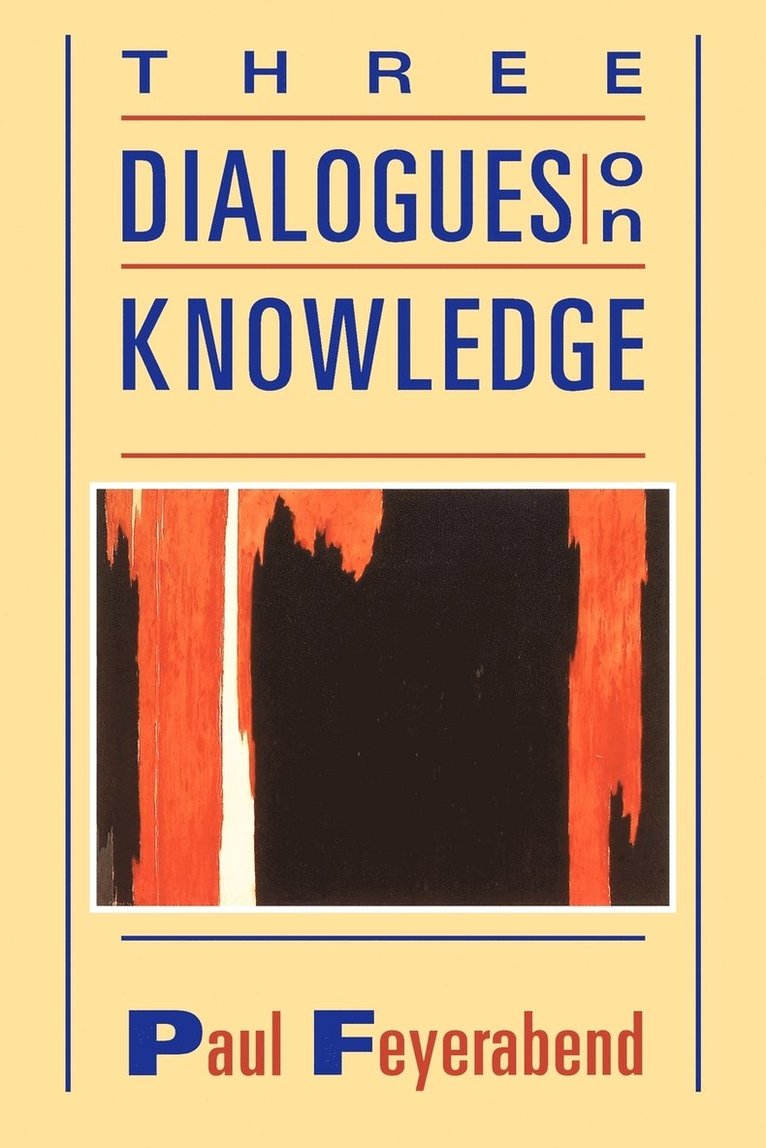
The Socratic, or dialog, form is central to the history of philosophy and has been the discipline's canonical genre ever since. Paul Feyerabend's Three Dialogues on Knowledge resurrects the form to provide an astonishingly flexible and invigorating analysis of epistemological, ethical and metaphysical problems. He uses literary strategies - of irony, voice and distance - to make profoundly philosophical points about the epistemic, existential and political aspects of common sense and scientific knowledge. He writes about ancient and modern relativism; the authority of science; the ignorance of scientists; the nature of being; and true and false enlightenment. Throughout Three Dialogues on Knowledge is provocative, controversial and inspiring. It is, unlike most current philosophical writing, written for readers with a keen sense of what matters and why.
736 kr
Skickas inom 7-10 vardagar
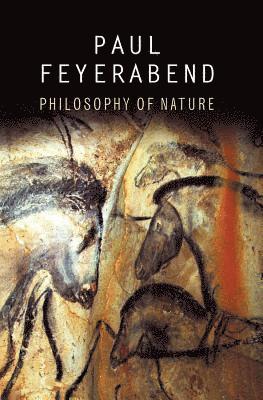
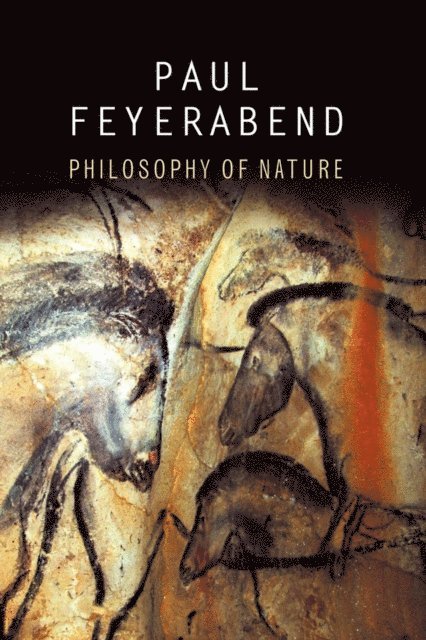
Philosopher, physicist, and anarchist Paul Feyerabend was one of the most unconventional scholars of his time. His book Against Method has become a modern classic. Yet it is not well known that Feyerabend spent many years working on a philosophy of nature that was intended to comprise three volumes covering the period from the earliest traces of stone age cave paintings to the atomic physics of the 20th century – a project that, as he conveyed in a letter to Imre Lakatos, almost drove him nuts: “Damn the ,Naturphilosophie.”The book’s manuscript was long believed to have been lost. Recently, however, a typescript constituting the first volume of the project was unexpectedly discovered at the University of Konstanz. In this volume Feyerabend explores the significance of myths for the early period of natural philosophy, as well as the transition from Homer’s “aggregate universe” to Parmenides’ uniform ontology. He focuses on the rise of rationalism in Greek antiquity, which he considers a disastrous development, and the associated separation of man from nature. Thus Feyerabend explores the prehistory of science in his familiar polemical and extraordinarily learned manner. The volume contains numerous pictures and drawings by Feyerabend himself. It also contains hitherto unpublished biographical material that will help to round up our overall image of one of the most influential radical philosophers of the twentieth century.
269 kr
Skickas inom 7-10 vardagar
Philosopher, physicist, and anarchist Paul Feyerabend was one of the most unconventional scholars of his time. His book Against Method has become a modern classic. Yet it is not well known that Feyerabend spent many years working on a philosophy of nature that was intended to comprise three volumes covering the period from the earliest traces of stone age cave paintings to the atomic physics of the 20th century – a project that, as he conveyed in a letter to Imre Lakatos, almost drove him nuts: “Damn the ,Naturphilosophie.”The book’s manuscript was long believed to have been lost. Recently, however, a typescript constituting the first volume of the project was unexpectedly discovered at the University of Konstanz. In this volume Feyerabend explores the significance of myths for the early period of natural philosophy, as well as the transition from Homer’s “aggregate universe” to Parmenides’ uniform ontology. He focuses on the rise of rationalism in Greek antiquity, which he considers a disastrous development, and the associated separation of man from nature. Thus Feyerabend explores the prehistory of science in his familiar polemical and extraordinarily learned manner. The volume contains numerous pictures and drawings by Feyerabend himself. It also contains hitherto unpublished biographical material that will help to round up our overall image of one of the most influential radical philosophers of the twentieth century.
712 kr
Skickas inom 5-8 vardagar
Paul Feyerabend is one of the greatest philosophers of science of the 20th century and his book Against Method is an international bestseller. In this new book he masterfully weaves together the main elements of his mature philosophy into a gripping tale: the story of the rise of rationalism in Ancient Greece that eventually led to the entrenchment of a mythical ‘scientific worldview’. In this wide-ranging and accessible book Feyerabend challenges some modern myths about science, including the myth that ‘science is successful’. He argues that some very basic assumptions about science are simply false and that substantial parts of scientific ideology were created on the basis of superficial generalizations that led to absurdmisconceptions about the nature of human life. Far from solving the pressing problems of our age, such as war and poverty, scientific theorizing glorifies ephemeral generalities, at the cost of confrontingthe real particulars that make life meaningful. Objectivity and generality are based on abstraction, and as such, they come at a high price. For abstraction drives a wedge between our thoughts and ourexperience, resulting in the degeneration of both. Theoreticians, as opposed to practitioners, tend to impose a tyranny on the concepts they use, abstracting away from the subjective experience that makeslife meaningful. Feyerabend concludes by arguing that practical experience is a better guide to reality than any theory, by itself, ever could be, and he stresses that there is no tyranny that cannot be resisted, even if it is exerted with the best possible intentions. Provocative and iconoclastic, The Tyranny of Science is one of Feyerabend’s last books and one of his best. It will be widely read by everyone interested in the role that science has played, and continues to play, in the shaping of the modern world.
178 kr
Skickas inom 7-10 vardagar
Paul Feyerabend is one of the greatest philosophers of science of the 20th century and his book Against Method is an international bestseller. In this new book he masterfully weaves together the main elements of his mature philosophy into a gripping tale: the story of the rise of rationalism in Ancient Greece that eventually led to the entrenchment of a mythical ‘scientific worldview’. In this wide-ranging and accessible book Feyerabend challenges some modern myths about science, including the myth that ‘science is successful’. He argues that some very basic assumptions about science are simply false and that substantial parts of scientific ideology were created on the basis of superficial generalizations that led to absurdmisconceptions about the nature of human life. Far from solving the pressing problems of our age, such as war and poverty, scientific theorizing glorifies ephemeral generalities, at the cost of confrontingthe real particulars that make life meaningful. Objectivity and generality are based on abstraction, and as such, they come at a high price. For abstraction drives a wedge between our thoughts and ourexperience, resulting in the degeneration of both. Theoreticians, as opposed to practitioners, tend to impose a tyranny on the concepts they use, abstracting away from the subjective experience that makeslife meaningful. Feyerabend concludes by arguing that practical experience is a better guide to reality than any theory, by itself, ever could be, and he stresses that there is no tyranny that cannot be resisted, even if it is exerted with the best possible intentions. Provocative and iconoclastic, The Tyranny of Science is one of Feyerabend’s last books and one of his best. It will be widely read by everyone interested in the role that science has played, and continues to play, in the shaping of the modern world.
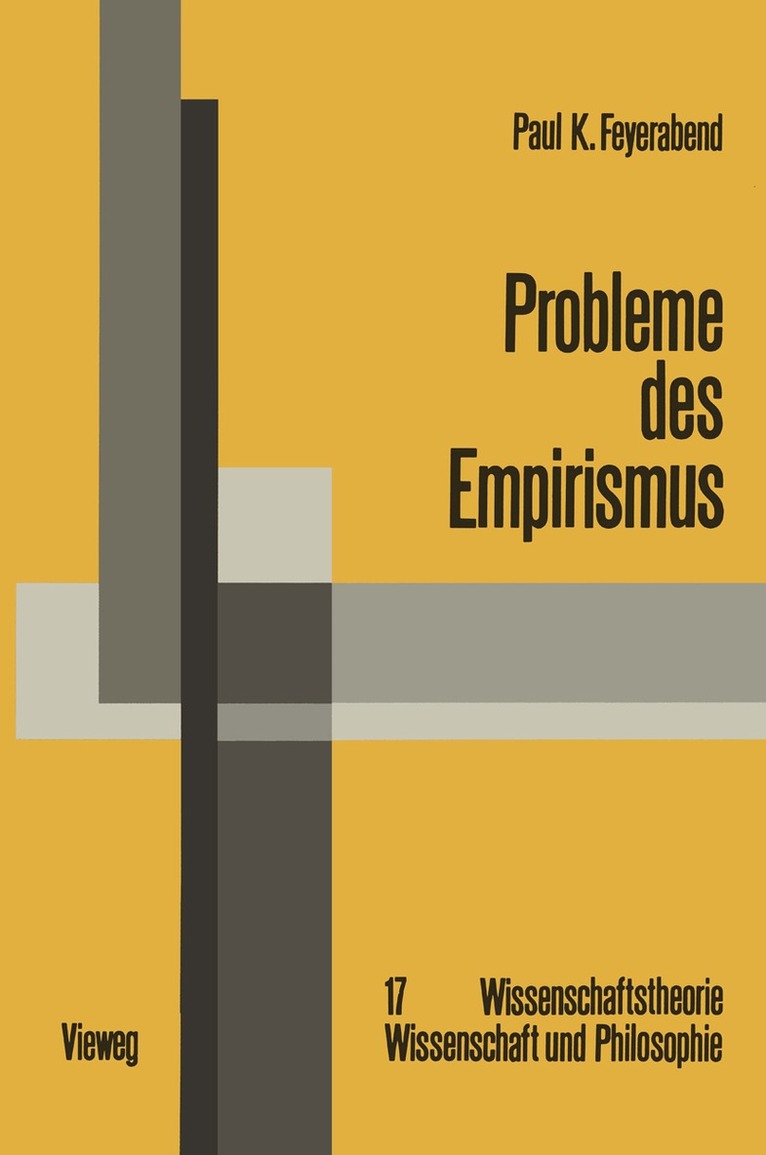
Probleme des Empirismus
Schriften zur Theorie der Erklärung, der Quantentheorie und der Wissenschaftsgeschichte Ausgewählte Schriften
Häftad, Tyska, 1981
452 kr
Skickas inom 7-10 vardagar