Paul K. Saint-Amour – författare
Visar alla böcker från författaren Paul K. Saint-Amour. Handla med fri frakt och snabb leverans.
10 produkter
10 produkter
Inbunden, Engelska, 2015
1 893 kr
Skickas inom 5-8 vardagar
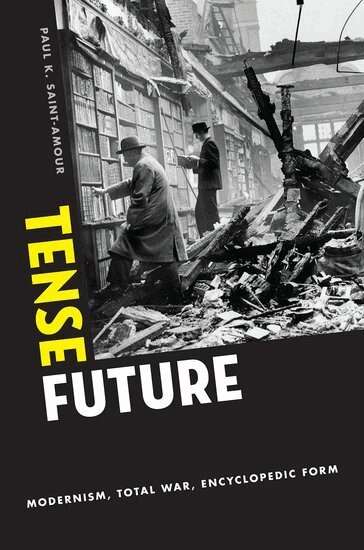
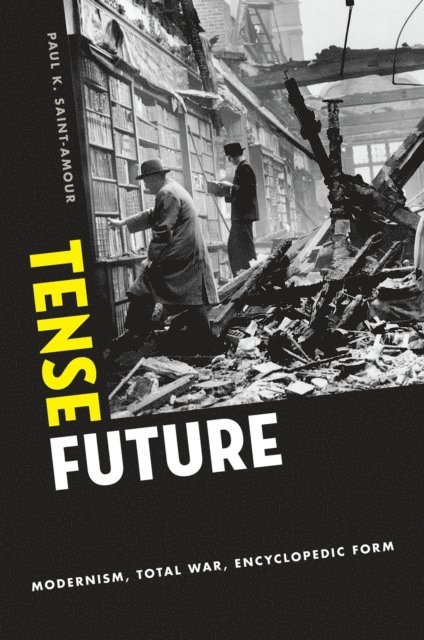
Tense Future falls into two parts. The first develops a critical account of total war discourse and addresses the resistant potential of acts, including acts of writing, before a future that looks barred or predetermined by war. Part two shifts the focus to long interwar narratives that pit both their scale and their formal turbulence against total war's portrait of the social totality, producing both ripostes and alternatives to that portrait in the practice of literary encyclopedism. The book's introduction grounds both parts in the claim that industrialized warfare, particularly the aerial bombing of cities, intensifies an under-examined form of collective traumatization: a pretraumatic syndrome in which the anticipation of future-conditional violence induces psychic wounds. Situating this claim in relation to other scholarship on "critical futurities," Saint-Amour discusses its ramifications for trauma studies, historical narratives generally, and the historiography of the interwar period in particular. The introduction ends with an account of the weak theory of modernism now structuring the field of modernist studies, and of weak theory's special suitability for opposing total war, that strongest of strong theories.
Häftad, Engelska, 2015
520 kr
Skickas inom 5-8 vardagar
Tense Future falls into two parts. The first develops a critical account of total war discourse and addresses the resistant potential of acts, including acts of writing, before a future that looks barred or predetermined by war. Part two shifts the focus to long interwar narratives that pit both their scale and their formal turbulence against total war's portrait of the social totality, producing both ripostes and alternatives to that portrait in the practice of literary encyclopedism. The book's introduction grounds both parts in the claim that industrialized warfare, particularly the aerial bombing of cities, intensifies an under-examined form of collective traumatization: a pretraumatic syndrome in which the anticipation of future-conditional violence induces psychic wounds. Situating this claim in relation to other scholarship on "critical futurities," Saint-Amour discusses its ramifications for trauma studies, historical narratives generally, and the historiography of the interwar period in particular. The introduction ends with an account of the weak theory of modernism now structuring the field of modernist studies, and of weak theory's special suitability for opposing total war, that strongest of strong theories.
E-bok
PDF, Engelska, 2015593 kr
Läs direkt efter köp
We know that trauma can leave syndromes in its wake. But can the anticipation of violence be a form of violence as well? Tense Future argues that it can-that twentieth-century war technologies and practices, particularly the aerial bombing of population centers, introduced non-combatants to a coercive and traumatizing expectation. During wartime, civilians braced for the next raid; during peacetime they braced for the next war. The pre-traumatic stress they experienced permeates the century''s public debates and cultural works. In a series of groundbreaking readings, Saint-Amour illustrates how air war prophets theorized the wounding power of anticipation, how archive theory changed course in war''s shadow, and how speculative fiction conjured visions of a civilizational collapse that would end literacy itself. And in this book''s central chapters, he shows us how Ford Madox Ford, Robert Musil, James Joyce, Virginia Woolf, and other interwar modernist writers faced the memory of one war and the prospect of another, some by pitting their fictions'' encyclopedic scale and formal turbulence against total war, others by conceding war''s inevitability while refusing to long for a politically regressive peace.Total war: a conflict that exempts no one, disregarding any difference between soldier and civilian. Tense Future forever alters our understanding of the concept of total war by tracing its emergence during the First World War, its incubation in air power theory between the wars, and above all its profound partiality. For total war, during most of the twentieth century, meant conflict between imperial nation states; it did not include the violence those states routinely visited on colonial subjects during peacetime. Tacking back and forth between metropole and colony, between world war and police action, Saint-Amour describes the interwar refashioning of a world system of violence-production, one that remains largely intact in our own moment of perpetual interwar.
E-bok
Engelska, 2015593 kr
Läs direkt efter köp
We know that trauma can leave syndromes in its wake. But can the anticipation of violence be a form of violence as well? Tense Future argues that it can-that twentieth-century war technologies and practices, particularly the aerial bombing of population centers, introduced non-combatants to a coercive and traumatizing expectation. During wartime, civilians braced for the next raid; during peacetime they braced for the next war. The pre-traumatic stress they experienced permeates the century''s public debates and cultural works. In a series of groundbreaking readings, Saint-Amour illustrates how air war prophets theorized the wounding power of anticipation, how archive theory changed course in war''s shadow, and how speculative fiction conjured visions of a civilizational collapse that would end literacy itself. And in this book''s central chapters, he shows us how Ford Madox Ford, Robert Musil, James Joyce, Virginia Woolf, and other interwar modernist writers faced the memory of one war and the prospect of another, some by pitting their fictions'' encyclopedic scale and formal turbulence against total war, others by conceding war''s inevitability while refusing to long for a politically regressive peace.Total war: a conflict that exempts no one, disregarding any difference between soldier and civilian. Tense Future forever alters our understanding of the concept of total war by tracing its emergence during the First World War, its incubation in air power theory between the wars, and above all its profound partiality. For total war, during most of the twentieth century, meant conflict between imperial nation states; it did not include the violence those states routinely visited on colonial subjects during peacetime. Tacking back and forth between metropole and colony, between world war and police action, Saint-Amour describes the interwar refashioning of a world system of violence-production, one that remains largely intact in our own moment of perpetual interwar.
Inbunden, Engelska, 2011
994 kr
Skickas inom 5-8 vardagar
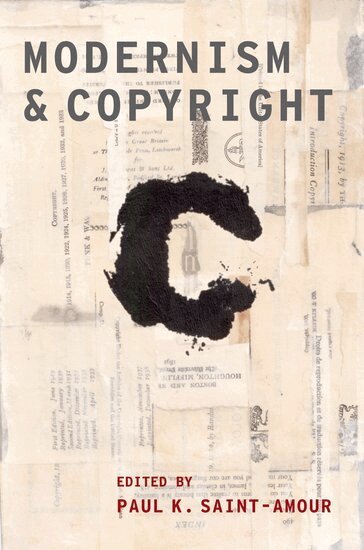
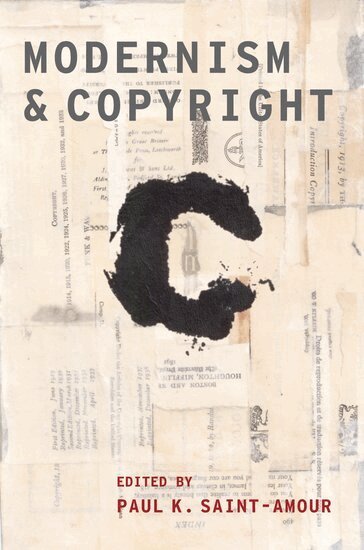
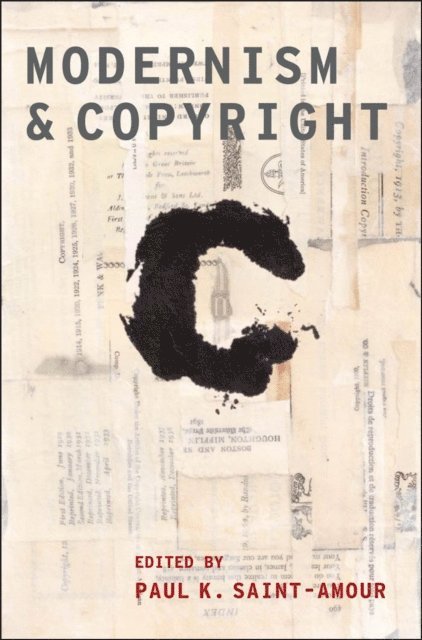
Copyright looms large in the digital world. As users and creators of expressive works, we all know more about copyright than we did a decade ago. But scholars of modernism have felt a special urgency in grappling with this branch of law, whose rapid expansion in recent years has prolonged or revived the rights in many modernist works. Indeed, thanks to public clashes between estates and users, 'modernism' has lately begun to seem like a byword for contested intellectual property. At the same time, today's volatile legal climate has prompted us to ask how modernism was, from its beginning, shaped by intellectual property law-and how modernists sought variously to exploit, reform, anoint, and evade copyright. We are beginning to discover, too, how copyright's transatlantic and imperial asymmetries during the modernist decades helped set the stage for its geopolitical role in the new millennium.Modernism and Copyright is the first book to take up these questions and discoveries in all their urgency. A truly multi-disciplinary study, it brings together essays by well-known scholars of literature, theater, cinema, music, and law as well as by practicing lawyers and caretakers of modernist literary estates. Its contributors' methods are as diverse as the works they discuss: Ezra Pound's copyright statute and Charlie Parker's bebop compositions feature here, as do early Chaplin, EverQuest, and the Madison Avenue memo. As our portrait of modernism expands and fragments, Modernism and Copyright locates works like these on one of the few landscapes they all clearly share: the uneven terrain of intellectual property law.
Häftad, Engelska, 2011
508 kr
Skickas inom 5-8 vardagar
Copyright looms large in the digital world. As users and creators of expressive works, we all know more about copyright than we did a decade ago. But scholars of modernism have felt a special urgency in grappling with this branch of law, whose rapid expansion in recent years has prolonged or revived the rights in many modernist works. Indeed, thanks to public clashes between estates and users, 'modernism' has lately begun to seem like a byword for contested intellectual property. At the same time, today's volatile legal climate has prompted us to ask how modernism was, from its beginning, shaped by intellectual property law-and how modernists sought variously to exploit, reform, anoint, and evade copyright. We are beginning to discover, too, how copyright's transatlantic and imperial asymmetries during the modernist decades helped set the stage for its geopolitical role in the new millennium.Modernism and Copyright is the first book to take up these questions and discoveries in all their urgency. A truly multi-disciplinary study, it brings together essays by well-known scholars of literature, theater, cinema, music, and law as well as by practicing lawyers and caretakers of modernist literary estates. Its contributors' methods are as diverse as the works they discuss: Ezra Pound's copyright statute and Charlie Parker's bebop compositions feature here, as do early Chaplin, EverQuest, and the Madison Avenue memo. As our portrait of modernism expands and fragments, Modernism and Copyright locates works like these on one of the few landscapes they all clearly share: the uneven terrain of intellectual property law.
E-bok
PDF, Engelska, 2010369 kr
Läs direkt efter köp
How was modernism shaped, from its beginning, by intellectual property law? What role did the law''s imperial and transatlantic asymmetries play in modernism''s dissemination? How did various modernists exploit, reform, anoint, and evade copyright? And how is the study of modernism today being affected by expanding copyright regimes?Modernism and Copyright is the first book to take up these questions. A truly multi-disciplinary study, it brings together essays by scholars of literature, theater, cinema, music, and law as well as by practicing lawyers and caretakers of modernist literary estates. Its contributors'' methods are as diverse as the works they discuss: Ezra Pound''s copyright statute and Charlie Parker''s bebop compositions feature here, as do early Chaplin films, EverQuest, and the Madison Avenue memo. As our portrait of modernism expands and fragments, Modernism and Copyright locates works such as these on one of the few landscapes they all clearly share: the uneven terrain of intellectual property law.
E-bok
Engelska, 2010369 kr
Läs direkt efter köp
How was modernism shaped, from its beginning, by intellectual property law? What role did the law''s imperial and transatlantic asymmetries play in modernism''s dissemination? How did various modernists exploit, reform, anoint, and evade copyright? And how is the study of modernism today being affected by expanding copyright regimes?Modernism and Copyright is the first book to take up these questions. A truly multi-disciplinary study, it brings together essays by scholars of literature, theater, cinema, music, and law as well as by practicing lawyers and caretakers of modernist literary estates. Its contributors'' methods are as diverse as the works they discuss: Ezra Pound''s copyright statute and Charlie Parker''s bebop compositions feature here, as do early Chaplin films, EverQuest, and the Madison Avenue memo. As our portrait of modernism expands and fragments, Modernism and Copyright locates works such as these on one of the few landscapes they all clearly share: the uneven terrain of intellectual property law.
Inbunden, Engelska, 2003
737 kr
Skickas inom 10-15 vardagar
They borrow from published works without attribution. They remake literary creation in the image of consumption. They celebrate the art of scissors and paste. Who are these outlaws? Postmodern culture-jammers or file-sharing teens? No, they are the Copywrights—Victorian and modernist writers, among them Oscar Wilde and James Joyce, whose work wrestled with the intellectual property laws of their day. In a highly readable and thought-provoking book that places today's copyright wars in historical context, Paul K. Saint-Amour asks: Would their art have survived the copyright laws of the new millennium?Revisiting major works by Wilde and Joyce as well as centos assembled by anonymous writers from existing poems, Saint-Amour sees the period 1830–1930 as a time when imaginative literature became aware of its own status as intellectual property and began to register that awareness in its subjects, plots, and formal architecture. The authors of these self-reflexive literary texts were more conscious than their precursors of the role played by consumption in both the composition and the consecration of literature. The texts in question became, in turn, part of what Saint-Amour characterizes as a "counterdiscourse" to extensive monopoly copyright, a vocal minority that insisted on a broadly conceived public domain not only as indispensable to free expression and fresh creation but as a good in itself.Recent events such as the court battle over the Copyright Term Extension Act (CTEA), which extends copyright terms by 20 years, the patenting of the human genome and of genetically altered seed lines, and high-stakes controversies over literary parody have increased public awareness of intellectual property law. In The Copywrights, Saint-Amour challenges the notion that copyright's function ends with the provision of private incentives to creation and innovation. The cases he examines lead him to argue that copyright performs a range of political, emotional, and even sacred functions that are too often ignored and that what seems to have emerged as copyright's primary function—the creation of private property incentives—must not be an end in itself.
Häftad, Engelska, 2010
400 kr
Skickas inom 3-6 vardagar
They borrow from published works without attribution. They remake literary creation in the image of consumption. They celebrate the art of scissors and paste. Who are these outlaws? Postmodern culture-jammers or file-sharing teens? No, they are the Copywrights—Victorian and modernist writers, among them Oscar Wilde and James Joyce, whose work wrestled with the intellectual property laws of their day. In a highly readable and thought-provoking book that places today's copyright wars in historical context, Paul K. Saint-Amour asks: Would their art have survived the copyright laws of the new millennium?Revisiting major works by Wilde and Joyce as well as centos assembled by anonymous writers from existing poems, Saint-Amour sees the period 1830–1930 as a time when imaginative literature became aware of its own status as intellectual property and began to register that awareness in its subjects, plots, and formal architecture. The authors of these self-reflexive literary texts were more conscious than their precursors of the role played by consumption in both the composition and the consecration of literature. The texts in question became, in turn, part of what Saint-Amour characterizes as a "counterdiscourse" to extensive monopoly copyright, a vocal minority that insisted on a broadly conceived public domain not only as indispensable to free expression and fresh creation but as a good in itself.Recent events such as the court battle over the Copyright Term Extension Act (CTEA), which extends copyright terms by 20 years, the patenting of the human genome and of genetically altered seed lines, and high-stakes controversies over literary parody have increased public awareness of intellectual property law. In The Copywrights, Saint-Amour challenges the notion that copyright's function ends with the provision of private incentives to creation and innovation. The cases he examines lead him to argue that copyright performs a range of political, emotional, and even sacred functions that are too often ignored and that what seems to have emerged as copyright's primary function—the creation of private property incentives—must not be an end in itself.