Paul M. Hayes – författare
Visar alla böcker från författaren Paul M. Hayes. Handla med fri frakt och snabb leverans.
3 produkter
3 produkter
Inbunden, Engelska, 2015
2 151 kr
Skickas inom 10-15 vardagar
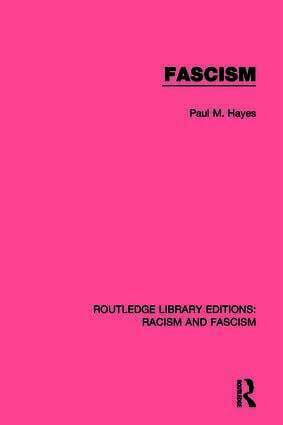
This book, first published in 1973, sets out to clear away many of the confused ideas and misconceptions concerning the origins and nature of fascism. The first section deals with the intellectual origins of fascism and examines the constituent strands and development of fascist theory, including discussion of such topics as the myth of race, the idea of the elite and the leader, nationalism, and the influence of militarism. The book then goes on to look at fascism in action, particularly in relation to economic affairs. The author here examines the process by which the fascists came to power in Germany and Italy, investigating both the political and social causes. A third section contains discussion of the nature of more recent regimes in Greece, Latin America and Africa.
Häftad, Engelska, 2017
588 kr
Skickas inom 10-15 vardagar
This book, first published in 1973, sets out to clear away many of the confused ideas and misconceptions concerning the origins and nature of fascism. The first section deals with the intellectual origins of fascism and examines the constituent strands and development of fascist theory, including discussion of such topics as the myth of race, the idea of the elite and the leader, nationalism, and the influence of militarism. The book then goes on to look at fascism in action, particularly in relation to economic affairs. The author here examines the process by which the fascists came to power in Germany and Italy, investigating both the political and social causes. A third section contains discussion of the nature of more recent regimes in Greece, Latin America and Africa.
Häftad, Engelska, 2012
389 kr
Skickas inom 3-6 vardagar
This book involves a conscious attempt to bridge progressive academic scholarship with activist groups and communities in Ireland and beyond. Taking Howard Zinn’s maxim “You can’t be neutral on a moving train” seriously, the book attempts to examine Irish society, as much as it is possible to do so, from the point of view of those who are actively fighting against ongoing attacks on the pay, conditions, rights and protections that were won by working people through the decades of the twentieth century. This effort comes at a time when the predatory nature of the capitalist system is being revealed on a daily basis, and its consequences exacerbated simultaneously across the globe.The chapters deal with the various impacts of world capitalism in Ireland, from the revolutionary upheavals of the early twentieth century, to the current economic crash. The individual perspectives of contributing scholars and activists differ substantially; they would not usually be found within the same publication. Nonetheless, they collectively manage to highlight the capitalist character of Irish society, and provide an analysis of its features that is specifically Marxist. They demonstrate that there are alternative ways of looking at Irish history, Irish political economy and the issues currently impacting on the working population and various marginalised or vulnerable groups. They show that the class struggle continues unabated and that progressive social change, now more than ever, requires the development of an organised resistance.