Paul R. Olson - Böcker
Visar alla böcker från författaren Paul R. Olson. Handla med fri frakt och snabb leverans.
3 produkter
3 produkter
165 kr
Skickas inom 5-8 vardagar
298 kr
Skickas inom 11-20 vardagar
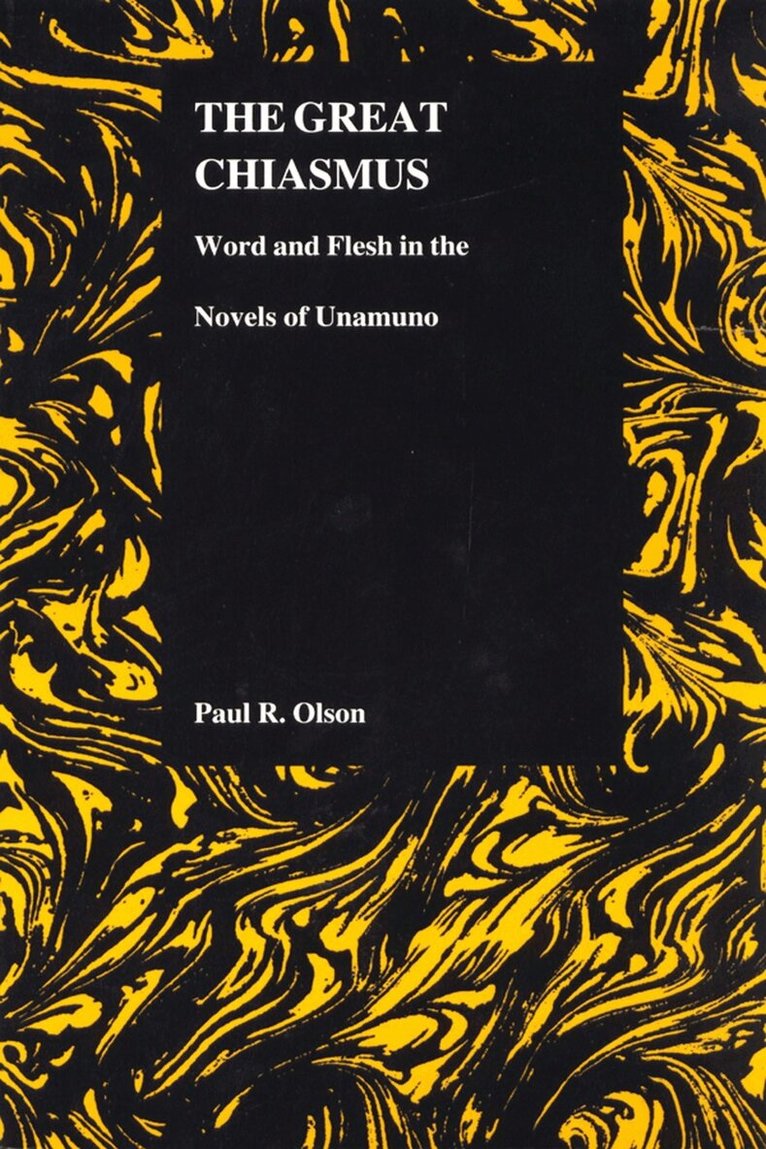
In The Great Chiasmus, Olson explores the use of the grammatical figure called the chiasmus in the work of Miguel de Unamuno. The chiasmus, a reversal in the order of words or parts of speech in parallel phrases, appears on a variety of levels, from brief microstructures (""blanca como la nieve y como la nieve fria""), to the narrative structures of entire novels, and even, Olson suggests, to encompass the stages in Unamuno's novelistic work, forming a chiasmus that can be schematized as ABC:CBA. As a phenomenon of enclosure, the chiasmus is related to other enclosing phenomena such as the image of Chinese boxes and the mise en abyme. These structures, three-dimensional versions of the chiasmus, are also frequent in Unamuno's texts. The chiasmus is also found on the conceptual level, in which Unamuno regards apparent contraties as freely reversible and thus identical. From early adulthood he was fascinated by the Hegelian idea of the identity of pure Being and pure Nothingness, and that concept provides the structure underlying a wide variety of his paradoxes and verbal conceits. In this connection, Unamuno explores concepts usually considered opposites, such as mind and body or spirit and matter (subsumed in the ""Word"" and ""Flesh"" of Olson's subtitle). Olson's close readings of the texts lead to observations on Spanish history, events in Unamuno's life, the psychological dimensions of his characters, and the authorial self found within his texts.
741 kr
Skickas inom 11-20 vardagar
In The Great Chiasmus, Paul R. Olson explores the use of the chiasmus in the work of Miguel de Unamuno. The chiasmus, a reversal in the order of words or parts of speech in parallel phrases, appears on a variety of levels, from brief microstructures (blanca como la nieve y como la nievefria), to the narrative structures of entire novel. Olsoneven suggests the chiasmus encompasses the stages in Unamuno's novelistic work, forming a chiasmus that can be schematized as ABC:CBA. As a phenomenon of enclosure, the chiasmus is related to other enclosing phenomena such as the image of Chinese boxes and the mise en abyme. These structures, three-dimensional version of the chiasmus, are also frequent in Unamuno's texts.The chiasmus is also found on the conceptual level, in which Unamuno regards apparent contraries as freely reversible and thus identical. From early adulthood he was fascinated by the Hegelian idea of the identity of pure Being and pure Nothingness, and that concept provides the structure underlying a wide variety of his paradoxes and verbal conceits. In this connection, Unamuno explores concepts usually considered opposites, such as mind and body or spirit and matter. Olson's close readings of the texts in terms of this structure lead to observations on Spanish history, events in Unamuno's life, the psychological dimensions of his characters, and the authorial self that is found within his texts.