Paul Wernick – författare
Visar alla böcker från författaren Paul Wernick. Handla med fri frakt och snabb leverans.
2 produkter
2 produkter
Häftad, Engelska, 2006
564 kr
Skickas inom 10-15 vardagar
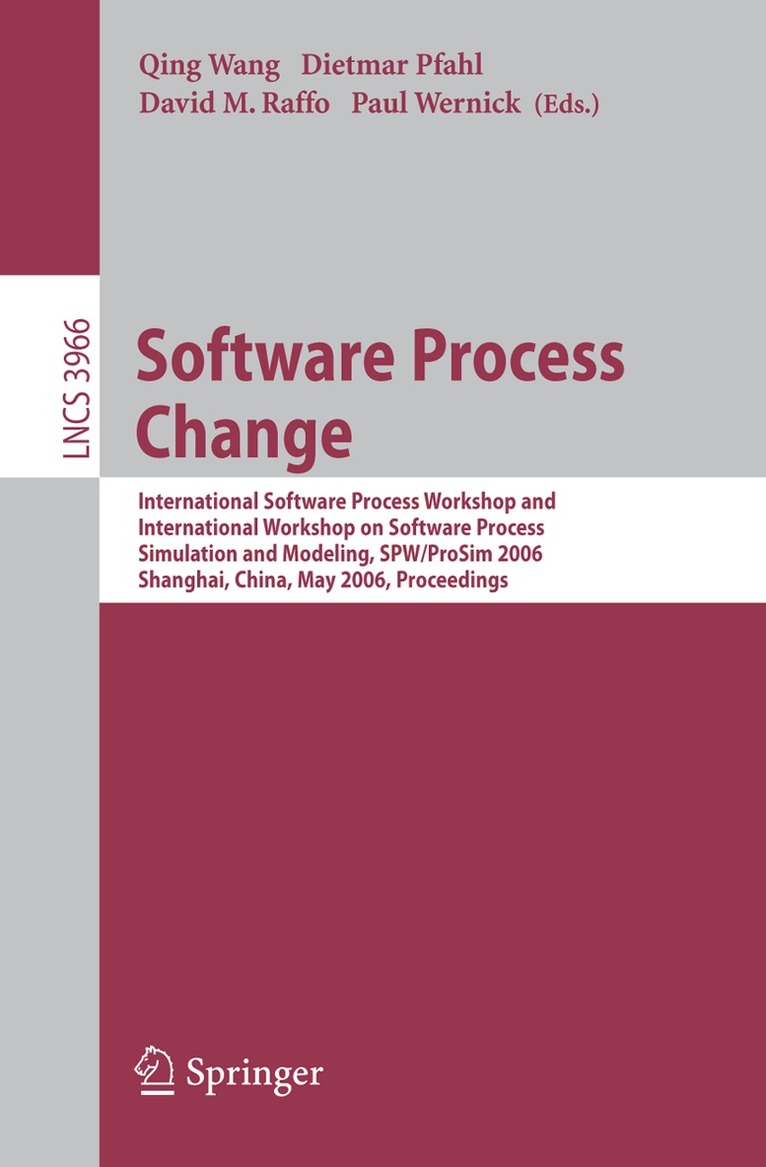
This volume contains papers presented at the first joint conference of the Software Pr- ess Workshop and the International Workshop on Software Process Simulation and Modeling (SPW/ProSim 2006) held in Shanghai, P.R. China, on May 20-21, 2006. The theme of SPW/ProSim 2006 was “Software Process Change – Meeting the Challenge.” Software developers are under ever-increasing pressure to deliver their products more quickly and with higher levels of quality. These demands are set in a dynamic context of frequently changing technologies, limited resources and globally distributed development teams. At the same time, global competition is forcing - ganizations that develop software to cut costs by rationalizing processes, outsourcing part or all of their activities, reusing existing software in new or modified applications and evolving existing systems to meet new needs, while still minimizing the risk of projects failing to deliver. To address these difficulties, new or modified processes are emerging, including agile methods and plan-based product line development. Open Source, COTS and community-developed software are becoming more popular. Outsourcing coupled with 24/7 development demands well-defined processes and interfaces to support the coordination of organizationally and geographically separated teams. All of these challenges combine to increase demands on the efficiency and effectiveness of so- ware processes.
E-bok
PDF, Engelska, 2006708 kr
Läs direkt efter köp
This volume contains papers presented at the first joint conference of the Software Pr- ess Workshop and the International Workshop on Software Process Simulation and Modeling (SPW/ProSim 2006) held in Shanghai, P.R. China, on May 20-21, 2006. The theme of SPW/ProSim 2006 was “Software Process Change – Meeting the Challenge.” Software developers are under ever-increasing pressure to deliver their products more quickly and with higher levels of quality. These demands are set in a dynamic context of frequently changing technologies, limited resources and globally distributed development teams. At the same time, global competition is forcing - ganizations that develop software to cut costs by rationalizing processes, outsourcing part or all of their activities, reusing existing software in new or modified applications and evolving existing systems to meet new needs, while still minimizing the risk of projects failing to deliver. To address these difficulties, new or modified processes are emerging, including agile methods and plan-based product line development. Open Source, COTS and community-developed software are becoming more popular. Outsourcing coupled with 24/7 development demands well-defined processes and interfaces to support the coordination of organizationally and geographically separated teams. All of these challenges combine to increase demands on the efficiency and effectiveness of so- ware processes.