Paulos Mar Gregorios - Böcker
Visar alla böcker från författaren Paulos Mar Gregorios. Handla med fri frakt och snabb leverans.
4 produkter
4 produkter
Light Too Bright
The Enlightenment Today: An Assessment of the Values of the European Enlightenment and a Search for New Foundations for Human Civilization
Inbunden, Engelska, 1992
1 057 kr
Tillfälligt slut
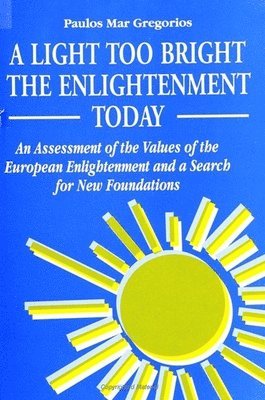
Questioning the very legitimacy of Western liberalism and the modern secular civilization it has given rise to, Dr. Gregorios critically examines the values of the European Enlightenment of the eighteenth and nineteenth centuries, and the corporate drive of European peoples by which they have dominated the external world. He shows that both Capitalism and Marxism, as well as Modern Science and Technology are creations of the same spirit, he argues.The powerful light of Critical Rationality emitted by the European Enlightenment is like the light of the sun. It is bright and helpful for seeing this world in detail, but too bright to let us see the night sky and the vast expanses of the universe. This "light too bright" eclipses the Transcendent. Dr. Gregorios invites us to appropriate the other Enlightenment of the overall-religious-cultural outlook in a new way and to relate it to the valid insights of the European Enlightenment.
Light Too Bright
The Enlightenment Today: An Assessment of the Values of the European Enlightenment and a Search for New Foundations for Human Civilization
Häftad, Engelska, 1992
335 kr
Tillfälligt slut
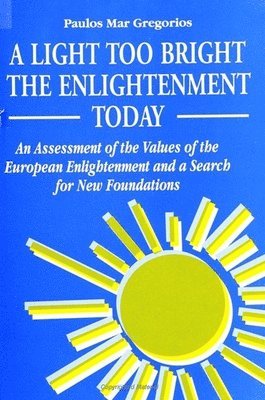
Questioning the very legitimacy of Western liberalism and the modern secular civilization it has given rise to, Dr. Gregorios critically examines the values of the European Enlightenment of the eighteenth and nineteenth centuries, and the corporate drive of European peoples by which they have dominated the external world. He shows that both Capitalism and Marxism, as well as Modern Science and Technology are creations of the same spirit, he argues.The powerful light of Critical Rationality emitted by the European Enlightenment is like the light of the sun. It is bright and helpful for seeing this world in detail, but too bright to let us see the night sky and the vast expanses of the universe. This "light too bright" eclipses the Transcendent. Dr. Gregorios invites us to appropriate the other Enlightenment of the overall-religious-cultural outlook in a new way and to relate it to the valid insights of the European Enlightenment.
1 057 kr
Tillfälligt slut
Explores connections between Neoplatonism and Indian philosophy.During the last two centuries a remarkable similarity between the philosophical system of Plotinus (205–270 A.D.) and those of various Hindu philosophers in various centuries, including some that lived prior to the Third Century A.D. has been discovered. This book addresses the possibility of any direct influence of Indian thought upon Plotinus and his teacher Ammonius Saccas (185–250 A.D.) or even upon their major source, Plato. Are Platonism and Plotinism, and the thought patterns in Western religion, literature, and art derived from them, to be considered as mere variations on themes found in ancient Hindu philosophy or are they pure evolutionary products of Greek philosophy?The essays in this book show the actual similarities in themes or philosophical systems that exist between certain Western Neoplatonic writers and some major Hindu philosophers and deals with the arguments, pro and con, of the case for an Indian source for the thought of Plotinus. Some of the essays are critical studies involving the comparison of technical terms and linguistic considerations, whereas others are only general comparisons. An exercise in comparative philosophy, this book constitutes a de facto East-West philosophical dialogue. It concludes with an extensive critical essay on the role of ritual, myth, and magic in Neoplatonism, an ancillary topic relevant to a comparison of Eastern and Western religious thought.
382 kr
Tillfälligt slut
Explores connections between Neoplatonism and Indian philosophy.During the last two centuries a remarkable similarity between the philosophical system of Plotinus (205–270 A.D.) and those of various Hindu philosophers in various centuries, including some that lived prior to the Third Century A.D. has been discovered. This book addresses the possibility of any direct influence of Indian thought upon Plotinus and his teacher Ammonius Saccas (185–250 A.D.) or even upon their major source, Plato. Are Platonism and Plotinism, and the thought patterns in Western religion, literature, and art derived from them, to be considered as mere variations on themes found in ancient Hindu philosophy or are they pure evolutionary products of Greek philosophy?The essays in this book show the actual similarities in themes or philosophical systems that exist between certain Western Neoplatonic writers and some major Hindu philosophers and deals with the arguments, pro and con, of the case for an Indian source for the thought of Plotinus. Some of the essays are critical studies involving the comparison of technical terms and linguistic considerations, whereas others are only general comparisons. An exercise in comparative philosophy, this book constitutes a de facto East-West philosophical dialogue. It concludes with an extensive critical essay on the role of ritual, myth, and magic in Neoplatonism, an ancillary topic relevant to a comparison of Eastern and Western religious thought.