Pedro Magalhaes – författare
Visar alla böcker från författaren Pedro Magalhaes. Handla med fri frakt och snabb leverans.
7 produkter
7 produkter
Inbunden, Engelska, 2012
2 267 kr
Skickas inom 5-8 vardagar
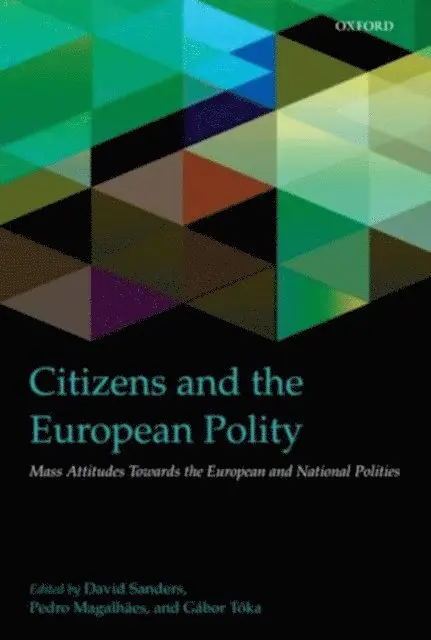
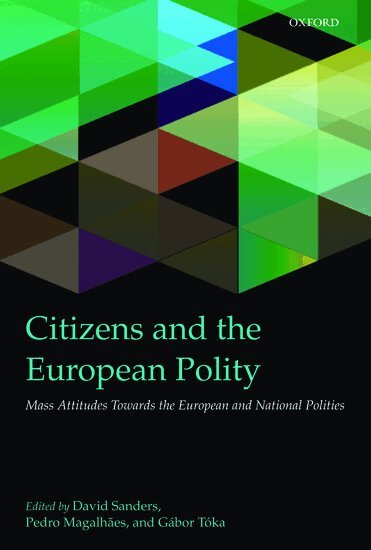
This book provides a broad overview of the main trends in mass attitudes towards domestic politics and European integration from the 1970s until today. Particularly in the last two decades, the "end of the permissive consensus" around European integration has forced analysts to place public opinion at the centre of their concerns. The book faces this challenge head on, and the overview it provides goes well beyond the most commonly used indicators. On the one hand, it shows how integration's deepening and enlargement involved polities and societies whose fundamental traits in terms of political culture - regime support, political engagement, ideological polarization - have remained anything but static or homogeneous. On the other hand, it addresses systematically what Scharpf (1999) has long identified as the main sources of the democratic deficits of the EU: the lack of a sense of collective identity, the lack of a Europe-wide structure for political accountability, and the lack of recognition of the EU as a legitimate political authority. In other words, it focuses on the fundamental dimensions of how Europeans relate to the EU: identity (the sense of an "European political community"; representation (the perception that European elites and institutions articulate citizens' interests and are responsive to them); and policy scope (the legitimacy awarded to the EU as a proper locus of policy-making). It does so by employing a cohesive theoretical framework derived from the entire IntUne project, survey and macro-social data encompassing all EU member countries, and state-of-the-art methods.The IntUne series is edited by Maurizio Cotta and Pierangelo IserniaIn a moment in which the EU is facing an important number of social, economic, political and cultural challenges, and its legitimacy and democratic capacities are increasingly questioned, it seems particularly important to address the issue of if and how EU citizenship is taking shape. This series intends to address this complex issue. It reports the main results of a quadrennial Europe-wide research project, financed under the 6th Framework Programme of the EU. That programme has studied the changes in the scope, nature and characteristics of citizenship presently underway as a result of the process of deepening and enlargement of the European Union. The INTUNE Project - Integrated and United: A Quest for Citizenship in an Ever Closer Europe - is one of the most recent and ambitious research attempts to empirically study how citizenship is changing in Europe. The Project lasted four years (2005-2009) and it involved 30 of the most distinguished European universities and research centres, with more than 100 senior and junior scholars as well as several dozen graduate students working on it. It had as its main focus an examination of how integration and decentralization processes, at both the national and European level, are affecting three major dimensions of citizenship: identity, representation, and scope of governance. It looked, in particular, at the relationships between political, social and economic elites, the general public, policy experts and the media, whose interactions nurture the dynamics of collective political identity, political legitimacy, representation, and standards of performance. In order to address empirically these issues, the INTUNE Project carried out two waves of mass and political, social and economic elite surveys in 18 countries, in 2007 and 2009; in-depth interviews with experts in five policy areas; extensive media analysis in four countries; and a documentary analysis of attitudes toward European integration, identity and citizenship. The book series presents and discusses in a coherent way the results coming out of this extensive set of new data.
Häftad, Engelska, 2017
625 kr
Skickas inom 10-15 vardagar
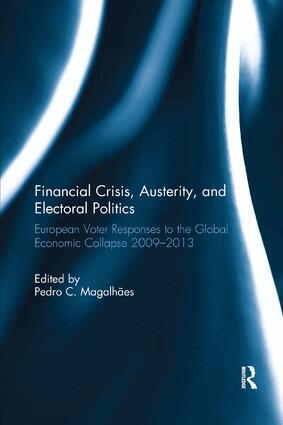
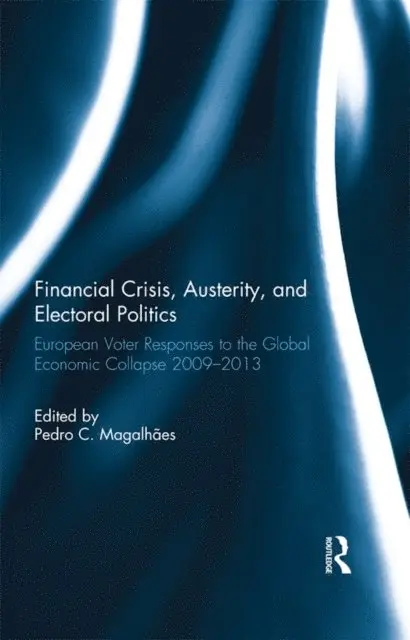
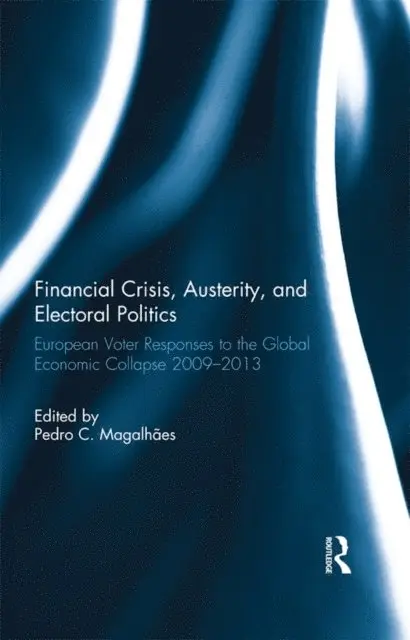
This book examines the domestic electoral consequences of the economic and financial crisis in Europe, particularly in those countries where the crisis manifested itself more devastatingly: the Southern European countries of Greece, Italy, Portugal, and Spain, as well as Iceland and Ireland. On the surface, the electoral consequences of the crisis seem largely similar, having resulted, in these countries, in large electoral losses for incumbents, as the most elementary versions of "economic voting" theory would have us expect. However, behind this fundamental similarity, important differences emerge. Whilst in some cases, on the basis of post-election surveys, it is possible to see that the "crisis elections" followed a previous pattern of performance-oriented voters, with no major changes either in known predictors of electoral choices or in basic party system properties, other elections brought the emergence of new parties, new issues and cleavages, altering patterns of political competition. By examining these different outcomes by comparing the "crisis elections" with previous ones, this book takes into account their timing relative to different stages of crisis. It also scrutinises party strategies and campaign dynamics, particularly as governments attempted (and sometimes succeeded) in framing events and proposals so as to apportion responsibility for economic outcomes. This book was originally published as a special issue of the Journal of Elections, Public Opinion and Parties.
Inbunden, Engelska, 2015
2 137 kr
Skickas inom 10-15 vardagar
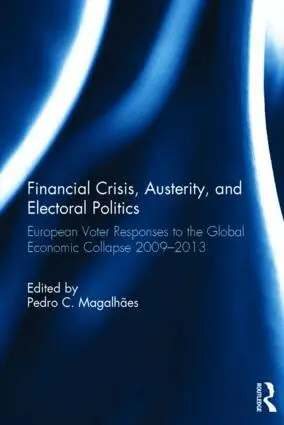
This book examines the domestic electoral consequences of the economic and financial crisis in Europe, particularly in those countries where the crisis manifested itself more devastatingly: the Southern European countries of Greece, Italy, Portugal, and Spain, as well as Iceland and Ireland. On the surface, the electoral consequences of the crisis seem largely similar, having resulted, in these countries, in large electoral losses for incumbents, as the most elementary versions of "economic voting" theory would have us expect. However, behind this fundamental similarity, important differences emerge. Whilst in some cases, on the basis of post-election surveys, it is possible to see that the "crisis elections" followed a previous pattern of performance-oriented voters, with no major changes either in known predictors of electoral choices or in basic party system properties, other elections brought the emergence of new parties, new issues and cleavages, altering patterns of political competition. By examining these different outcomes by comparing the "crisis elections" with previous ones, this book takes into account their timing relative to different stages of crisis. It also scrutinises party strategies and campaign dynamics, particularly as governments attempted (and sometimes succeeded) in framing events and proposals so as to apportion responsibility for economic outcomes. This book was originally published as a special issue of the Journal of Elections, Public Opinion and Parties.
Häftad, Tyska, 2024
428 kr
Skickas inom 5-8 vardagar
Häftad, Franska, 2024
428 kr
Skickas inom 5-8 vardagar
Häftad, Italienska, 2024
432 kr
Skickas inom 5-8 vardagar
Häftad, Portugisiska, 2024
428 kr
Skickas inom 5-8 vardagar