Peggy Wireman – författare
Visar alla böcker från författaren . Handla med fri frakt och snabb leverans.
5 produkter
5 produkter
Häftad, Engelska, 2018
370 kr
Skickas inom 10-15 vardagar
This is the third in the series of volumes of essays that Robin Fox began with Reproduction and Succession and continued with The Challenge of Anthropology. Fox who has been described as "the conscience of anthropology" continues to have the same aim: to expose readers in the social sciences and beyond to the consequences of "the biosocial orientation," and to assess the "state of the art" in anthropology in particular and the social sciences in general.As always he encompasses a wide range of topics: Why do bureaucracies fail? Are we really an innovative animal? Is nationalism a purely constructed phenomenon? What is the role of sexual competition in epic literature? In all these enquiries he tries to show in non-technical language how the evolutionary approach throws new light on old problems--and even raises new and more interesting problems. He pursues the issue of whether we have a naturally developed moral sense, and if so what it could possibly be (on the way attempting a definitive definition of the good); he looks at the status of the idea of self-interest in economic and biological science; he examines the current state of archaeology as a basis for a renewed scientific anthropology; and he tries to adjudicate the debate between the scientific and humanistic camps in the social sciences.
Häftad, Engelska, 2017
481 kr
Skickas inom 10-15 vardagar
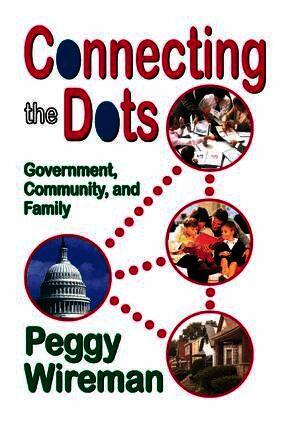
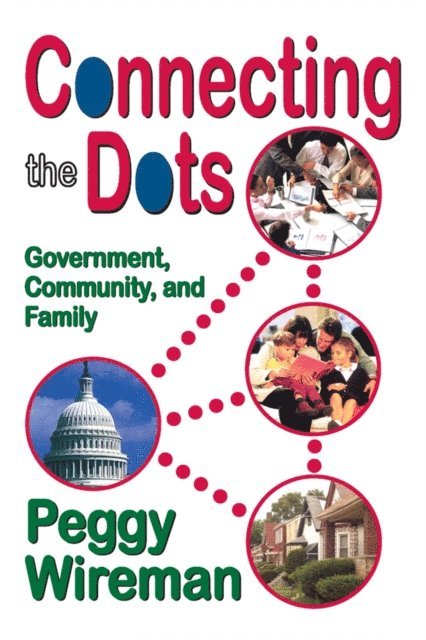
Despite its size and social diversity, the United States is one nation, and what happens in one city or neighborhood ultimately affects all Americans. Connecting the Dots addresses the complex relationships between family and community, and between community and other players affecting family and community life, including the private sector, government, nonprofit groups, and religious organizations.Contrary to much rhetoric, Wireman argues that America does not suffer from a loss of family values, but from a shift in business practices and public commitments. The American dream of work hard, buy a home, and give your children a better life is no longer realistic for millions of workers, both white-collar and blue-collar. At an individual level, millions of Americans face significant challenges as they go about trying to meet the everyday responsibilities of earning an income, feeding their families, maintaining their health, finding housing, handling everyday household chores, and caring for their children.Besides identifying top-down structures, laws, and attitudes that create a supportive context for family life, the book includes bottom-up anecdotal examples to ground its policy-oriented discussion. It also provides statistical data needed to develop realistic solutions. Wireman examines diversity as well, since how America handles racial and ethnic differences remains crucial to its future. She discusses ways in which communities have created social capital, community cohesion, and local organizational ability.Wireman provides a framework for policymakers, local community leaders, and neighborhood activists to use in analyzing their situations and selecting the best approach; she also describes what various players can and must do to uphold the American dream. Connecting the Dots will be of keen interest to sociologists, political scientists, economists, and social workers.
E-bok
Engelska, 2017505 kr
Läs direkt efter köp
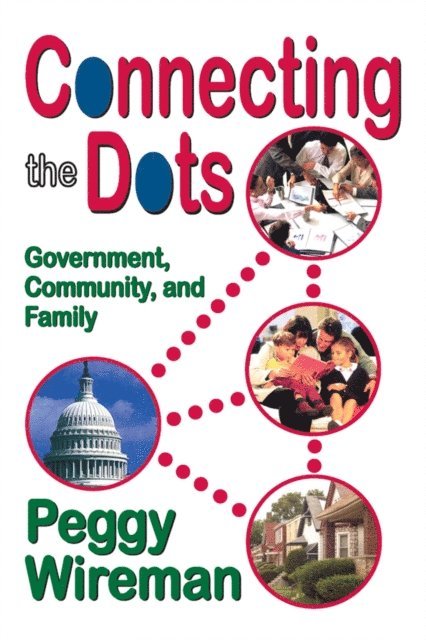
Despite its size and social diversity, the United States is one nation, and what happens in one city or neighborhood ultimately affects all Americans. "Connecting the Dots" addresses the complex relationships between family and community, and between community and other players affecting family and community life, including the private sector, government, nonprofit groups, and religious organizations. Contrary to much rhetoric, Wireman argues that America does not suffer from a loss of family values, but from a shift in business practices and public commitments. The American dream of work hard, buy a home, and give your children a better life is no longer realistic for millions of workers, both white-collar and blue-collar. At an individual level, millions of Americans face significant challenges as they go about trying to meet the everyday responsibilities of earning an income, feeding their families, maintaining their health, finding housing, handling everyday household chores, and caring for their children. Besides identifying top-down structures, laws, and attitudes that create a supportive context for family life, the book includes bottom-up anecdotal examples to ground its policy-oriented discussion. It also provides statistical data needed to develop realistic solutions. Wireman examines diversity as well, since how America handles racial and ethnic differences remains crucial to its future. She discusses ways in which communities have created social capital, community cohesion, and local organizational ability. Wireman provides a framework for policymakers, local community leaders, and neighborhood activists to use in analyzing their situations and selecting the best approach; she also describes what various players can and must do to uphold the American dream. "Connecting the Dots" will be of keen interest to sociologists, political scientists, economists, and social workers.
E-bok
PDF, Engelska, 2017505 kr
Läs direkt efter köp
Despite its size and social diversity, the United States is one nation, and what happens in one city or neighborhood ultimately affects all Americans. "Connecting the Dots" addresses the complex relationships between family and community, and between community and other players affecting family and community life, including the private sector, government, nonprofit groups, and religious organizations. Contrary to much rhetoric, Wireman argues that America does not suffer from a loss of family values, but from a shift in business practices and public commitments. The American dream of work hard, buy a home, and give your children a better life is no longer realistic for millions of workers, both white-collar and blue-collar. At an individual level, millions of Americans face significant challenges as they go about trying to meet the everyday responsibilities of earning an income, feeding their families, maintaining their health, finding housing, handling everyday household chores, and caring for their children. Besides identifying top-down structures, laws, and attitudes that create a supportive context for family life, the book includes bottom-up anecdotal examples to ground its policy-oriented discussion. It also provides statistical data needed to develop realistic solutions. Wireman examines diversity as well, since how America handles racial and ethnic differences remains crucial to its future. She discusses ways in which communities have created social capital, community cohesion, and local organizational ability. Wireman provides a framework for policymakers, local community leaders, and neighborhood activists to use in analyzing their situations and selecting the best approach; she also describes what various players can and must do to uphold the American dream. "Connecting the Dots" will be of keen interest to sociologists, political scientists, economists, and social workers.
Inbunden, Engelska, 2008
1 457 kr
Skickas inom 10-15 vardagar
Despite its size and social diversity, the United States is one nation, and what happens in one city or neighborhood ultimately affects all Americans. Connecting the Dots addresses the complex relationships between family and community, and between community and other players affecting family and community life, including the private sector, government, nonprofit groups, and religious organizations.Contrary to much rhetoric, Wireman argues that America does not suffer from a loss of family values, but from a shift in business practices and public commitments. The American dream of work hard, buy a home, and give your children a better life is no longer realistic for millions of workers, both white-collar and blue-collar. At an individual level, millions of Americans face significant challenges as they go about trying to meet the everyday responsibilities of earning an income, feeding their families, maintaining their health, finding housing, handling everyday household chores, and caring for their children.Besides identifying top-down structures, laws, and attitudes that create a supportive context for family life, the book includes bottom-up anecdotal examples to ground its policy-oriented discussion. It also provides statistical data needed to develop realistic solutions. Wireman examines diversity as well, since how America handles racial and ethnic differences remains crucial to its future. She discusses ways in which communities have created social capital, community cohesion, and local organizational ability.Wireman provides a framework for policymakers, local community leaders, and neighborhood activists to use in analyzing their situations and selecting the best approach; she also describes what various players can and must do to uphold the American dream. Connecting the Dots will be of keen interest to sociologists, political scientists, economists, and social workers.