Peter Blood – författare
Visar alla böcker från författaren Peter Blood. Handla med fri frakt och snabb leverans.
5 produkter
5 produkter
E-bok
PDF, Engelska, 2015458 kr
Läs direkt efter köp
The semiconductor laser, invented over 50 years ago, has had an enormous impact on the digital technologies that now dominate so many applications in business, commerce and the home. The laser is used in all types of optical fibre communication networks that enable the operation of the internet, e-mail, voice and skype transmission. Approximately one billion are produced each year for a market valued at around $5 billion. Nearly all semiconductor lasers now useextremely thin layers of light emitting materials (quantum well lasers). Increasingly smaller nanostructures are used in the form of quantum dots. The impact of the semiconductor laser is surprising in the light of the complexity of the physical processes that determine the operation of every device.This text takes the reader from the fundamental optical gain and carrier recombination processes in quantum wells and quantum dots, through descriptions of common device structures to an understanding of their operating characteristics. It has a consistent treatment of both quantum dot and quantum well structures taking full account of their dimensionality, which provides the reader with a complete account of contemporary quantum confined laser diodes. It includes plenty of illustrations fromboth model calculations and experimental observations. There are numerous exercises, many designed to give a feel for values of key parameters and experience obtaining quantitative results from equations. Some challenging concepts, previously the subject matter of research monographs, are treated hereat this level for the first time.
Del 23 - Oxford Master Series in Physics
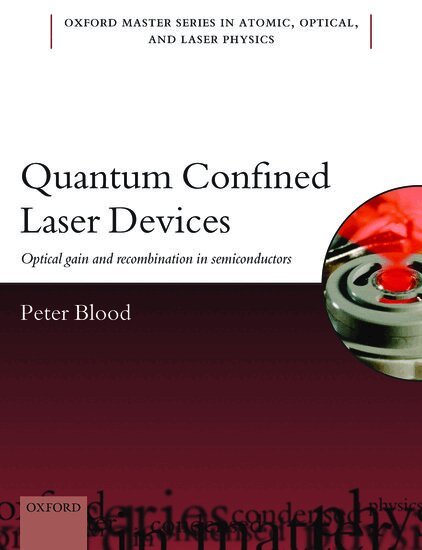
Quantum Confined Laser Devices
Optical gain and recombination in semiconductors
Inbunden, Engelska, 2015
1 648 kr
Skickas inom 7-10 vardagar
The semiconductor laser, invented over 50 years ago, has had an enormous impact on the digital technologies that now dominate so many applications in business, commerce and the home. The laser is used in all types of optical fibre communication networks that enable the operation of the internet, e-mail, voice and skype transmission. Approximately one billion are produced each year for a market valued at around $5 billion. Nearly all semiconductor lasers now use extremely thin layers of light emitting materials (quantum well lasers). Increasingly smaller nanostructures are used in the form of quantum dots. The impact of the semiconductor laser is surprising in the light of the complexity of the physical processes that determine the operation of every device. This text takes the reader from the fundamental optical gain and carrier recombination processes in quantum wells and quantum dots, through descriptions of common device structures to an understanding of their operating characteristics. It has a consistent treatment of both quantum dot and quantum well structures taking full account of their dimensionality, which provides the reader with a complete account of contemporary quantum confined laser diodes. It includes plenty of illustrations from both model calculations and experimental observations. There are numerous exercises, many designed to give a feel for values of key parameters and experience obtaining quantitative results from equations. Some challenging concepts, previously the subject matter of research monographs, are treated here at this level for the first time.
Del 23 - Oxford Master Series in Physics
Quantum Confined Laser Devices
Optical gain and recombination in semiconductors
Häftad, Engelska, 2015
567 kr
Skickas inom 7-10 vardagar
The semiconductor laser, invented over 50 years ago, has had an enormous impact on the digital technologies that now dominate so many applications in business, commerce and the home. The laser is used in all types of optical fibre communication networks that enable the operation of the internet, e-mail, voice and skype transmission. Approximately one billion are produced each year for a market valued at around $5 billion. Nearly all semiconductor lasers now use extremely thin layers of light emitting materials (quantum well lasers). Increasingly smaller nanostructures are used in the form of quantum dots. The impact of the semiconductor laser is surprising in the light of the complexity of the physical processes that determine the operation of every device. This text takes the reader from the fundamental optical gain and carrier recombination processes in quantum wells and quantum dots, through descriptions of common device structures to an understanding of their operating characteristics. It has a consistent treatment of both quantum dot and quantum well structures taking full account of their dimensionality, which provides the reader with a complete account of contemporary quantum confined laser diodes. It includes plenty of illustrations from both model calculations and experimental observations. There are numerous exercises, many designed to give a feel for values of key parameters and experience obtaining quantitative results from equations. Some challenging concepts, previously the subject matter of research monographs, are treated here at this level for the first time.
Häftad, Engelska, 2015
422 kr
Skickas inom 3-6 vardagar
E-bok
Engelska, 2021123 kr
Läs direkt efter köp
In this guide, you will learn all about Bitcoin (BTC) and cryptocurrency, how they work, why they exist, and what kind of technology is behind Bitcoin. It wasnt too long ago when people started hearing the words Bitcoin and cryptocurrencies.Few people outside of the crypto-communities knew what they were and many thought it was just another fad that was bound to fail in a few years or so. The value of one bitcoin was just a few cents then so obviously it wasnt worth a lot.For this reason, it was ignored by the masses. There were far more profitable investments one could make, after all. Those who invested sums of money on the new digital currency either believed in the system proposed by its founder, Satoshi Nakamoto, or they simply wanted to see how it works.