Peter Boger – författare
Visar alla böcker från författaren Peter Boger. Handla med fri frakt och snabb leverans.
5 produkter
5 produkter
Inbunden, Engelska, 1989
8 721 kr
Skickas inom 10-15 vardagar
This publication is based on the plant processes and reaction sites for which reliable knowledge on both their physiology and biochem-istry and the mode of herbicidal action is available. Targets of the agrochemical research, such as enzymes of biosynthetic pathways or herbicide-binding peptides in the photosynthetic membrane, are highlighted. Detailed knowledge about the target sites will allow bio-chemical model systems to evaluate the biological activity of newly synthesized compounds before their conventional screening in the greenhouse. Quantitative structure/activity relationships should be performed more reliably with simple biological species or enzymol-ogy assays, to aid in the rational design of pesticides. This text is highly valuable for plant physiologists, pathologists, and chemists in the agrochemical industry and universities.
E-bok
PDF, Engelska, 202010 219 kr
Läs direkt efter köp
This publication is based on the plant processes and reaction sites for which reliable knowledge on both their physiology and biochem-istry and the mode of herbicidal action is available. Targets of the agrochemical research, such as enzymes of biosynthetic pathways or herbicide-binding peptides in the photosynthetic membrane, are highlighted. Detailed knowledge about the target sites will allow bio-chemical model systems to evaluate the biological activity of newly synthesized compounds before their conventional screening in the greenhouse. Quantitative structure/activity relationships should be performed more reliably with simple biological species or enzymol-ogy assays, to aid in the rational design of pesticides. This text is highly valuable for plant physiologists, pathologists, and chemists in the agrochemical industry and universities.
E-bok
Engelska, 202010 219 kr
Läs direkt efter köp
This publication is based on the plant processes and reaction sites for which reliable knowledge on both their physiology and biochem-istry and the mode of herbicidal action is available. Targets of the agrochemical research, such as enzymes of biosynthetic pathways or herbicide-binding peptides in the photosynthetic membrane, are highlighted. Detailed knowledge about the target sites will allow bio-chemical model systems to evaluate the biological activity of newly synthesized compounds before their conventional screening in the greenhouse. Quantitative structure/activity relationships should be performed more reliably with simple biological species or enzymol-ogy assays, to aid in the rational design of pesticides. This text is highly valuable for plant physiologists, pathologists, and chemists in the agrochemical industry and universities.
E-bok
PDF, Engelska, 2012687 kr
Läs direkt efter köp
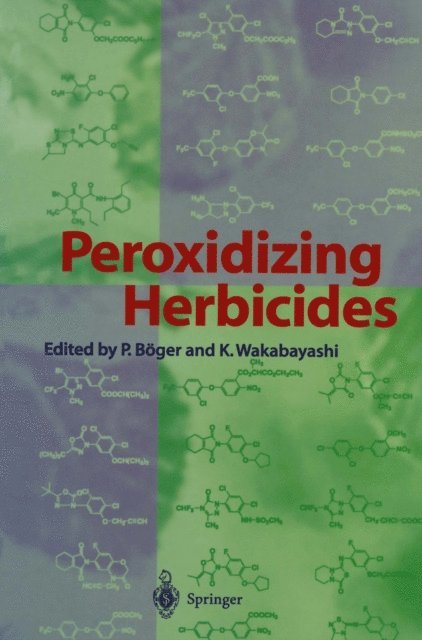
Experts in herbicide research and development - chemists and plant physiologists -, have written 15 chapters that review all aspects pertinent to peroxidizing herbicides, compounds of topical interest since extremely low use rates ensure high environmental safety. Topics covered include structure-activity relationships, relevant patent literature, preparative methods, modes of action, greenhouse screening, laboratory assays, plant pigment biochemistry, and enzymology of the decisive target enzyme of this class of herbicides. This comprehensive review will be welcomed as a unique and timely compilation of the current status of peroxidizing herbicide research and development. It will be of interest to professional chemists and biologists in agrochemical companies, universities and agricultural colleges.
E-bok
PDF, Engelska, 20121 977 kr
Läs direkt efter köp
Chemical pest control is in use in practically every country in the world since agrochemicals play a decisive role in ensuring food supply and protection against damage by pests, insects and pathogenic fungi. Particularly in the half century since World War II, food production has risen dramatically in most parts of the world. In the last 20 years, the yield of major crops has roughly doubled in Western agriculture and there is still the potential for further achievements, particularly in the developing countries. The world''s cereal and rice production, now more than 2 billion tons/year, has to increase by 2. 4% annually to cope with the rising food demand caused mainly by the growing population and improvement of living standards in most of the developing countries. Such a demand for food has to be achieved by higher yields from the restricted arable land already in use. Global farm land resources are about 1. 4 billion ha, of which 1. 2 billion ha is cultivated with major crops. Experts agree that a future substantial addition of new produc tive areas is unlikely. Those with a high yield potential are already in use; new fields with a lower output may possibly be obtained by cultivation of arid or cold areas. More recently, new areas of large-scale farmland have been devel oped in tropical regions of Latin America, primarily in Argentina and Brazil, at the cost of the destruction of tropical rain forest.