Peter Csermely - Böcker
Visar alla böcker från författaren Peter Csermely. Handla med fri frakt och snabb leverans.
5 produkter
5 produkter
Molecular Aspects of the Stress Response: Chaperones, Membranes and Networks
Inbunden, Engelska, 2006
1 585 kr
Skickas inom 10-15 vardagar
We are extremely happy to present the reader this book containing a summary of a well-known research field, the phenomenon of cellular stress defense from two new angles: networks and membranes. The volume starts with an introduction to the concept of molecular chaperones in their original sense: R. John Ellis, the founder of the chaperone concept describes chaperones as mediators of correct assembly and/or misassembly of other macromolecular complexes. This sets the tone of the book, where later chapters give detailed examples of the richness of chaperone ac tion by hundreds of other proteins and membrane structures. The reader will learn the role of chaperone classes such as Hsp27 or Hsp90, the action of highly organized chaperone networks in various cellular compartments such as the ER or mitochondrial/ER networks as well as the molecular details of the signaling mechanisms leading to chaperone induction during stress. Various special stress defense mechanisms against oxidative stress or dryness will also be covered. Membranes comprise a surprising mixture of stability and dynamics in the cell. Their role in the regulation of the stress response has been accepted only slowly in the field. Two chapters summarize this important aspect of the stress response showing the importance of membrane hyperstructures, lipid species composition, protein/ membrane interactions and cold adaptation.

1 632 kr
Skickas inom 10-15 vardagar
We are extremely happy to present the reader this book containing a summary of a well-known research field, the phenomenon of cellular stress defense from two new angles: networks and membranes. The volume starts with an introduction to the concept of molecular chaperones in their original sense: R. John Ellis, the founder of the chaperone concept describes chaperones as mediators of correct assembly and/or misassembly of other macromolecular complexes. This sets the tone of the book, where later chapters give detailed examples of the richness of chaperone ac tion by hundreds of other proteins and membrane structures. The reader will learn the role of chaperone classes such as Hsp27 or Hsp90, the action of highly organized chaperone networks in various cellular compartments such as the ER or mitochondrial/ER networks as well as the molecular details of the signaling mechanisms leading to chaperone induction during stress. Various special stress defense mechanisms against oxidative stress or dryness will also be covered. Membranes comprise a surprising mixture of stability and dynamics in the cell. Their role in the regulation of the stress response has been accepted only slowly in the field. Two chapters summarize this important aspect of the stress response showing the importance of membrane hyperstructures, lipid species composition, protein/ membrane interactions and cold adaptation.

1 371 kr
Tillfälligt slut
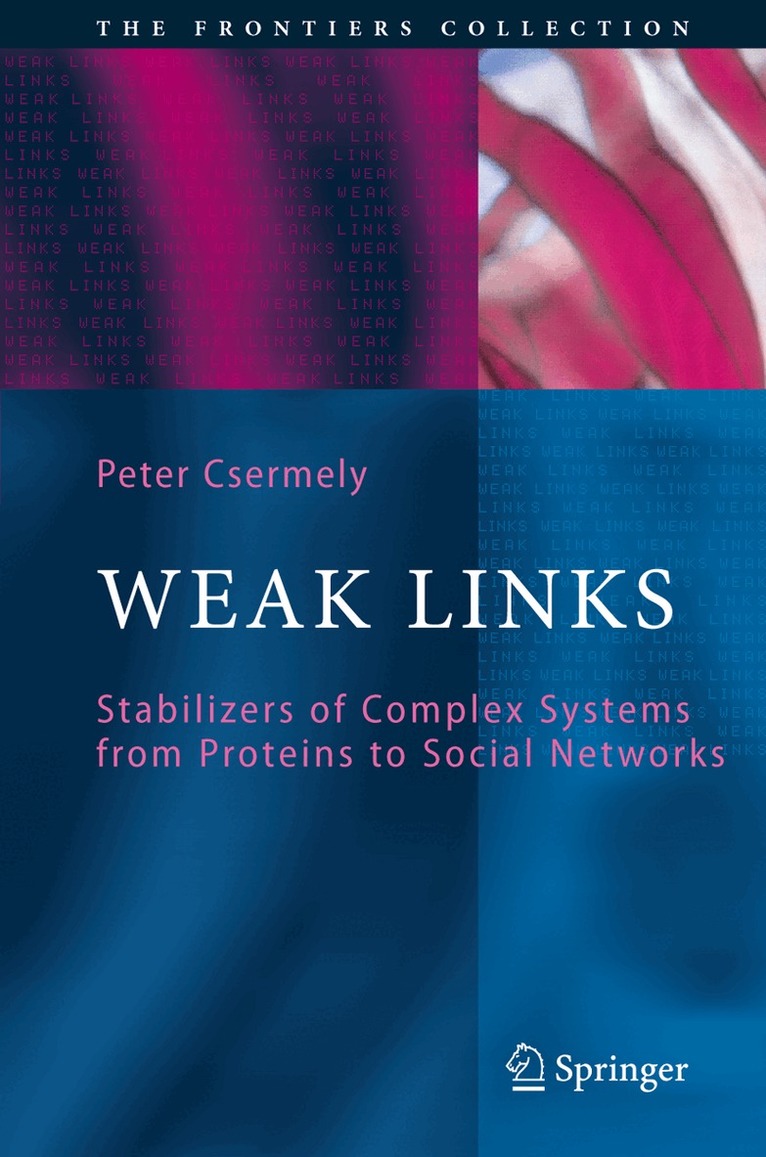
Weak Links
The Universal Key to the Stability of Networks and Complex Systems
Inbunden, Engelska, 2006
489 kr
Skickas inom 10-15 vardagar
How can our societies be stabilized in a crisis? Why can we enjoy and understand Shakespeare? Why are fruitflies uniform? How do omnivorous eating habits aid our survival? What makes the Mona Lisa’s smile beautiful? How do women keep our social structures intact? – Could there possibly be a single answer to all these questions? This book shows that the statement: "weak links stabilize complex systems" provides the key to understanding each of these intriguing puzzles, and many others too. The author (recipient of several distinguished science communication prizes) uses weak (low affinity, low probability) interactions as a thread to introduce a vast variety of networks from proteins to economics and ecosystems. Many people, from Nobel Laureates to high-school students have helped to make the book understandable to all interested readers. This unique book and the ideas it develops will have a significant impact on many, seemingly diverse, fields of study.
533 kr
Skickas inom 10-15 vardagar
How can our societies be stabilized in a crisis? Why can we enjoy and understand Shakespeare? Why are fruitflies uniform? How do omnivorous eating habits aid our survival? What makes the Mona Lisa’s smile beautiful? How do women keep our social structures intact? – Could there possibly be a single answer to all these questions? This book shows that the statement: "weak links stabilize complex systems" provides the key to understanding each of these intriguing puzzles, and many others too. The author (recipient of several distinguished science communication prizes) uses weak (low affinity, low probability) interactions as a thread to introduce a vast variety of networks from proteins to economics and ecosystems. Many people, from Nobel Laureates to high-school students have helped to make the book understandable to all interested readers. This unique book and the ideas it develops will have a significant impact on many, seemingly diverse, fields of study.