Peter De k – författare
Visar alla böcker från författaren . Handla med fri frakt och snabb leverans.
6 produkter
6 produkter
E-bok
Engelska, 20112 009 kr
Läs direkt efter köp
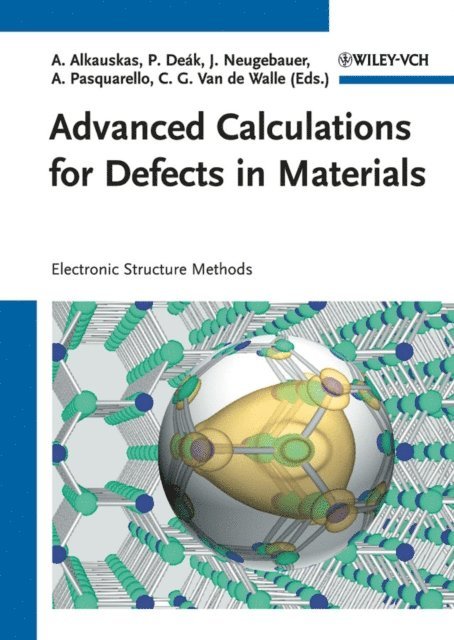
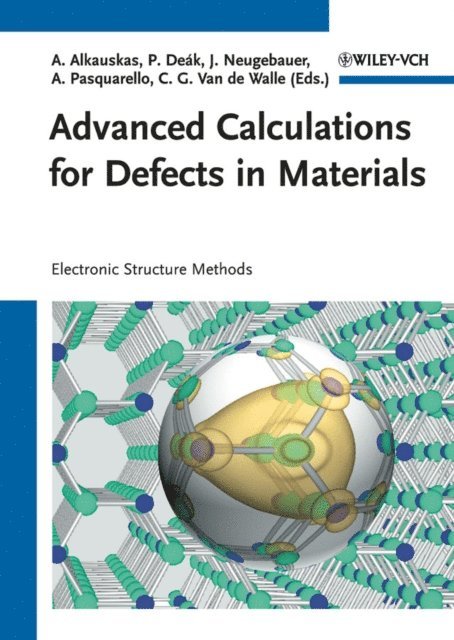
This book investigates the possible ways of improvement by applying more sophisticated electronic structure methods as well as corrections and alternatives to the supercell model. In particular, the merits of hybrid and screened functionals, as well as of the +U methods are assessed in comparison to various perturbative and Quantum Monte Carlo many body theories. The inclusion of excitonic effects is also discussed by way of solving the Bethe-Salpeter equation or by using time-dependent DFT, based on GW or hybrid functional calculations. Particular attention is paid to overcome the side effects connected to finite size modeling. The editors are well known authorities in this field, and very knowledgeable of past developments as well as current advances. In turn, they have selected respected scientists as chapter authors to provide an expert view of the latest advances. The result is a clear overview of the connections and boundaries between these methods, as well as the broad criteria determining the choice between them for a given problem. Readers will find various correction schemes for the supercell model, a description of alternatives by applying embedding techniques, as well as algorithmic improvements allowing the treatment of an ever larger number of atoms at a high level of sophistication.
E-bok
PDF, Engelska, 20112 009 kr
Läs direkt efter köp
This book investigates the possible ways of improvement by applying more sophisticated electronic structure methods as well as corrections and alternatives to the supercell model. In particular, the merits of hybrid and screened functionals, as well as of the +U methods are assessed in comparison to various perturbative and Quantum Monte Carlo many body theories. The inclusion of excitonic effects is also discussed by way of solving the Bethe-Salpeter equation or by using time-dependent DFT, based on GW or hybrid functional calculations. Particular attention is paid to overcome the side effects connected to finite size modeling. The editors are well known authorities in this field, and very knowledgeable of past developments as well as current advances. In turn, they have selected respected scientists as chapter authors to provide an expert view of the latest advances. The result is a clear overview of the connections and boundaries between these methods, as well as the broad criteria determining the choice between them for a given problem. Readers will find various correction schemes for the supercell model, a description of alternatives by applying embedding techniques, as well as algorithmic improvements allowing the treatment of an ever larger number of atoms at a high level of sophistication.
E-bok
Tyska, 2015401 kr
Läs direkt efter köp
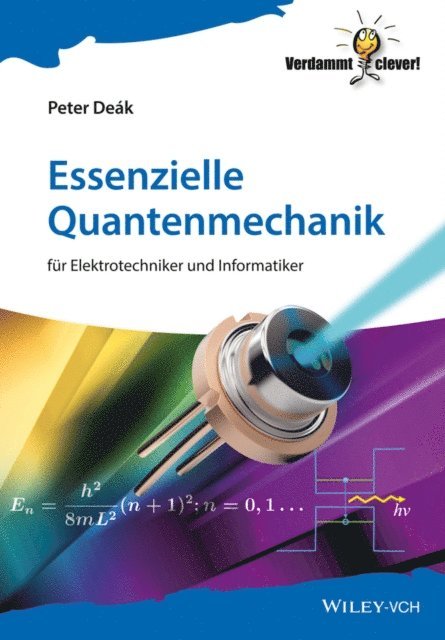
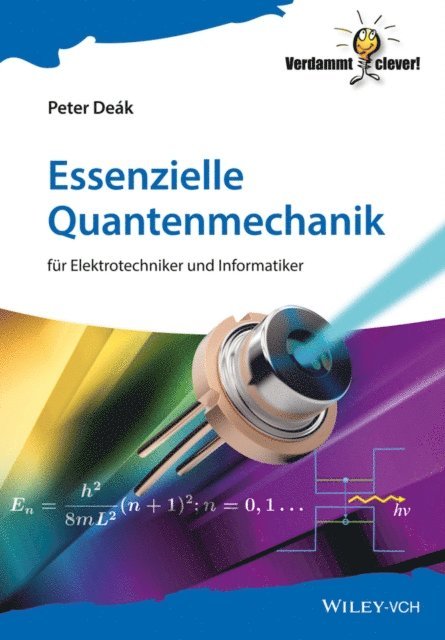
Der Autor zeigt an Beispielen aus der Festkörperelektronik und der Quanteninformationstechnologie, welche Rolle quantenmechanische Konzepte in der modernen Energie-, Kommunikations- und Informationstechnik spielen.
E-bok
PDF, Tyska, 2015410 kr
Läs direkt efter köp
Der Autor zeigt an Beispielen aus der Festkörperelektronik und der Quanteninformationstechnologie, welche Rolle quantenmechanische Konzepte in der modernen Energie-, Kommunikations- und Informationstechnik spielen.
E-bok
PDF, Engelska, 2017792 kr
Läs direkt efter köp
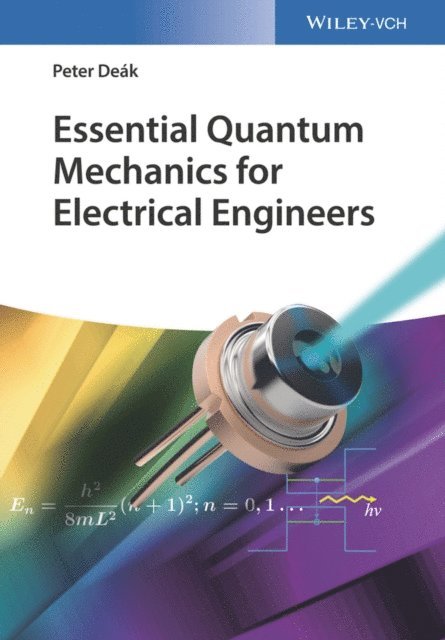
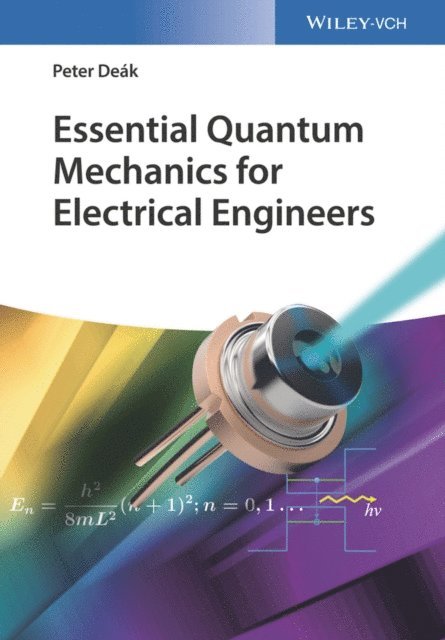
Quantum mechanics (QM) is latently present in the life of electrical engineers already, since the hardware of todays information technology - from electrical data processing, through interconversion of electronic and optical information, to data storage and visualization - works on QM principles. New developments in micro- and opto-electronics and the advent of quantum information processing will soon make the active understanding of QM unavoidable for engineers, too. Unfortunately, the principles of QM can only be formulated mathematically, so even introductory books on the subject are mostly rather abstract. This book, written mainly for BSc students, tries to help the reader by showing "QM in action", demonstrating its surprising effects directly in applications, like lighting technology, lasers, photo- and solar cells, flash memories and quantum bits. While the axioms and basic concepts of quantum mechanics are introduced without compromises, the math is kept at a level which is required from electrical engineers anyhow. Computational work is spared by the use of Applets which also visualize the results. Among the host of other didactic features are learning objectives, chapter summaries, self-testing questions, and problems with solutions, while two appendices summarize the knowledge in classical physics and mathematics which is needed for this book.
E-bok
Engelska, 2017792 kr
Läs direkt efter köp
Quantum mechanics (QM) is latently present in the life of electrical engineers already, since the hardware of todays information technology - from electrical data processing, through interconversion of electronic and optical information, to data storage and visualization - works on QM principles. New developments in micro- and opto-electronics and the advent of quantum information processing will soon make the active understanding of QM unavoidable for engineers, too. Unfortunately, the principles of QM can only be formulated mathematically, so even introductory books on the subject are mostly rather abstract. This book, written mainly for BSc students, tries to help the reader by showing "QM in action", demonstrating its surprising effects directly in applications, like lighting technology, lasers, photo- and solar cells, flash memories and quantum bits. While the axioms and basic concepts of quantum mechanics are introduced without compromises, the math is kept at a level which is required from electrical engineers anyhow. Computational work is spared by the use of Applets which also visualize the results. Among the host of other didactic features are learning objectives, chapter summaries, self-testing questions, and problems with solutions, while two appendices summarize the knowledge in classical physics and mathematics which is needed for this book.