Peter E. Quint – författare
Visar alla böcker från författaren Peter E. Quint. Handla med fri frakt och snabb leverans.
5 produkter
Civil Disobedience and the German Courts
The Pershing Missile Protests in Comparative Perspective
Inbunden, 2007
2311 kr
Lägg i varukorg
In the 1980s the West German Peace Movement -- fearing that the stationing of NATO nuclear missiles in Germany threatened an imminent nuclear war in Europe -- engaged in massive protests, including sustained civil disobedience in the form of sit-down demonstrations. Civil Disobedience and the …
Civil Disobedience and the German Courts
The Pershing Missile Protests in Comparative Perspective
Häftad, 2008
690 kr
Lägg i varukorg
In the 1980s the West German Peace Movement -- fearing that the stationing of NATO nuclear missiles in Germany threatened an imminent nuclear war in Europe -- engaged in massive protests, including sustained civil disobedience in the form of sit-down demonstrations. Civil Disobedience and the …
Civil Disobedience and the German Courts
The Pershing Missile Protests in Comparative Perspective
E-bok, 2007
795 kr
Lägg i varukorg
In the 1980s the West German Peace Movement -- fearing that the stationing of NATO nuclear missiles in Germany threatened an imminent nuclear war in Europe -- engaged in massive protests, including sustained civil disobedience in the form of sit-down demonstrations. Civil Disobedience and the …
Civil Disobedience and the German Courts
The Pershing Missile Protests in Comparative Perspective
E-bok, 2007
813 kr
Lägg i varukorg
In the 1980s the West German Peace Movement -- fearing that the stationing of NATO nuclear missiles in Germany threatened an imminent nuclear war in Europe -- engaged in massive protests, including sustained civil disobedience in the form of sit-down demonstrations. Civil Disobedience and the …
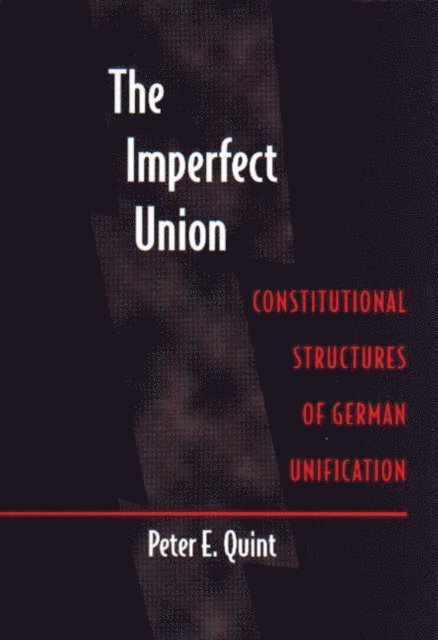
Imperfect Union
Constitutional Structures of German Unification
E-bok, 2012
1395 kr
Lägg i varukorg
In the mid-summer of 1989 the German Democratic Republic-- known as the GDR or East Germany--was an autocratic state led by an entrenched Communist Party. A loyal member of the Warsaw Pact, it was a counterpart of the Federal Republic of Germany (West Germany), which it confronted with a mixture of …