Peter Günter - Böcker
Visar alla böcker från författaren Peter Günter. Handla med fri frakt och snabb leverans.
13 produkter
13 produkter
1 064 kr
Skickas inom 10-15 vardagar
This is the first volume of a set of three within the Springer Series in Optical Sciences, and is devoted to photorefractive effects, photorefractive materials, and their applications. Since the publication of our first two Springer books on Photorefractive Materials and Their Applications (Topics in Applied Physics, Vols. 61 and 62) almost 20 years ago, a lot of research has been done in this area. New and often expected effects have been discovered, theoretical models developed, known effects finally explained, and novel applications proposed. We believe that the field has now reached a high level of maturity, even if research continues in all areas mentioned above and with new discoveries arriving quite regularly. We therefore have decided to invite some of the top experts in the field to put together the state of the art in their respective fields. This after we had been encouraged to do so for more than ten years by the publisher, due to the fact that the former volumes were long out of print.
535 kr
Skickas inom 10-15 vardagar
In this second volume of the book series devoted to photorefractive effects we focus on the most recent developments in the field of photorefractive materials and we highlight the parameters which govern the photoinduced nonlinearity. The availability of materials having the required properties is of major importance for further development of this field, and there are many parameters which have to be considered in the figure of merit of a photorefractive material. As an example, it concerns in priority, the recording slope of the dynamic hologram and the saturation value of the index modulation which are specific characteristics of a given material. However, other features like spectral sensitivity range, dark storage time, material stability and power handling capabilities are also critical parameters to consider when using the crystal for advanced applications in laser photonics. There are a large diversity of potential materials which exhibit interesting photorefractive properties, like ferroelectric or non ferroelectric electro-optic crystals, semi insulating semiconductors or electro-optic polymers. If the basic mechanisms for space charge recording are well established, it is now required to have a very precise and extended knowledge of the physics of the charge transfer and related mechanisms which arises in doped materials. Also, we must know the material response for different conditions of hologram recording wavelength, laser intensity, continuous or pulsed regime. These research achievements on the physics of the photorefractive materials is of great importance in order to optimize or to tailor material properties. The main purpose of this second volume is to highlight the advances in material research but also including crystal growing conditions or material preparations and their impact on photorefractive performances. Following this objective, the reader will find in this book very detailed analysis on the material physics : investigations ofdefects in crystal, growing of stochiometric LiNbO3 or LiTaO3, a new crystal Sn2P2S6 for the near infrared, Quantum Well semiconductor structures and Sillenites. Beside the conventional electro-optic crystals, the volume also deals with organic photorefractive materials. Large progress have been made in the field recently in term of material sensitivity and efficiency under applied electric field. It is undoubtly a class of material of growing interest. We are confident that new advances will be done on the chemistry and on the synthesis of the polymers for a better control and optimization of the photorefractive properties. A closely related field is the photorefractive effect in liquid crystals materials, which exhibit attractive perspectives due to their large photoinduced index modulation. We also outline in this volume two other contributions which have an important impact for applications : the mechanisms of permanent photoinduced gratings in Silica-glass fibers used as wavelength selective Bragg filters and the growing of materials like LiNbO3 which have to be highly resistant to photorefractive damage for electro-optic and nonlinear optic applications. This volume gives an in depth review of the present understanding of the fundamental origins of the effect in a variety of materials. All the materials considered in this volume will play a significant role in the development of applications such as presented in the third volume of this serie. The contribution of the material is determinant for new progress in the field of photorefractive nonlinear optics. It is therefore most important to stimulate significant efforts of research on the basic physical phenomena in different materials. These research achievements may contribute to the discovery of new class of photorefractive material or will permit to optimize the performances of existing materials.
1 577 kr
Skickas inom 10-15 vardagar
This is the third and final volume of a three volumes book series devoted to photorefractive effects, photorefractive materials and their applications. Since the publication of our first two Springer books on "Photorefractive Materials and Their Applications" (Topics in Applied Physics, Vols 61 and 62) almost 20 years ago a lot of research has been done in this area. New and often unexpected effects have been discovered, theoretical models developed, known effects could be finally explained and novel applications had been proposed. We believe that the field has now reached a high level of maturity, even if research continues in all areas mentioned above and with new discoveries arriving quite regularly.We therefore have decided to invite some of the top experts in the field to put together the state of the art in their respective fields. This after we had been encouraged to do so for more than ten years by the publisher, due to the fact that the former volumes were out of print since long time.The first volume is devoted to the description of the basic effects leading to photoinduced refractive index changes in electro-optical materials. In the second volume the status of the most recent developments in the field of photorefractive materials is reviewed and the parameters, which govern the photorefractive nonlinearity are highlighted.This third volume deals with the applications of the photorefractive effects and of materials. Starting about 35 years ago the attractivity of the photorefractive effect for data storage, for optical metrology, optical signal processing and nonlinear optical applications has been recognized. One of the main reasons for this is the large nonlinearity or refractive index change, which can be induced by low light intensities by using the photoinduced space-charge fields in electro-optical materials. Many new concepts have been demonstrated in the laboratories over all these years. Several of these concepts have been proved useful also in other areas of nonlinear optics. Particularly interesting was the observation of a large energy from pump beams to the signal beam in two- and fourwave mixing experiments. This effects lead to coherent amplification of a waveform covering spatial information and to self-pumped optical phase conjugation with applications in the area of wavefront correction of self-induced optical resonators.In this third volume a series of applications of photorefractive nonlinear optics and of optical data storage are presented in several chapters.This and the other two volumes on photorefractive effects, materials and applications have been prepared mainly for researchers in the field, but also for physics, engineering and materials science students. Several chapters contain sufficient introductory material for those not so familiar with the topic to obtain a thorough understanding of the photorefractive effect. We hope that for researchers active in the field these books should provide a useful reference source for their work.
1 064 kr
Skickas inom 10-15 vardagar
The three-part treatment Photorefractive Effects, Materials and Applications offers comprehensive treatments of the fundamental phenomena, materials and the applications. Volume I deals with the basic phenomena of photorefraction. A comprehensive treatment of photorefractive effects in crystals is given. The book reviews our present understanding of the fundamental origins of the effect in a variety of materials from ferroelectrics to compound semiconductors, organic crystals and polymers. This book has been prepared for researchers in the field as well as for students of solid-state physics and engineering. The chapters contain and convey a thorough understanding of the photorefractive effect, as well as providing a useful reference source for researchers already involved in this field.
535 kr
Skickas inom 10-15 vardagar
In this second volume of the book series devoted to photorefractive effects we focus on the most recent developments in the field of photorefractive materials and we highlight the parameters which govern the photoinduced nonlinearity. The availability of materials having the required properties is of major importance for further development of this field, and there are many parameters which have to be considered in the figure of merit of a photorefractive material. As an example, it concerns in priority, the recording slope of the dynamic hologram and the saturation value of the index modulation which are specific characteristics of a given material. However, other features like spectral sensitivity range, dark storage time, material stability and power handling capabilities are also critical parameters to consider when using the crystal for advanced applications in laser photonics. There are a large diversity of potential materials which exhibit interesting photorefractive properties, like ferroelectric or non ferroelectric electro-optic crystals, semi insulating semiconductors or electro-optic polymers. If the basic mechanisms for space charge recording are well established, it is now required to have a very precise and extended knowledge of the physics of the charge transfer and related mechanisms which arises in doped materials. Also, we must know the material response for different conditions of hologram recording wavelength, laser intensity, continuous or pulsed regime. These research achievements on the physics of the photorefractive materials is of great importance in order to optimize or to tailor material properties. The main purpose of this second volume is to highlight the advances in material research but also including crystal growing conditions or material preparations and their impact on photorefractive performances. Following this objective, the reader will find in this book very detailed analysis on the material physics : investigations ofdefects in crystal, growing of stochiometric LiNbO3 or LiTaO3, a new crystal Sn2P2S6 for the near infrared, Quantum Well semiconductor structures and Sillenites. Beside the conventional electro-optic crystals, the volume also deals with organic photorefractive materials. Large progress have been made in the field recently in term of material sensitivity and efficiency under applied electric field. It is undoubtly a class of material of growing interest. We are confident that new advances will be done on the chemistry and on the synthesis of the polymers for a better control and optimization of the photorefractive properties. A closely related field is the photorefractive effect in liquid crystals materials, which exhibit attractive perspectives due to their large photoinduced index modulation. We also outline in this volume two other contributions which have an important impact for applications : the mechanisms of permanent photoinduced gratings in Silica-glass fibers used as wavelength selective Bragg filters and the growing of materials like LiNbO3 which have to be highly resistant to photorefractive damage for electro-optic and nonlinear optic applications. This volume gives an in depth review of the present understanding of the fundamental origins of the effect in a variety of materials. All the materials considered in this volume will play a significant role in the development of applications such as presented in the third volume of this serie. The contribution of the material is determinant for new progress in the field of photorefractive nonlinear optics. It is therefore most important to stimulate significant efforts of research on the basic physical phenomena in different materials. These research achievements may contribute to the discovery of new class of photorefractive material or will permit to optimize the performances of existing materials.
1 577 kr
Skickas inom 10-15 vardagar
This is the third and final volume of a three volumes book series devoted to photorefractive effects, photorefractive materials and their applications. Since the publication of our first two Springer books on "Photorefractive Materials and Their Applications" (Topics in Applied Physics, Vols 61 and 62) almost 20 years ago a lot of research has been done in this area. New and often unexpected effects have been discovered, theoretical models developed, known effects could be finally explained and novel applications had been proposed. We believe that the field has now reached a high level of maturity, even if research continues in all areas mentioned above and with new discoveries arriving quite regularly.We therefore have decided to invite some of the top experts in the field to put together the state of the art in their respective fields. This after we had been encouraged to do so for more than ten years by the publisher, due to the fact that the former volumes were out of print since long time.The first volume is devoted to the description of the basic effects leading to photoinduced refractive index changes in electro-optical materials. In the second volume the status of the most recent developments in the field of photorefractive materials is reviewed and the parameters, which govern the photorefractive nonlinearity are highlighted.This third volume deals with the applications of the photorefractive effects and of materials. Starting about 35 years ago the attractivity of the photorefractive effect for data storage, for optical metrology, optical signal processing and nonlinear optical applications has been recognized. One of the main reasons for this is the large nonlinearity or refractive index change, which can be induced by low light intensities by using the photoinduced space-charge fields in electro-optical materials. Many new concepts have been demonstrated in the laboratories over all these years. Several of these concepts have been proved useful also in other areas of nonlinear optics. Particularly interesting was the observation of a large energy from pump beams to the signal beam in two- and fourwave mixing experiments. This effects lead to coherent amplification of a waveform covering spatial information and to self-pumped optical phase conjugation with applications in the area of wavefront correction of self-induced optical resonators.In this third volume a series of applications of photorefractive nonlinear optics and of optical data storage are presented in several chapters.This and the other two volumes on photorefractive effects, materials and applications have been prepared mainly for researchers in the field, but also for physics, engineering and materials science students. Several chapters contain sufficient introductory material for those not so familiar with the topic to obtain a thorough understanding of the photorefractive effect. We hope that for researchers active in the field these books should provide a useful reference source for their work.
2 758 kr
Skickas inom 3-6 vardagar
Del 72 - Springer Series in Optical Sciences
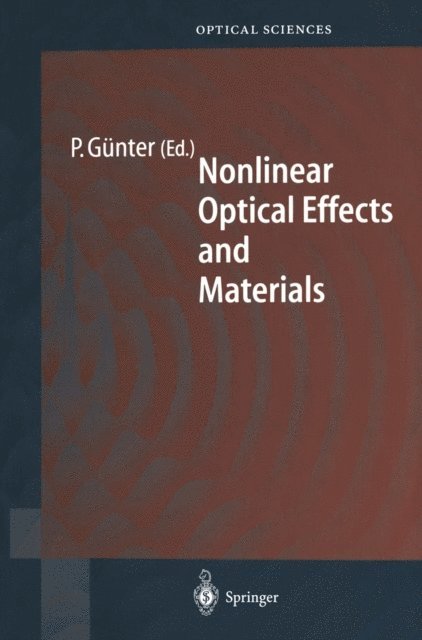
Nonlinear Optical Effects and Materials
Häftad, Engelska, 2012
535 kr
Skickas inom 10-15 vardagar
It is now well established that a unique feature of coherent optical beams is their ability to transmit, process, store and interconnect in parallel a large number of high bandwidth information channels. However, although these techniques possess great potential their development depends critically on the nonlinear optical effects used and on the availability of nonlinear optical materials that work at high speed and low incident optical power. At present, these requirements are stimulating a great deal of research in materials science and are challenging existing technologies, in particular high speed electronics. This volume devoted to nonlinear optical effects and materials presents a detailed account of selected topics in inorganic and organic materials re search. The status of organic crystals and polymers for nonlinear optics is critically compared with their inorganic counterparts. The preparation tech niques and a description of the methods used to characterize the nonlinear optical effects relevant for device applications are dealt with, as well as a theoretical description of the nonlinear optical, electro-optical and photore fractive effects observed. The main concepts and potential applications are outlined and developed in the various chapters of this book. This collection of articles provides a broad survey of selected research topics in organic and in organic nonlinear optics.
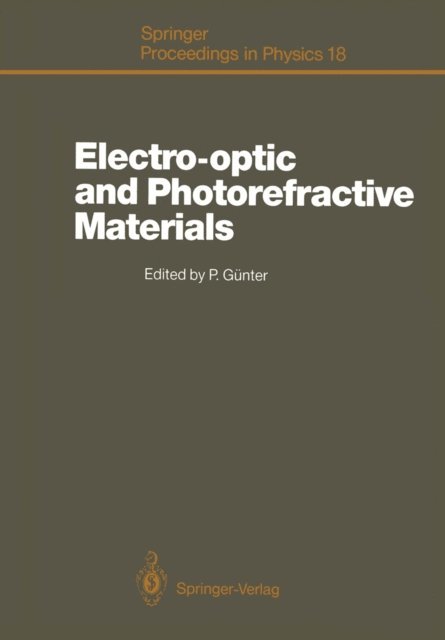
Electro-optic and Photorefractive Materials
Proceedings of the International School on Material Science and Technology, Erice, Italy, July 6–17, 1986
Häftad, Engelska, 2011
1 064 kr
Skickas inom 10-15 vardagar
This volume is based on lectures and contributed papers presented at the Eleventh Course of the International School of Materials Science and Tech nology that was held in Erice, Sicily, Italy at the Ettore Majorana Center for Scientific Culture during the period 6-17 July 1986. The subject of the course was "Electro-optic and Photorefractive Materials: Applications in Sig nal Processing and Phase Conjugation" . The fields of electro-optics and photorefraction have developed rapidly since the invention of lasers just over twenty-five years ago. The possibil of altering the optical properties of a material by electric fields or by ity optical waves is of great importance for both pure science and for practical applications such as optical signal processing, telecommunications and opti cal display devices. These effects allow us to manipulate (modulate, deflect) and process a given light wave. Modulation, deflection and processing of light waves by means of the electro-optic effect is of fundamental importance in fiber optic telecommuniC1. tions and sensor systems w here the light signals can be processed prior or subsequent to transmission through the fibers. Thin film electro-optic materials with suitable electrode arrays on· the surface of the wave-guiding structures result in a technology often referred to as inte grated optics. In principle, integrated optics devices allow miniaturization and integration of many operations onto a single chip. The photorefractive effect, defined as a photo-induced change of the in dices of refraction, was the other topic treated in this course.
634 kr
Skickas inom 5-8 vardagar
535 kr
Skickas inom 10-15 vardagar
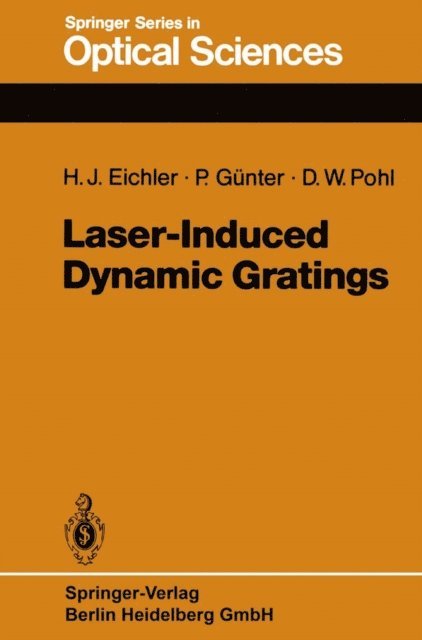
The invention ofthe laser 25years ago resulted in powerfullight sources which led to the observation of unexpected and striking phenomena. New fields of science such as holography and nonlinear optics developed constituting the basis of this volume. The classical principle of linear superposition of light wavesdoes not hold anymore. Two laser beams crossing in a suitable material may produce a set of new beams with different directions and frequencies. The interaction of light waves can be understood by considering the optical grating structures which develop in the overlap region. The optical properties of matter become spatially modulated in the interference region of two light waves. Permanent holographic gratings have been produced in this way by photographic processes for many years. In contrast, dynamic or transient gratings disappear after the inducing light source, usually a laser, has been switched off. The grating amplitude is controlled by the light intensity. Dynamic gratings have been induced in a large number ofsolids, liquids, and gases, and are detected by diffraction, 'forced light scattering' of a third probing beam, or by self-diffraction of the light waves inducing the grating. The combined interference and diffraction effect corresponds to four-wave mixing (FWM) in the language of nonlinear optics. The process is called degenerate ifthe frequenciesofthe three incident wavesand the scattered wave are equal. Degenerate four-wave mixing (DFWM) is a simple method to achieve phase conjugation, i.e. to generate a wave which propagates time reversed with respect to an incident wave.
Del 61 - Topics in Applied Physics
Photorefractive Materials and Their Applications I
Fundamental Phenomena
Häftad, Engelska, 2014
535 kr
Skickas inom 10-15 vardagar
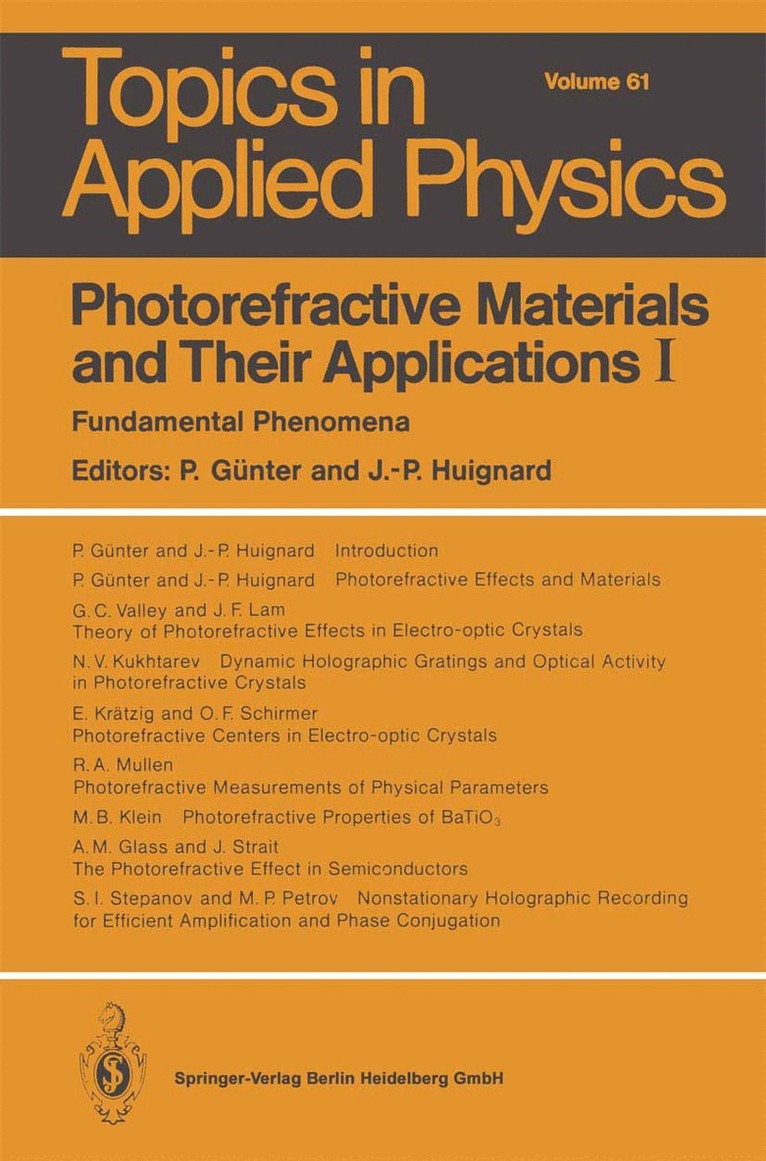
This is the first of two volumes that review, for the first time, all major aspects of photorefractive effects and their applications. Photorefractive effects in electro-optic crystals are based on optically induced space-charge fields which ultimately alter the refractive indices by the electro-optic Pockels effect. The fundamental phenomena leading to photoinduced changes of refractive index, the materials requirements and experimental results on a variety of photorefractive materials are discussed and the most recent theoretical models describing these phenomena are presented. Interest in photorefractive materials has increased in recent years mainly because of their potential for nonlinear optical devices and for optical signals processing applications. Most of these applications are reviewed in the second volume devoted to this topic. The contributions to these two volumes are written by experts on each topic and are intended for scientists and engineers active in the field and for researchers and graduate students entering the field. Over 300 references to original papers on photorefractive and associated phenomena are cited.
Del 62 - Topics in Applied Physics
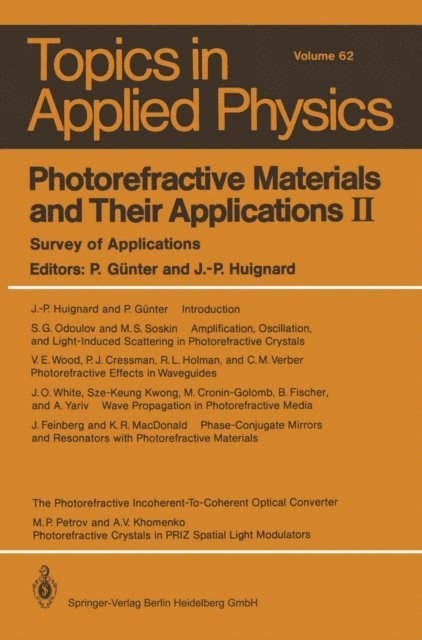
Photorefractive Materials and Their Applications II
Survey of Applications
Häftad, Engelska, 2014
535 kr
Skickas inom 10-15 vardagar
This is the second of two volumes that review, for the first time, all major aspects of photorefractive effects and their applications. Photorefractive effects in electro-optic crystals are based on optically induced space-charge fields which ultimately alter the refractive indices by the electro-optic Pockels effect. The fundamental phenomena leading to photoinduced changes of refractive index, the materials requirements and experimental results on a variety of photorefractive materials are discussed and the most recent theoretical models describing these phenomena are presented. Interest in photorefractive materials has increased in recent years mainly because of their potential for nonlinear optical devices and for optical signals processing applications. Most of these applications are reviewed in this volume. The contributions to the two volumes are written by experts on each topic and are intended for scientists and engineers active in the field and for researchers and graduate students entering the field. Over 300 references to original papers on photorefractive and associated phenomena are cited. Volume 1 appeared as Volume 61 of Topics in Applied Physics.