Peter K. Austin - Böcker
Visar alla böcker från författaren Peter K. Austin. Handla med fri frakt och snabb leverans.
5 produkter
5 produkter
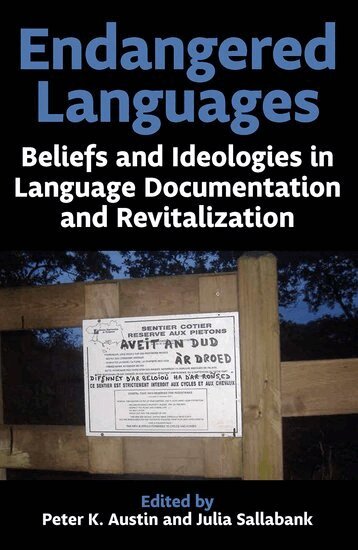
Endangered Languages
Beliefs and Ideologies in Language Documentation and Revitalization
Inbunden, Engelska, 2014
1 493 kr
Skickas inom 7-10 vardagar
Over the few past centuries, and the last 65 years in particular, there has been a tremendous reduction in global linguistic diversity, as people abandon minority language varieties and switch to larger and what they perceive to be more economically, socially and politically powerful regional or national languages. In addition, governments have been promoting standardised official languages for use in schooling, media and bureaucracy, often under a rubric of linguistic unity supporting national unity. The last two decades have seen a significant increase in interest in minority languages and language shift, endangerment and loss, in academia and among language speakers and the wider public. There has also been growing interest from anthropological linguists and sociolinguists in the study of language ideologies and beliefs about languages.This volume brings together chapters on theoretical and practical issues in these two areas, especially the views of linguists and communities about support and revitalisation of endangered languages. The chapters thus go straight to the heart of ideological bases of reactions to language endangerment among those most closely involved, drawing their discussions from case studies of how language ideologies and beliefs affect language practices (and vice versa). Most of the authors conduct collaborative community-based research and take a reflective engagement stance to investigate (potential) clashes in ideological perspectives. This is one of the key theoretical and practical issues in research on endangered languages, and has important implications for language documentation, support and revitalisation, as well as language policy at local, national and international levels.
23 438 kr
Skickas inom 10-15 vardagar
At least half of the seven thousand or so languages spoken today are in danger of disappearing during the 21st century. Although languages have always come and gone, the current rate of language extinction is unprecedented, a loss which not only affects individual communities but also diminishes the world's linguistic heritage. This crisis has stimulated a variety of responses from linguists: sociolinguists have been concerned with the study of language revitalisation—how the tendency to shift away from minority languages can be reversed—while general linguists have paid more attention to the structural aspects of language endangerment—how languages change as they fall into disuse. In recent years linguists have been particularly concerned with language documentation—the activity of recording, annotating, translating and archiving audiovisual materials of languages before they are lost. In addition, all linguists working on endangered languages face the ethical question of how much effort they should devote to non-academic activities in support of the communities with whom they work.The study of language endangerment has only really become a concern of mainstream linguistics in the past twenty years, and this four-volume collection is the first of its kind, bringing together research on language endangerment from leading scholars. Theoretical and practical responses by linguists have led to the emergence of the linguistic sub-fields of language documentation and language revitalisation, and most of the publications within them date from just the last ten years. There has however been a veritable flood of books and articles during this time, and an enormous flowering of interest both within academia and in the wider community as well. Twenty years ago an extensive collection on this topic could not have been put together.A general introduction by the editors gives an overview of the history of research on endangered languages and the main issues faced by scholars of language endangerment today, while specific volume introductions detail the research context for the individual articles. Endangered Languages is an essential one-stop work of reference and will be appreciated by researchers and students of language endangerment and related disciplines.
1 990 kr
Skickas inom 7-10 vardagar
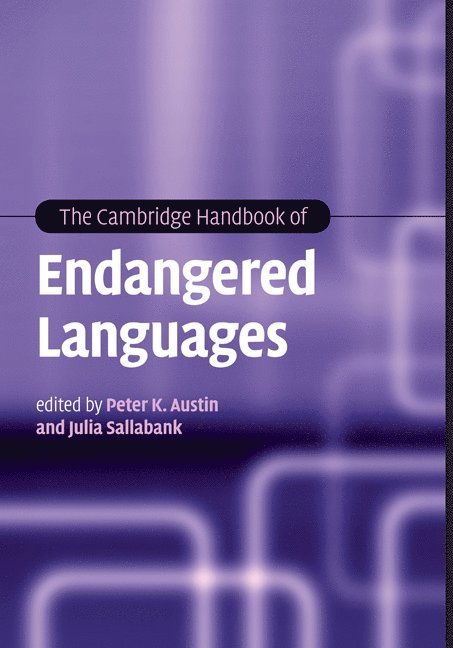
It is generally agreed that about 7,000 languages are spoken across the world today and at least half may no longer be spoken by the end of this century. This state-of-the-art Handbook examines the reasons behind this dramatic loss of linguistic diversity, why it matters, and what can be done to document and support endangered languages. The volume is relevant not only to researchers in language endangerment, language shift and language death, but to anyone interested in the languages and cultures of the world. It is accessible both to specialists and non-specialists: researchers will find cutting-edge contributions from acknowledged experts in their fields, while students, activists and other interested readers will find a wealth of readable yet thorough and up-to-date information.
594 kr
Skickas inom 7-10 vardagar
It is generally agreed that about 7,000 languages are spoken across the world today and at least half may no longer be spoken by the end of this century. This state-of-the-art Handbook examines the reasons behind this dramatic loss of linguistic diversity, why it matters, and what can be done to document and support endangered languages. The volume is relevant not only to researchers in language endangerment, language shift and language death, but to anyone interested in the languages and cultures of the world. It is accessible both to specialists and non-specialists: researchers will find cutting-edge contributions from acknowledged experts in their fields, while students, activists and other interested readers will find a wealth of readable yet thorough and up-to-date information.
230 kr
Skickas inom 7-10 vardagar
This volume explores various problems in the syntax of Austronesian languages, which are found primarily in Malaysia and the Polynesian islands. Using the framework of constraint-based theories of syntax, contributors discuss the nature of these voice systems, the function of their verbal morphology, valence, verbal diathesis and transitivity in such languages, and the nature of their lexical categories. Each analysis is presented within the frameworks of lexical-functional grammar and head-driven phrase structure grammar.