Peter Politzer - Böcker
Visar alla böcker från författaren Peter Politzer. Handla med fri frakt och snabb leverans.
3 produkter
3 produkter
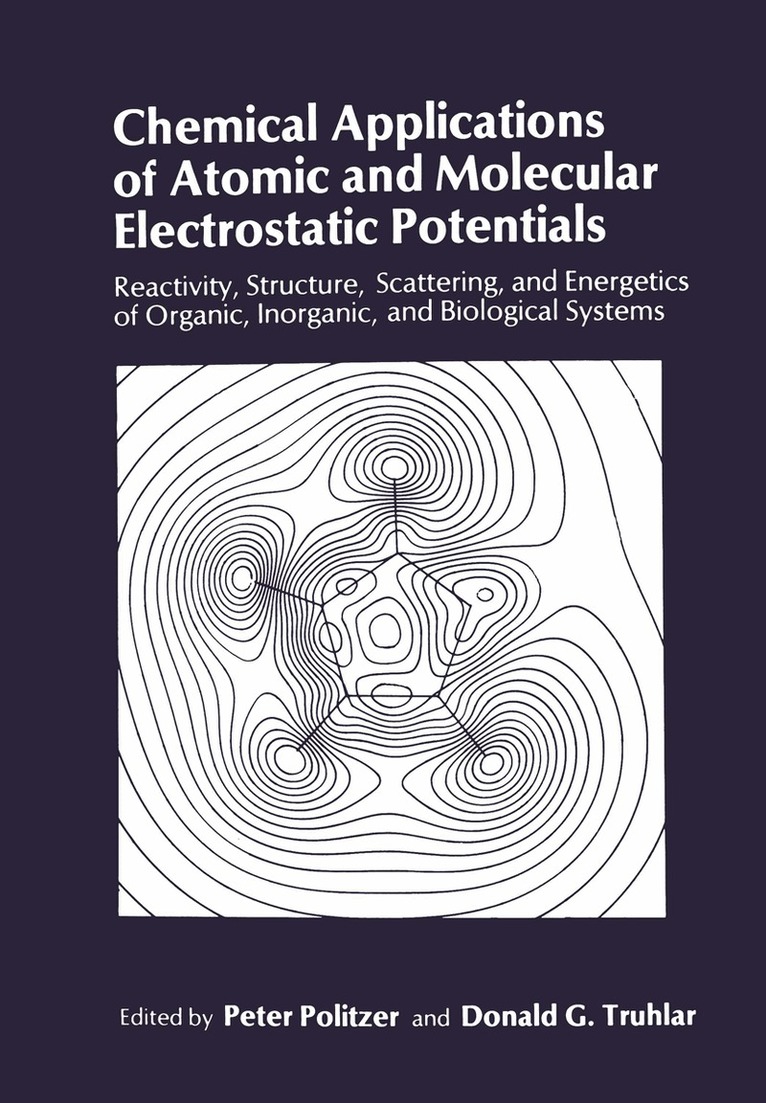
Chemical Applications of Atomic and Molecular Electrostatic Potentials
Reactivity, Structure, Scattering, and Energetics of Organic, Inorganic, and Biological Systems
Inbunden, Engelska, 1981
1 593 kr
Skickas inom 10-15 vardagar
On March 26-27, 1980, a symposium organized by one of us (P. P. ) was held at the l79th American Chemical Society National ~1eeting in Houston, Texas, under the sponsorship of the Theoretical Chemistry Subdivision of the Division of Physical Chemistry. The symposium was entitled "The Role of the Electrostatic Potential in Chemistry," and it served as a stimulus for this book. The original scope and coverage have been broadened, however; included here, in addition to contributions from the eleven invited symposium speakers and two of the poster-session participants, are four papers that were specially invited for this book. Furthermore, several authors have taken this opportunity to present at least partial reviews of the areas being discussed. Most of the manuscripts were completed in the late spring and early summer of 1980. We hope that this book will achieve two goals: First, we are trying to provide an overall picture, including recent advances, of current chemical research, both fundamental and applied, involving the electrostatic potential. Second, we want to convey an appreci ation of both the powers and also the limitations of the electro static potential approach. In order to achieve these goals, we have selected contributors whose research areas provide a very broad coverage of the field. Throughout the book, we have used a. u.
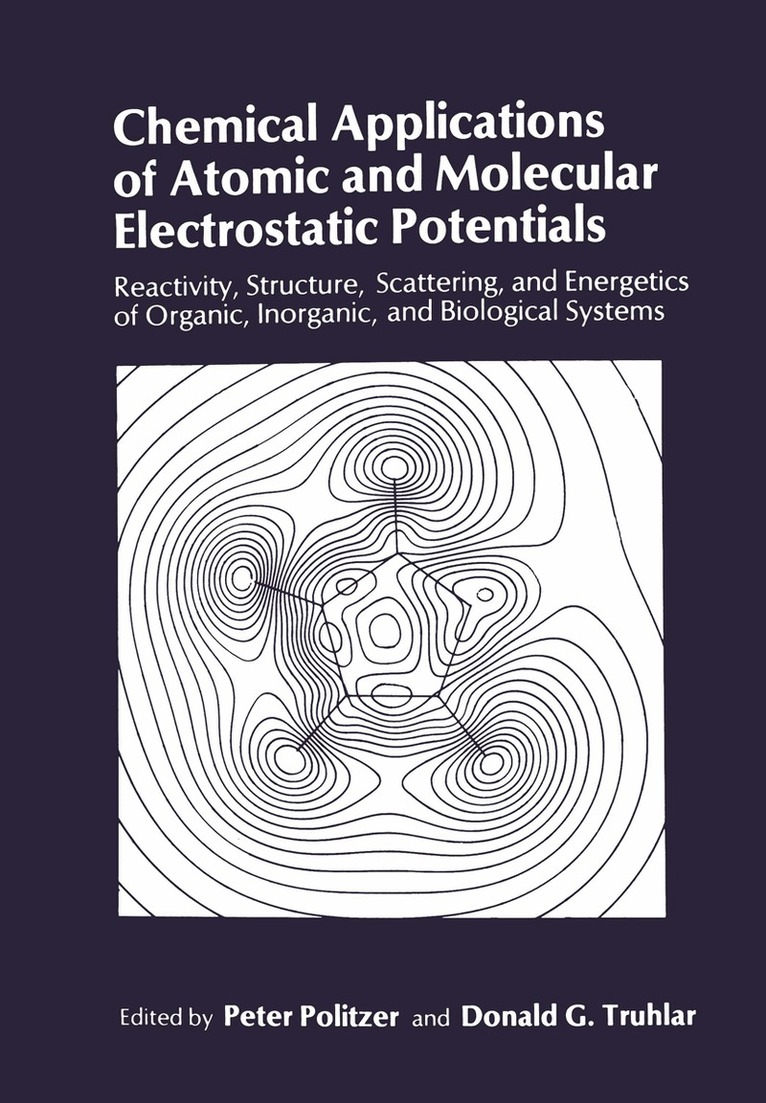
Chemical Applications of Atomic and Molecular Electrostatic Potentials
Reactivity, Structure, Scattering, and Energetics of Organic, Inorganic, and Biological Systems
Häftad, Engelska, 2013
1 593 kr
Skickas inom 10-15 vardagar
On March 26-27, 1980, a symposium organized by one of us (P. P. ) was held at the l79th American Chemical Society National ~1eeting in Houston, Texas, under the sponsorship of the Theoretical Chemistry Subdivision of the Division of Physical Chemistry. The symposium was entitled "The Role of the Electrostatic Potential in Chemistry," and it served as a stimulus for this book. The original scope and coverage have been broadened, however; included here, in addition to contributions from the eleven invited symposium speakers and two of the poster-session participants, are four papers that were specially invited for this book. Furthermore, several authors have taken this opportunity to present at least partial reviews of the areas being discussed. Most of the manuscripts were completed in the late spring and early summer of 1980. We hope that this book will achieve two goals: First, we are trying to provide an overall picture, including recent advances, of current chemical research, both fundamental and applied, involving the electrostatic potential. Second, we want to convey an appreci ation of both the powers and also the limitations of the electro static potential approach. In order to achieve these goals, we have selected contributors whose research areas provide a very broad coverage of the field. Throughout the book, we have used a. u.
Del 4 - Computational Chemistry: Reviews Of Current Trends
Computational Chemistry: Reviews Of Current Trends, Vol. 4
Inbunden, Engelska, 1999
1 807 kr
Tillfälligt slut
This volume presents a balanced blend of methodological and applied contributions. It supplements well the first three volumes of the series, revealing results of current research in computational chemistry. It also reviews the topographical features of several molecular scalar fields. A brief discussion of topographical concepts is followed by examples of their application to several branches of chemistry.The size of a basis set applied in a calculation determines the amount of computer resources necessary for a particular task. The details of a common strategy — the ab initio model potential method — which could be used to minimize such a task are revealed in the subsequent contribution. Such an approach is applied to atoms, molecules and solids. Two chapters are devoted to the prediction of solvent effects in biological systems. These effects are significant for interactions of nucleic acid bases and crucial for an evaluation of the free energies that govern the associations of macromolecules in aqueous solutions.A chapter on the developments and applications of the multireference Moller-Plesset method could be used as a reference in theoretical studies of systems where both the dynamical and nondynamical correlation effects should be accounted for. This technique is an efficient tool in such investigations. An explosive application of computational techniques — studies of detonation initiation and sensitivity in energetic compounds — is discussed in detail in the last chapter. The computational treatment of such unstable compounds allows the prediction of their crucial properties without being subject to their destructive forces.