Peter R. Monge – författare
Visar alla böcker från författaren Peter R. Monge. Handla med fri frakt och snabb leverans.
5 produkter
5 produkter
Häftad, Engelska, 2003
510 kr
Skickas inom 5-8 vardagar
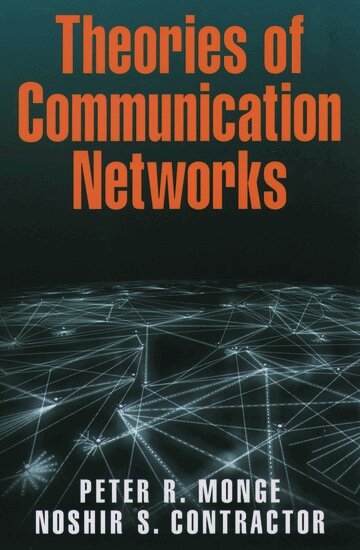
To date, most network research contains one or more of five major problems. First, it tends to be atheoretical, ignoring the various social theories that contain network implications. Second, it explores single levels of analysis rather than the multiple levels out of which most networks are comprised. Third, network analysis has employed very little the insights from contemporary complex systems analysis and computer simulations. Foruth, it typically uses descriptive rather than inferential statistics, thus robbing it of the ability to make claims about the larger universe of networks. Finally, almost all the research is static and cross-sectional rather than dynamic.Theories of Communication Networks presents solutions to all five problems. The authors develop a multitheoretical model that relates different social science theories with different network properties. This model is multilevel, providing a network decomposition that applies the various social theories to all network levels: individuals, dyads, triples, groups, and the entire network. The book then establishes a model from the perspective of complex adaptive systems and demonstrates how to use Blanche, an agent-based network computer simulation environment, to generate and test network theories and hypotheses. It presents recent developments in network statistical anlysis, the p* family, which provides a basis for valid multilevel statistical inferences regarding networks. Finally, it shows how to relate communication networks to other networks, thus providing the basis in conjunction with computer simulations to study the emergence of dynamic organizational networks.
E-bok
PDF, Engelska, 2003602 kr
Läs direkt efter köp
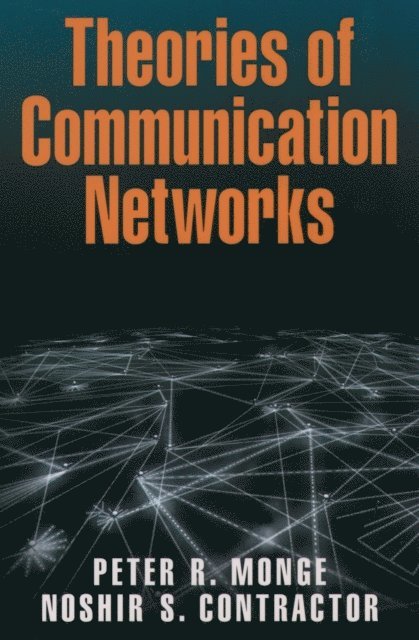
To date, most network research contains one or more of five major problems. First, it tends to be atheoretical, ignoring the various social theories that contain network implications. Second, it explores single levels of analysis rather than the multiple levels out of which most networks are comprised. Third, network analysis has employed very little the insights from contemporary complex systems analysis and computer simulations. Foruth, it typically uses descriptive rather than inferential statistics, thus robbing it of the ability to make claims about the larger universe of networks. Finally, almost all the research is static and cross-sectional rather than dynamic. Theories of Communication Networks presents solutions to all five problems. The authors develop a multitheoretical model that relates different social science theories with different network properties. This model is multilevel, providing a network decomposition that applies the various social theories to all network levels: individuals, dyads, triples, groups, and the entire network. The book then establishes a model from the perspective of complex adaptive systems and demonstrates how to use Blanche, an agent-based network computer simulation environment, to generate and test network theories and hypotheses. It presents recent developments in network statistical analysis, the p* family, which provides a basis for valid multilevel statistical inferences regarding networks. Finally, it shows how to relate communication networks to other networks, thus providing the basis in conjunction with computer simulations to study the emergence of dynamic organizational networks.
E-bok
Engelska, 2003535 kr
Läs direkt efter köp
To date, most network research contains one or more of five major problems. First, it tends to be atheoretical, ignoring the various social theories that contain network implications. Second, it explores single levels of analysis rather than the multiple levels out of which most networks are comprised. Third, network analysis has employed very little the insights from contemporary complex systems analysis and computer simulations. Foruth, it typically uses descriptive rather than inferential statistics, thus robbing it of the ability to make claims about the larger universe of networks. Finally, almost all the research is static and cross-sectional rather than dynamic. Theories of Communication Networks presents solutions to all five problems. The authors develop a multitheoretical model that relates different social science theories with different network properties. This model is multilevel, providing a network decomposition that applies the various social theories to all network levels: individuals, dyads, triples, groups, and the entire network. The book then establishes a model from the perspective of complex adaptive systems and demonstrates how to use Blanche, an agent-based network computer simulation environment, to generate and test network theories and hypotheses. It presents recent developments in network statistical analysis, the p* family, which provides a basis for valid multilevel statistical inferences regarding networks. Finally, it shows how to relate communication networks to other networks, thus providing the basis in conjunction with computer simulations to study the emergence of dynamic organizational networks.
E-bok
PDF, Engelska, 2014756 kr
Läs direkt efter köp
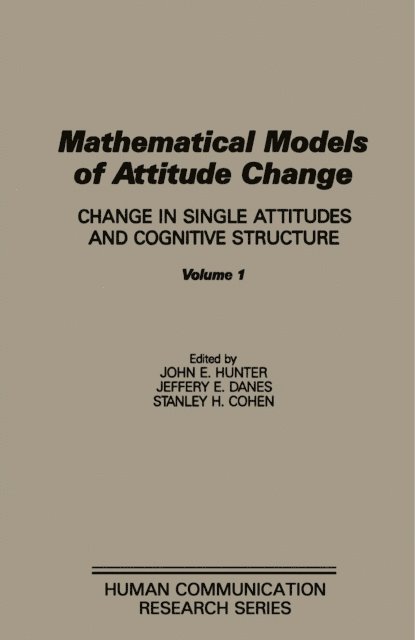
Mathematical Models of Attitude Change, Volume 1: Change in Single Attitudes and Cognitive Structure presents the mathematical models that address the existing verbal attitude change theories, which are translated into families of mathematical models. This book discusses the two types of attitude change, namely, the attitude toward the object of the message and the attitude toward the source of the message. Organized into three parts encompassing 17 chapters, this volume begins with an overview of the mathematical models of attitude change that are derived from several theories. This text then explains the empirical work designed to test selected mathematical models of attitude change. Other chapters consider the predictions made by different models, including reinforcement, information processing, social judgment, balance, dissonance, and congruity. This book discusses as well the attitude-related variable, namely, belief and belief change. The final chapter deals with models of change in hierarchical organized attitudes using alternative theories of attitude change. This book is a valuable resource for psychologists.
E-bok
PDF, Engelska, 2013756 kr
Läs direkt efter köp
Computer-Mediated Communication Systems: Status and Evaluation synthesizes current knowledge about computerized conferencing systems, electronic mail, and office information-communication systems. It should be of interest both to students and researchers studying this new form of electronic communication and to organizations that are planning the installation of electronic mail or other computer-mediated communication systems and that need to be aware of the information gleaned from the studies presented here. The book is organized into four main sections, focusing on the following issues: (1) What are the important considerations in designing software or choosing a system from the many available options and capabilities? (2) What factors determine whether such systems are likely to be accepted or rejected? (3) What are the likely impacts of such systems upon the individuals, groups, and organizations which use them? It is not the economic costs and benefits, but the social problems and ""payoffs"" in the form of enhanced performance and organizational efficiency that should be the main considerations in deciding whether or not to use a computer-mediated communication system. (4) Given the conditional nature of many of the possible impacts, no system should be implemented without formal evaluation and feedback from users to guide the implementation. The major kinds of evaluational strategies that have been successfully employed are described in this book.